




Introduction to Soil Drainage and Its Importance in Real Estate
Soil drainage describes how water moves through and away from soil.
Good drainage keeps excess water from lingering near structures.
Therefore, drainage forms an important part of property condition and usability.
What Soil Drainage Means
Soil drainage describes how water travels through the ground.
Well-drained soil moves water away from structures and outdoor areas.
However, poorly drained soil allows excess water to remain in place.
Why Soil Drainage Matters for Properties
Water affects building foundations and outdoor spaces.
Consequently, drainage conditions can influence maintenance needs and repair frequency.
Property stakeholders should consider drainage when evaluating long-term property care.
Common Signs of Poor Soil Drainage
Several visible conditions can indicate that soil drains poorly.
These conditions often appear after rainfall or during consistently wet periods.
Regular observation can help stakeholders identify drainage concerns early.
- Rainfall leaves water pooled on the ground.
- Lawns feel spongy or remain consistently wet.
- Surface discoloration or muddy patches appear frequently.
How Drainage Impacts Real Estate Value Considerations
Buyers and sellers consider site conditions during property transactions.
Moreover, drainage conditions can influence perceived property risk.
Unresolved drainage issues may also prompt additional inspections or reviews.
Transform Your Agribusiness
Unlock your farm's potential with expert advice tailored to your needs. Get actionable steps that drive real results.
Get StartedApproaches to Address Drainage Issues
Professionals assess drainage conditions before recommending specific actions.
Common approaches include surface grading and subsurface water management.
Furthermore, regular maintenance helps preserve drainage function over time.
Key Considerations for Property Stakeholders
Early awareness can reduce unexpected drainage issues during ownership changes.
Property stakeholders can monitor conditions and address concerns when they appear.
Consequently, drainage management supports long-term property stewardship.
Market Perception and Buyer Demand
Consequently, poor drainage often lowers buyer interest in a property.
Additionally, buyers may anticipate higher maintenance needs in the future.
Therefore, these properties may attract fewer offers than comparable listings.
Structural Risks and Repair Costs
Poor drainage can increase structural risks.
Consequently, owners may face higher repair expenses over time.
Furthermore, potential buyers may request inspections or repairs before purchasing.
Usable Land and Landscaping Value
Standing water can reduce the outdoor space owners can use.
Additionally, landscaping may suffer and require more maintenance.
As a result, outdoor living appeal can decline for prospective buyers.
Sales Timeline and Appraisal Considerations
Appraisers may factor drainage issues into property valuations.
Therefore, valuations can reflect perceived drainage risks and related costs.
Moreover, sellers may wait longer before securing a sale.
Insurance and Financing Challenges
Poor drainage can influence lender financing decisions.
Additionally, some buyers may face increased underwriting scrutiny.
Consequently, sale contingencies can become more complex for everyone involved.
Mitigation Impact on Long Term Value
Addressing drainage problems can help stabilize property value over time.
However, repair costs and timing can affect market perception and buyer responses.
Therefore, transparent disclosure can strengthen buyer confidence and influence transaction outcomes.
Showcase Your Farming Business
Publish your professional farming services profile on our blog for a one-time fee of $200 and reach a dedicated audience of farmers and agribusiness owners.
Publish Your Profile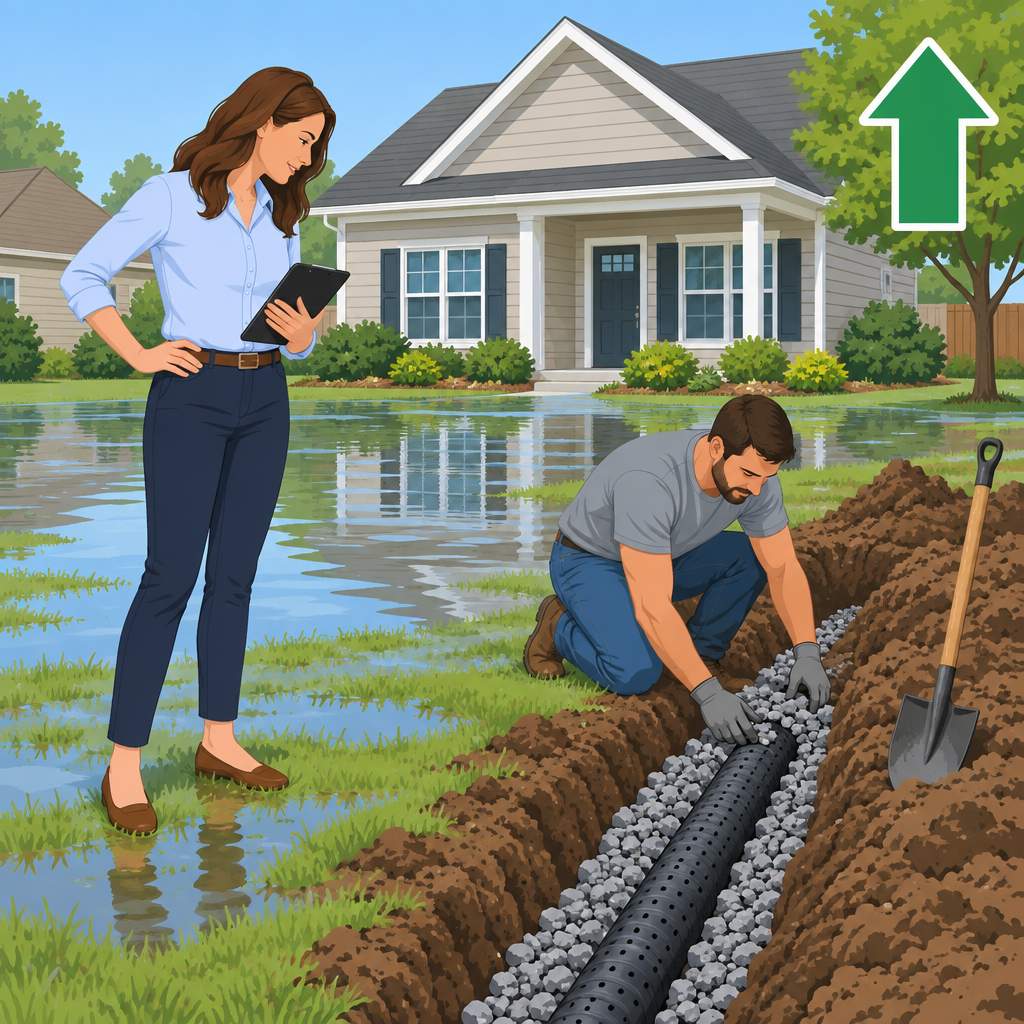
Common Signs of Poor Soil Drainage in Real Estate Properties
Property drainage problems often appear through changes in soil, vegetation, building materials, and indoor conditions.
These clues can help buyers and sellers identify areas that require closer evaluation.
Additionally, recurring moisture patterns provide useful context during property inspections.
Exterior Indicators
Standing water on lawns after rain indicates poor drainage.
Also, waterlogged or spongy ground signals slow absorption.
Persistent muddy patches appear in low spots of yards.
Additionally, erosion or rills form where runoff cannot drain.
In addition, puddles that last more than a day suggest drainage problems.
Interior Indicators
Water stains on walls or floors indicate moisture intrusion.
Damp or musty odors appear inside buildings.
Efflorescence may show as white deposits on masonry surfaces.
Also, peeling paint and bubbling wall coverings signal trapped moisture.
Basements that feel persistently damp often reflect drainage issues.
Vegetation and Landscape Clues
Patchy grass or bare spots can indicate saturated soil.
Also, mushrooms and algae thrive in chronically wet areas.
Trees and shrubs may decline when roots sit in water.
Furthermore, slow growth or yellowing may occur in waterlogged soil.
Structural and Material Signs
Cracks in exterior hardscapes may form from soil movement.
Also, warped decking or buried patios can indicate moisture issues.
Standing water near foundation walls raises concern for seepage.
Moreover, clogged gutters or downspouts can worsen soil saturation.
Seasonal and Temporal Patterns
Seasonal ponding after heavy rains shows slow drainage response.
In addition, spring thaw can reveal drainage limitations.
Moreover, recurring wetness during certain months signals chronic problems.
Inspection Checklist for Buyers and Sellers
- Look for standing water in yards and near foundations.
- Inspect basements and crawl spaces for dampness and stains.
- Examine landscaping for consistently soggy or compacted areas.
- Check gutters and downspouts for clogs and proper runoff.
- Note plant health and signs of fungal growth or decay.
- Observe soil texture and compaction during and after rain.
Therefore, document observed signs during property evaluation for later reference.
Delve into the Subject: How Soil Quality Influences Building Foundations and Property Longevity
Impact of Soil Drainage on Structural Integrity of Buildings
Excess water can weaken soil that supports building foundations.
As soil conditions change, foundations may settle unevenly or shift over time.
Therefore, effective drainage helps protect structural stability and limit moisture-related movement.
How Excess Water Interacts with Building Foundations
Excess water saturates soil beside building foundations.
Consequently, saturated soil may lose load-bearing capacity beneath foundations.
Additionally, changing moisture levels can cause repeated soil expansion and contraction.
Structural Elements Most at Risk
Foundations often experience the earliest effects of poor drainage.
Meanwhile, moisture and soil pressure can affect several connected structural elements.
These conditions may increase movement, cracking, or stress throughout the building.
- Foundations can settle or shift when supporting soil becomes saturated.
- Concrete slabs may develop cracks or uneven surfaces as soil movement continues.
- Basement walls can experience increased hydrostatic pressure and structural movement.
- Retaining walls can lose lateral support when backfill becomes saturated.
- Support beams and floor systems may face added moisture and load stress.
Patterns of Structural Damage Linked to Drainage Problems
Drainage-related movement can create recognizable patterns throughout a building.
For example, cracks may develop where foundations and walls experience changing support.
Furthermore, interior alignment problems can reveal movement beneath the structure.
- Cracking often appears along foundation corners and wall joints.
- Settling may cause doors and windows to stick or misalign.
- Buckling or bowing walls can indicate changing lateral soil pressure.
- Floor slopes and separation may reveal underlying support failure.
Assessment and Diagnosis
Begin with a visual inspection of structural elements and surrounding soil.
Next, document damage patterns and recent changes in moisture conditions.
Showcase Your Farming Business
Publish your professional farming services profile on our blog for a one-time fee of $200 and reach a dedicated audience of farmers and agribusiness owners.
Publish Your ProfileFinally, compare drainage observations with structural movement over time.
Repair and Mitigation Strategies to Protect Structures
Repair strategies should address both water movement and structural response.
First, reduce water accumulation around the building perimeter.
Then, address structural movement when it compromises building safety.
- Improve surface grading to direct water away from building perimeters.
- Install or restore perimeter drainage to reduce soil saturation levels.
- Apply waterproofing measures to walls and below-grade elements.
- Stabilize or reinforce foundations when movement compromises structural safety.
- Maintain vegetation and landscaping to manage runoff effectively.
Maintenance and Monitoring to Prevent Recurrence
Regular maintenance helps keep drainage systems functioning around structural areas.
Additionally, monitoring can reveal whether structural movement continues after repairs.
Timely action can limit further drainage-related stress and damage.
- Regularly inspect drainage components and surrounding grading conditions.
- Clear debris and blockages from surface drainage features.
- Monitor structural movement indicators and record progressive changes.
- Schedule timely interventions when drainage or structural issues arise.
You Might Also Like: The Role of Vegetation in Preventing Soil Erosion on Real Estate Land
Health Risks Associated with Poor Soil Drainage
Poor soil drainage increases moisture around a building’s envelope.
Consequently, indoor humidity levels can rise.
Therefore, prolonged dampness can create health concerns for building occupants.
Indoor Air Quality Concerns
Poor drainage can increase moisture near walls, floors, and other parts of the building envelope.
As a result, indoor humidity levels may rise over time.
Additionally, higher humidity supports mold and mildew growth indoors.
Moreover, biological growth can worsen indoor air quality.
Common Biological Growths
Mold can develop in damp, dark areas.
Meanwhile, mildew can form on porous and wet surfaces.
Furthermore, fungal spores may become airborne from damp materials.
- Mold
- Mildew
- Fungal spores
Health Symptoms to Watch For
Symptoms can vary among individuals exposed to damp indoor conditions.
For example, some occupants may experience nasal congestion or coughing.
Additionally, sensitive individuals may notice worsening breathing difficulties.
- Nasal congestion
- Coughing or throat irritation
- Eye irritation
- Worsening breathing difficulties for sensitive individuals
Populations at Higher Risk
Certain occupants may face greater vulnerability to damp-related health effects.
For instance, people with respiratory sensitivities often react more strongly.
Moreover, infants and older adults can experience greater impacts.
When to Seek Professional Assessment
Consider professional assessment when symptoms persist despite basic cleaning.
Additionally, seek help when visible mold appears on indoor surfaces.
Furthermore, consult a professional if indoor humidity remains elevated over time.
Prevention Through Moisture Control
Preventing prolonged dampness reduces the likelihood of health risks.
Therefore, early attention to moisture issues supports healthier indoor conditions.
Regularly addressing dampness can also limit biological growth indoors.
See Related Content: Understanding Soil Erosion and Drainage Issues in Property Development
Assessing Soil Drainage Before You Buy
Before purchasing, evaluate available records, visible conditions, and likely drainage behavior.
A structured review can reveal questions that require further inspection.
Use documented findings and professional advice to guide purchase decisions and contingencies.
Review Available Documentation
Start by requesting property drainage documents from the seller.
Also obtain past maintenance and repair records when available.
Review easements and drainage agreements that affect the site.
- Collect inspection reports provided by the seller.
- Ask for municipal permits related to grading or drainage.
Conduct a Thorough Site Visit
Visit the property during daylight and after recent rain, if possible.
Walk the full perimeter and note changes in grading and slope.
Also inspect visible stormwater paths and runoff routes.
Showcase Your Farming Business
Publish your professional farming services profile on our blog for a one-time fee of $200 and reach a dedicated audience of farmers and agribusiness owners.
Publish Your ProfilePerform Simple Field Checks
Dig a small test hole to observe subsurface water behavior over time.
Next, monitor how quickly water drains from the excavation.
However, short observations may not reveal long term patterns.
Consult a Qualified Professional
Hire a qualified drainage or soil professional for a detailed evaluation.
Additionally, request a written assessment describing recommended remediation approaches.
Use those findings to inform purchase decisions and contingencies.
Confirm Neighborhood and Regulatory Context
Talk with nearby residents about local drainage experiences.
Additionally, contact local authorities about stormwater and grading regulations.
Also check for planned public works that may affect drainage patterns.
Negotiate Purchase Terms and Contingencies
Include drainage inspection contingencies in your offer when appropriate.
Furthermore, request remediation cost estimates before finalizing purchase terms.
Reserve time for additional evaluations if issues arise.
Plan for Post-Purchase Monitoring
Establish a monitoring routine during the first seasons after purchase.
Additionally, document observations and remedial actions for future reference.
Finally, update maintenance plans based on observed drainage performance.
See Related Content: The Role of Crop Adaptation in Sustainable Farmland Ownership
Effective Solutions for Improving Soil Drainage
Previously conducted assessments should guide the selection of drainage remedies.
Property owners can combine surface changes, subsurface systems, and soil improvements.
Maintenance and professional implementation can preserve drainage performance over time.
- Surface grading and landscape adjustments can redirect runoff.
- Subsurface drains and outlets can manage groundwater.
- Soil amendments and vegetation can increase permeability.
- Aeration and compaction control can restore infiltration.
- Surface routing features can protect foundations and low areas.
- Regular monitoring can preserve system performance.
- Professional design can support durable drainage solutions.
Surface Grading and Landscape Design
First, regrade surfaces to direct water away from buildings.
Gentle slopes and swales can channel runoff across the property.
Moreover, hardscaping can guide surface flows around important areas.
Subsurface Drainage Systems
Subsurface drains can remove excess groundwater from saturated areas.
Additionally, trenches filled with coarse material can improve water movement.
Safe outlets can discharge collected water away from vulnerable areas.
Soil Improvement and Vegetation
Compacted soil amendments can increase permeability and improve drainage.
Organic matter can improve soil structure and porosity.
Furthermore, deep-rooted vegetation can help manage subsurface moisture.
Aeration and Compaction Management
Mechanical aeration can relieve compaction where soils remain dense.
It can also reopen pathways that allow water to enter the soil.
Meanwhile, avoiding heavy equipment on wet ground prevents further compaction.
Surface Water Management Features
Gutters and downspouts can route roof water away from foundations.
Furthermore, extensions can direct downspouts toward stable discharge points.
Surface drains can capture and redirect concentrated water flows.
Maintenance and Monitoring
Regular maintenance keeps drainage features functioning over time.
Routine cleaning removes debris from channels and outlets.
After storms, inspections can reveal emerging drainage problems early.
Professional Assessment and Implementation
Qualified professionals can address complex drainage problems beyond basic remedies.
They can design integrated solutions that match site conditions.
Professional installation can support reliable and durable drainage performance.
Showcase Your Farming Business
Publish your professional farming services profile on our blog for a one-time fee of $200 and reach a dedicated audience of farmers and agribusiness owners.
Publish Your ProfilePreventative Measures and Long-term Strategies for Sustainable Soil Drainage Management
Sustainable soil drainage management begins with thoughtful planning and consistent property care.
These practices help properties manage excess water while supporting stable soil conditions.
Furthermore, long-term strategies combine site design, vegetation, monitoring, maintenance, and community coordination.
Planning and Site Design
Plan site layouts that respect natural drainage patterns.
Additionally, integrate grading that channels water away from structures.
Furthermore, retain natural contours to support steady water flow.
Design Elements to Consider
Site design should reflect slope, layout, and surrounding land conditions.
Meanwhile, setbacks can separate high water paths from building foundations.
Finally, accessible layouts support future maintenance and drainage inspections.
- Consider slope and layout relative to surrounding land.
- Include setbacks between high water paths and foundations.
- Plan access for future maintenance and inspections.
Landscape and Vegetation Strategies
Use vegetation to improve infiltration and support soil structure.
Additionally, avoid practices that compact soils and reduce permeability.
Vegetation can also help manage surface flow across the property.
Vegetative Approaches
Continuous ground cover slows surface water movement.
Meanwhile, established root systems help stabilize soil over time.
Careful landscape practices preserve infiltration and reduce unnecessary soil compaction.
- Maintain continuous ground cover to slow surface flow.
- Encourage root systems that help stabilize soil long term.
Water Management Philosophy
Design properties to handle excess water without causing damage.
Furthermore, anticipate changing conditions when planning drainage capacity.
Additionally, direct runoff toward designated areas for safe handling.
Maintenance and Monitoring Plans
Schedule routine inspections to identify drainage issues early.
Also, document findings and interventions for future comparison.
Regular records help property owners track changing surface water patterns.
Inspection Guidelines
Inspect drainage conditions after major weather events and seasonal changes.
Next, compare current conditions with earlier observations.
Finally, record shifts in surface water patterns over time.
- Inspect after major weather events and seasonal changes.
- Record any shifts in surface water patterns over time.
Community and Policy Approaches
Engage neighboring property owners on shared water concerns.
Furthermore, align property practices with broader land use planning.
Additionally, promote local education about long-term drainage care.
Financial and Record-Keeping Practices
Budget for ongoing drainage upkeep within long-term property plans.
Also, track costs and performance to inform future decisions.
Consistent records connect drainage spending with observed property performance.


