






Queensland sheep and goat eID checks depend on both the birth cohort and the departure event. For a planned movement, do not rely on the phrase “January 2027” alone. Start with the current Queensland guidance, then keep the animal, property and date evidence together. This article offers a records checklist, not permission to move livestock.
The 20 November 2026 agriculture ministers’ communiqué says ministers discussed ongoing sheep eID implementation. It does not announce a revised Queensland deadline. For the controlling timetable, use Business Queensland’s two-stage guidance, rather than treating the meeting as a new national rule.
Queensland sheep and goat eID: distinguish the two cohorts
Animals born on or after 1 January 2025 require an NLIS-accredited eID device before leaving their property of birth. From 1 January 2027, the guidance extends the identification requirement to all other sheep and goats before leaving a property. Check applicable exceptions and the current official instructions for the actual circumstances.
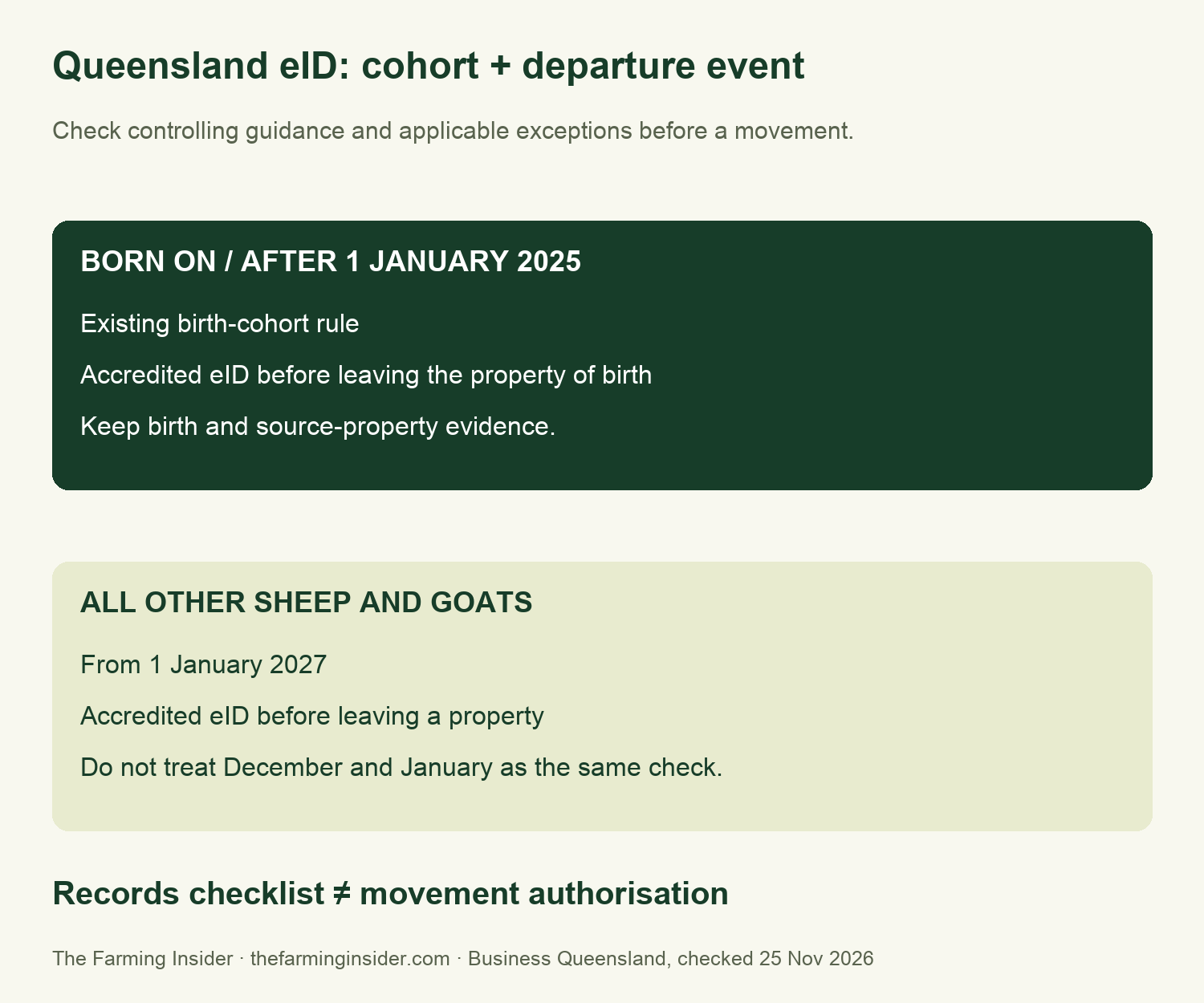
A December departure and a January departure can therefore raise different checks for an older cohort. However, the existing birth-property rule does not disappear during December. Keep the two questions separate rather than assigning one deadline to every animal. If birth evidence is uncertain, record that uncertainty explicitly.
Build one record for each unresolved question
Use a local reference in the worksheet so a question can be followed through without circulating real identifiers. Record species, birth-cohort evidence, property of birth, source property, proposed departure date and destination. Add a field for accredited-device evidence and one for an unresolved status. These fields serve different purposes and should not overwrite one another.
For example, a source-property record can be present while a birth date is still unclear. A visible tag can be recorded while its accreditation evidence remains unresolved. Do not turn either partial record into a completed checklist merely because another field is filled. Assign each question to a named responsible person in your private working copy.
Keep device-read status separate from the evidence field. The worksheet does not assess a device, validate a database entry or substitute for required NLIS processes. Avoid placing real tag numbers, property codes or routing details in a publicly shared example. Use the relevant official service when the evidence does not resolve the question.
Test a fictional 36-animal batch without declaring breaches
Our fictional exercise covers 36 animals intended to leave after 1 January 2027. Records for 31 contain evidence of accredited eID; five remain unresolved. The useful output is a queue of five questions. It is not a finding that five animals breach a rule, nor proof that the other 31 meet every movement requirement.
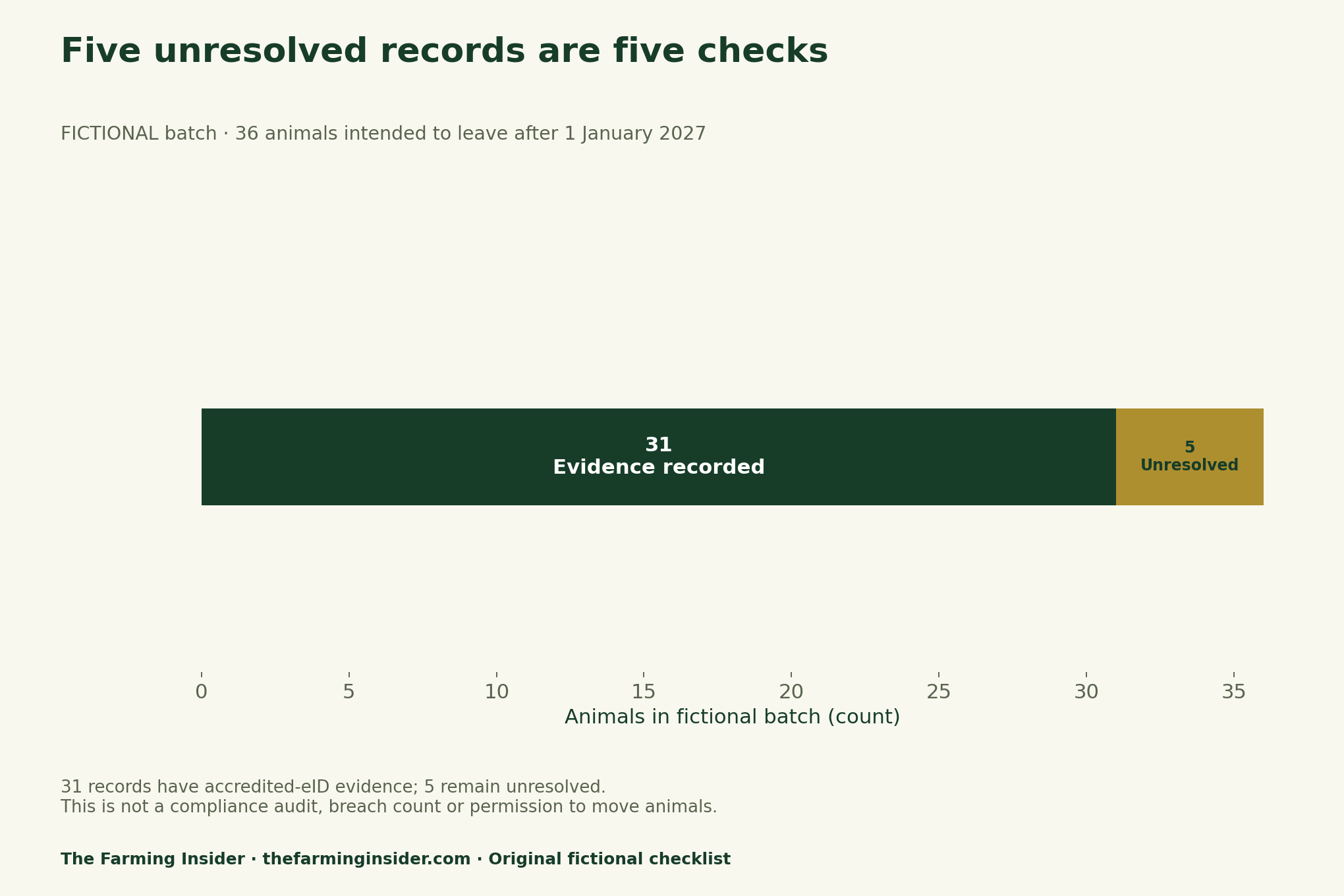
To reproduce the summary, count the two recorded statuses and confirm that 31 + 5 = 36. The downloadable summary also reports 86.1% and 13.9%, rounded to one decimal. Those percentages describe evidence status in this invented batch. They must not be presented as an industry readiness or compliance rate.
The sample resolution register gives each unresolved example a different question, such as confirming the birth cohort or checking the departure date. Replace these examples with verified questions in your own private record. When a question is resolved, retain the evidence date and reference rather than silently deleting the earlier uncertainty.
Verify exceptions through the official guidance
Business Queensland provides separate conditions for harvested rangeland goats. Do not assume that a goat’s location or description establishes that an exception applies. Read the full conditions on the official page and verify the relevant requirements with the responsible service. Our general checklist cannot decide a specific exception or approve a route.
Likewise, the national implementation plan distinguishes jurisdictions. Queensland’s dates are not a substitute for another state’s requirements. A records check should identify the relevant jurisdiction and current source, then leave any unresolved rule or movement question open until it has an appropriate answer.
Methods, limits and downloadable records tools
We compared the ministerial communiqué with Queensland’s controlling guidance, then built an original checklist and a fictional status summary. The illustration contains no real animal, property or movement identifiers. It does not assess a business, certify compliance, establish rebate eligibility or provide livestock-handling directions.
- Cohort, departure trigger and source register (CSV)
- Fictional 36-animal evidence-status summary (CSV)
- Blank cohort and departure-evidence checklist (CSV)
- Fictional unresolved-question register (CSV)
For wider context, browse Livestock Management and our Research & Reports archive. Suggested citation: The Farming Insider, “Queensland Sheep and Goat eID: Check the Departure Cohort”, 25 November 2026. Official guidance was checked on that date; revisit it before a real movement.


