






Canadian canola farm cash receipts in 2026 rose sharply through September. However, a national receipts gain does not tell you when your own crop sale will fund a bill. For that decision, keep the contract date, delivery date and actual payment date separate. A sale can cross a reporting cutoff even when the grain has already left the farm.
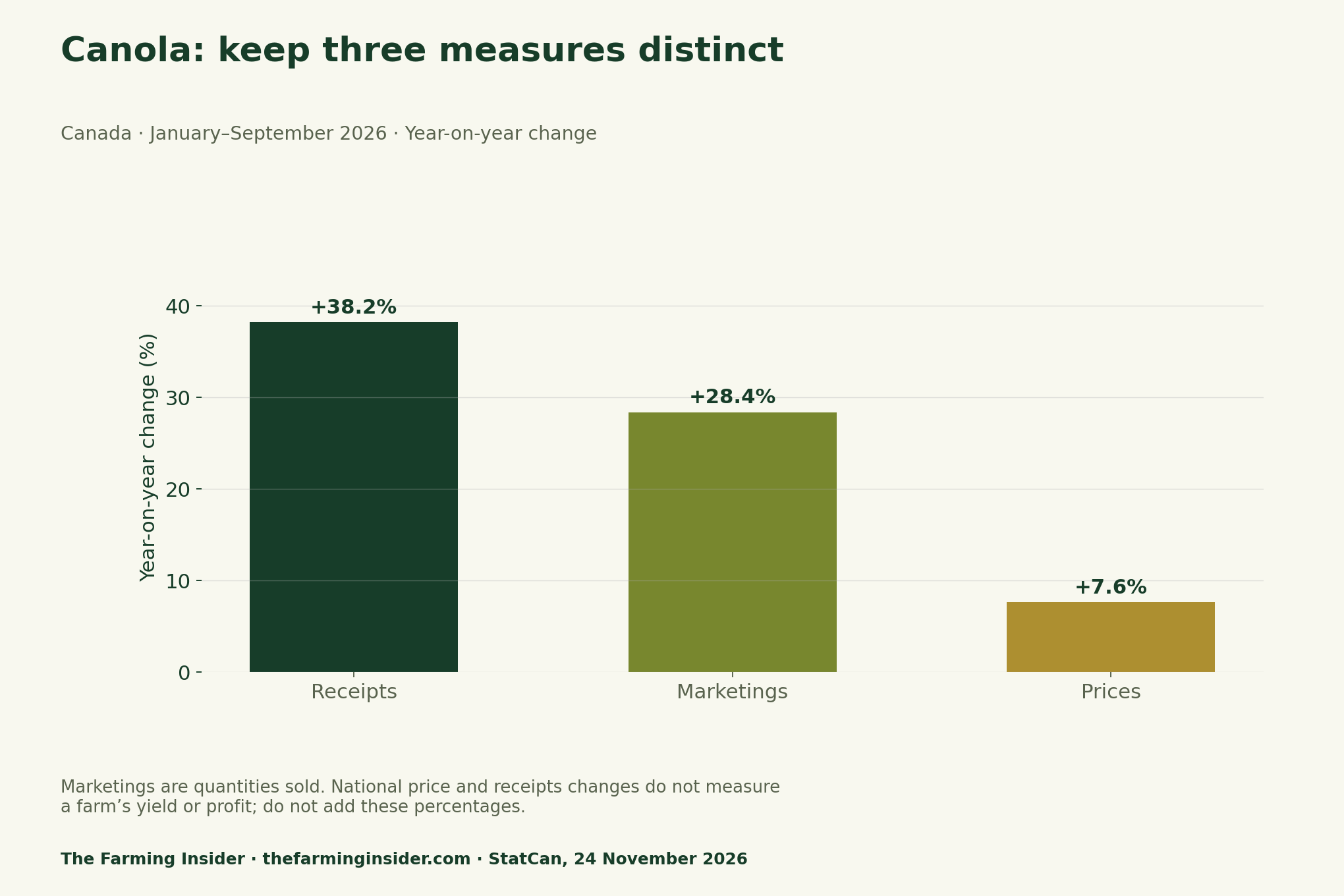
The Statistics Canada release of 24 November reports C$79.7 billion in total farm receipts for January–September, up 7.7%. Canola receipts increased 38.2%, while marketings rose 28.4% and prices rose 7.6%. These are different measures. Our cash-calendar example below is fictional and does not forecast your price, yield or margin.
Canadian canola farm cash receipts: start with the measure
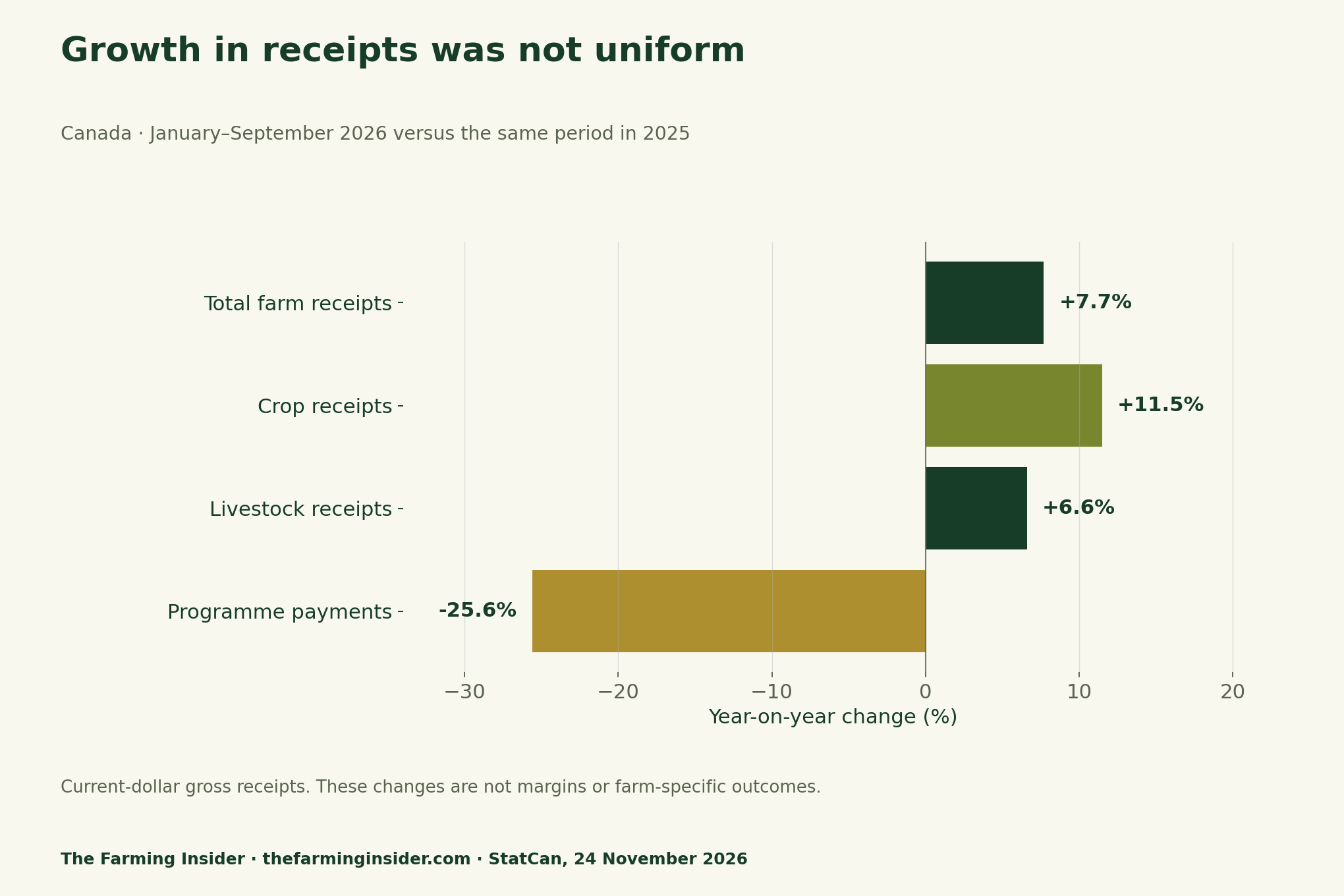
Crop receipts reached C$42.4 billion. Direct programme payments fell 25.6% to C$2.5 billion. Those two directions can coexist. Keep expected support payments separate from invoices, because their evidence and timing may differ. A national total cannot confirm whether a specific payment will arrive for your business.
The agency defines receipts as current-dollar gross revenue recorded when farmers receive payment. Expenses, loan payments and depreciation are separate. Consequently, a receipts chart cannot establish the cash left after costs. Nor does it measure the physical crop harvested in that period.
Build one record from contract to cleared payment
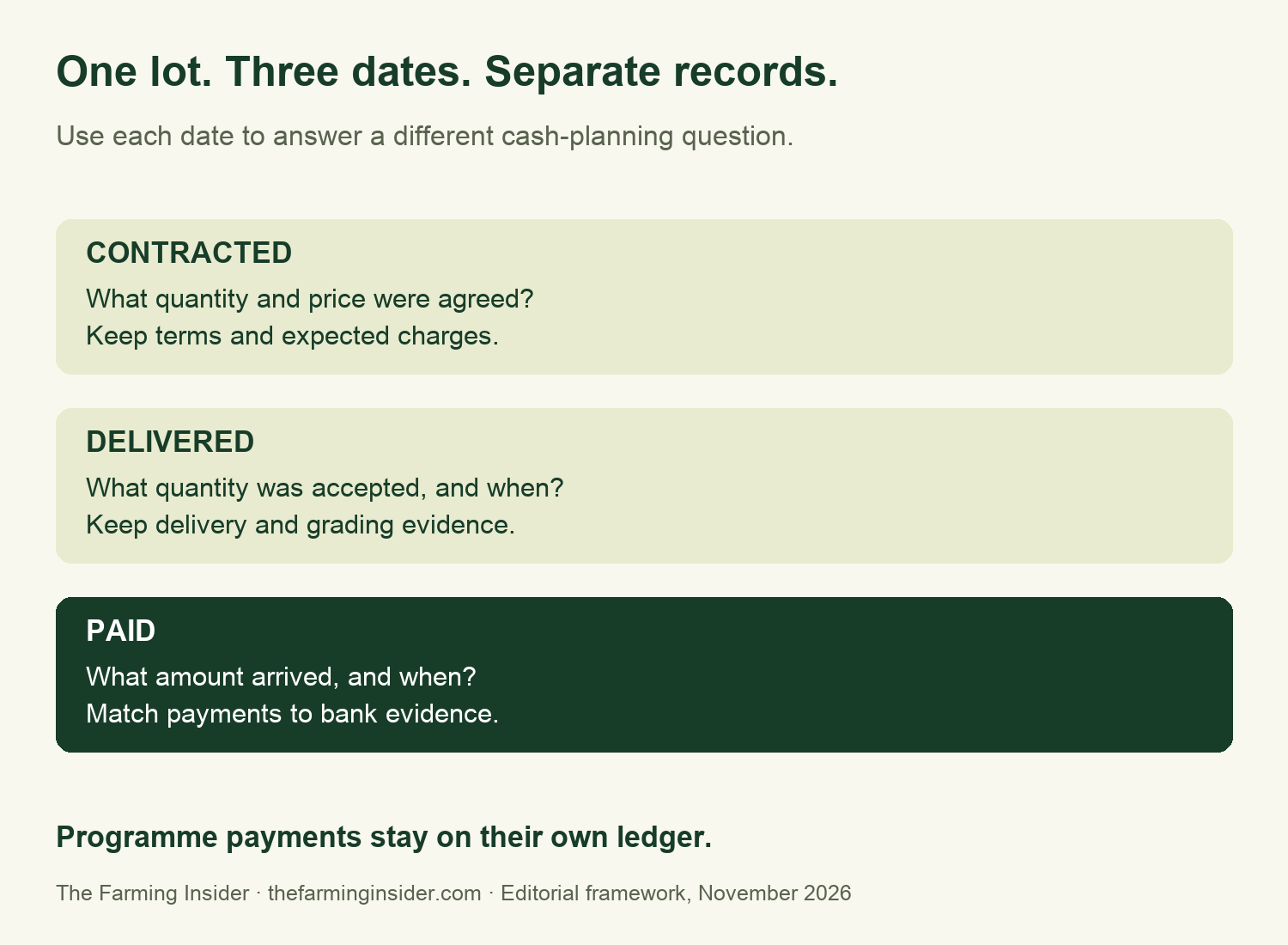
Start with one lot reference that appears on each document. Then enter tonnes, agreed price, expected charges and the payment terms. Record delivery separately, including any quantity or grade adjustment. Finally, match each received amount to that lot. Leave an unconfirmed receipt date visibly uncertain rather than filling it with a convenient estimate.
A payment due date is useful for planning, but it is not proof that money arrived. Keep both fields. If one transfer covers several lots, document the allocation rather than counting the entire transfer against each sale. Likewise, a partial receipt should reduce the unpaid balance only once.
Test the September cutoff with a fictional sale
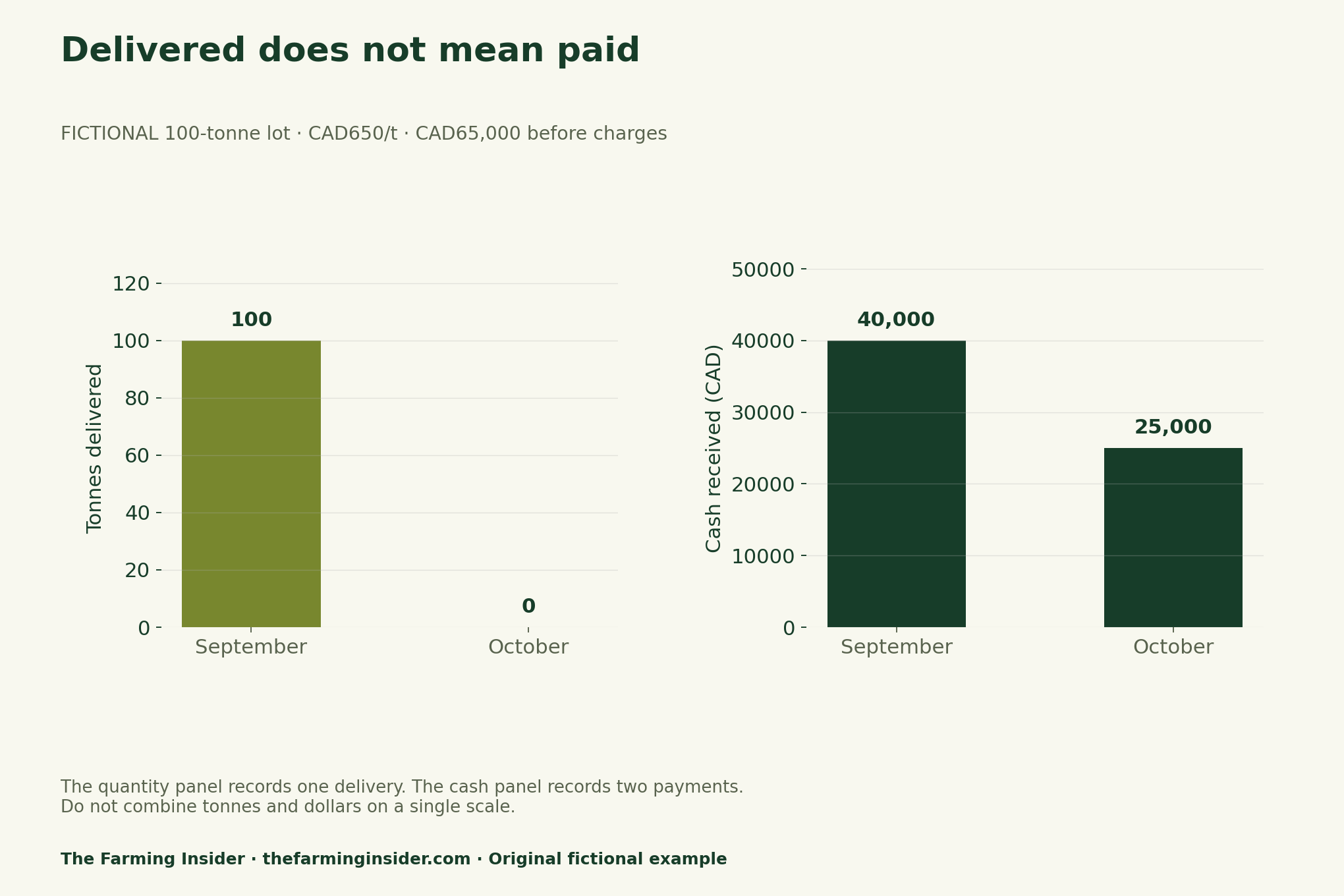
Assume a fictional contract for 100 tonnes at C$650 per tonne: 100 × 650 = C$65,000 before charges. All 100 tonnes are delivered in September. The buyer pays C$40,000 on 25 September and C$25,000 on 10 October. No interest, deductions, taxes or other transactions enter this teaching example.
| Record | September | October |
|---|---|---|
| Physical delivery | 100 tonnes | 0 tonnes |
| Payment received | C$40,000 | C$25,000 |
| Cumulative payment | C$40,000 | C$65,000 |
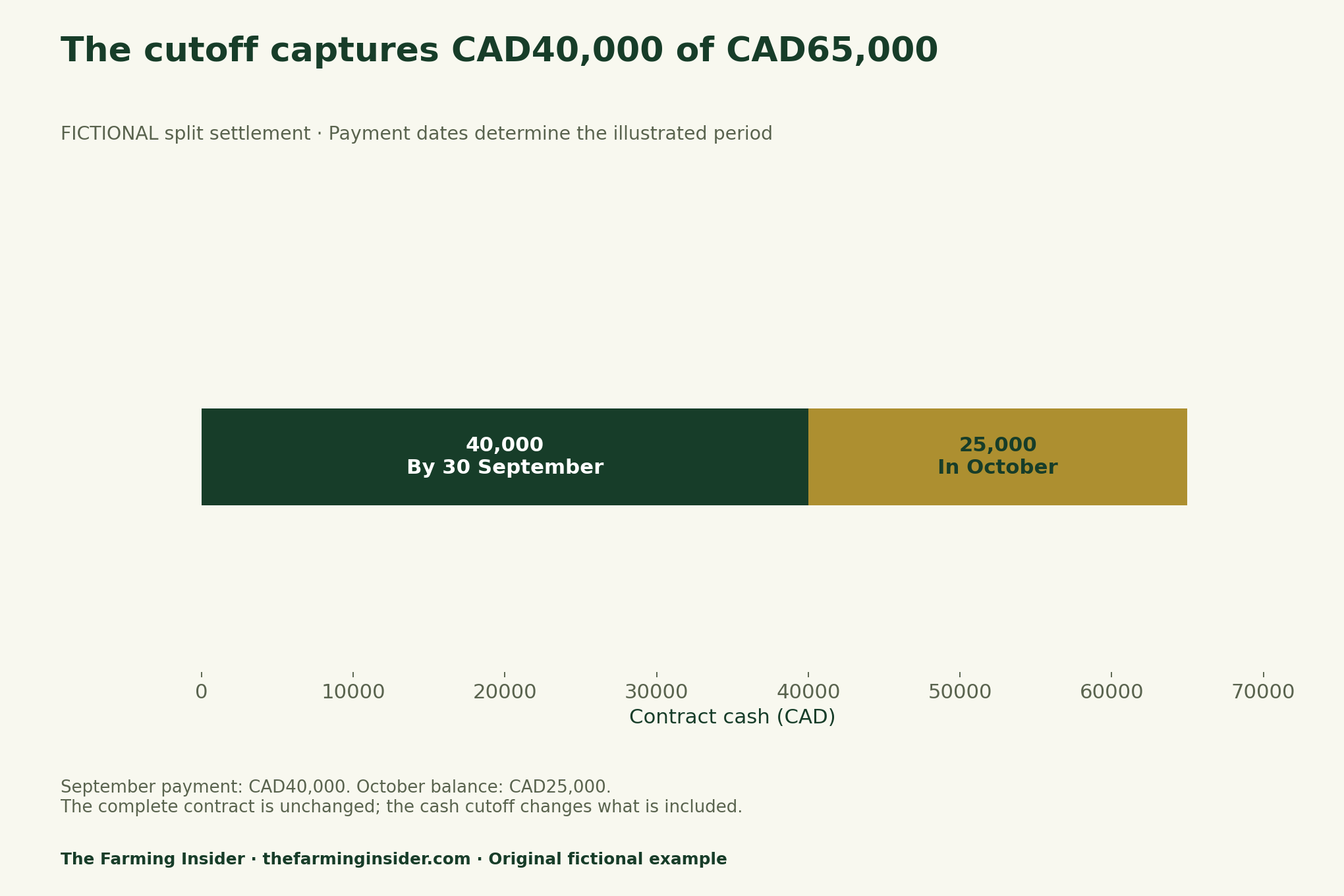
The cutoff does not erase the unpaid C$25,000. It places that balance outside the period’s received-cash column. Keep it in a separate outstanding column, with its due date and supporting evidence. This makes a late receipt easier to spot without presenting it as cash already available.
Compare payment dates with the obligation date
Now add a fictional C$50,000 bill due by 30 September. If the entire sale settles in September, these receipts exceed that one bill by C$15,000. Under the split settlement, the receipt-only gap is minus C$10,000. If all payment arrives in October, it is minus C$50,000 at the cutoff.
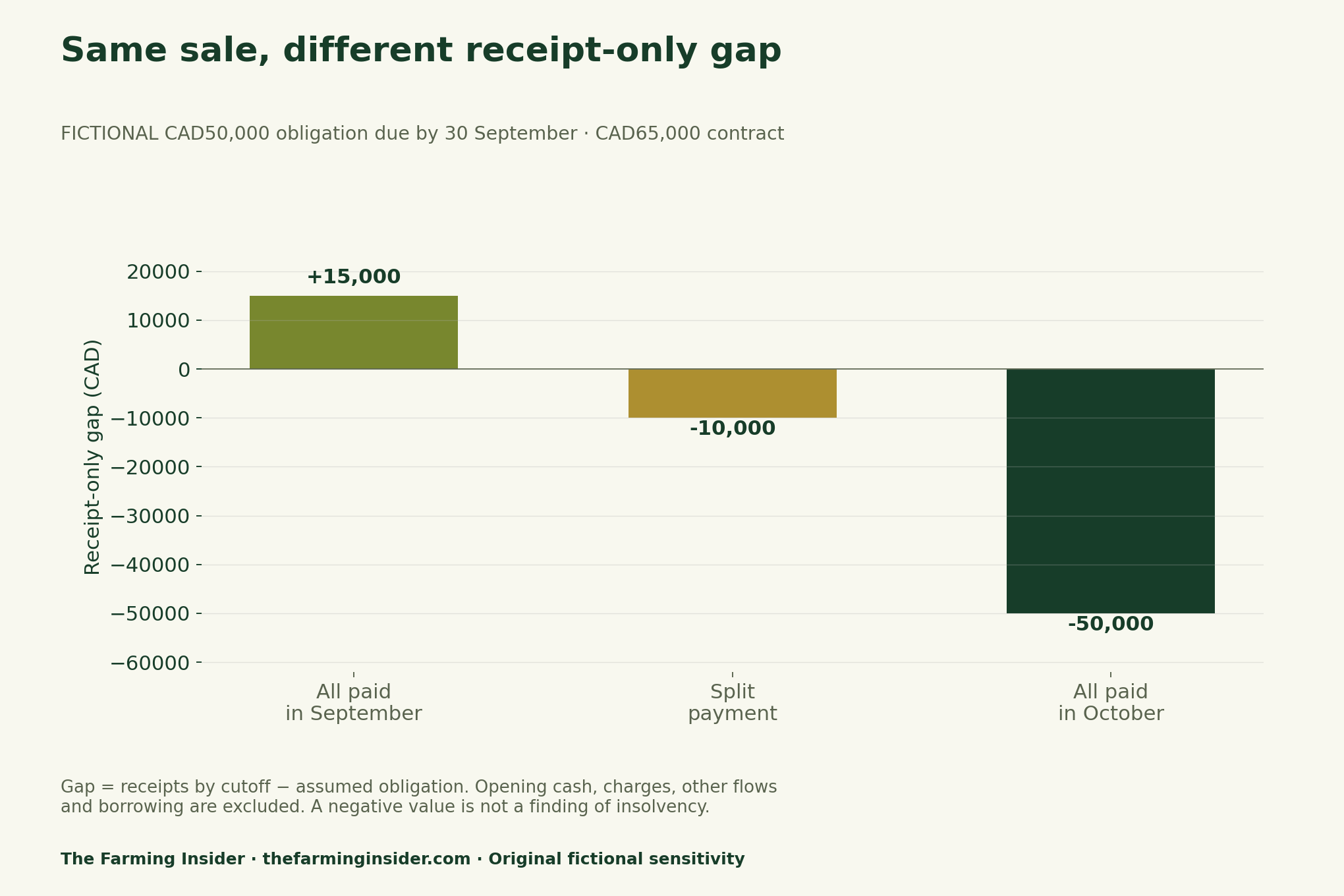
Use that comparison to identify the next question, not to select a loan. Check opening cash, other verified receipts, charges and every obligation before assessing the whole position. If timing remains unresolved, ask the buyer to clarify the relevant payment terms. Record the answer and update the calendar when the transfer clears.
Method, limits and reusable cash-calendar files
We transcribed the release’s rounded national measures and kept their units and period explicit. The original example uses multiplication, payment allocation and receipts less one assumed obligation. It does not reconstruct canola production or estimate a representative farm. All scenario dates and amounts are invented for teaching, and national data remain subject to revision.
The blank ledger includes a separate programme-payment field. Fill it only with evidence relevant to your own business. Do not assume a national decline predicts your payment, or use a blank cell as zero. Retain your source documents locally and avoid publishing private buyer or bank details.
- National source measures and boundaries (CSV)
- Fictional sale, delivery and payment calendar (CSV)
- Blank sales and payment-date ledger (CSV)
- Fictional payment-date sensitivity calculations (CSV)
For related evidence, explore our Research & Reports archive and Agribusiness Strategies. Use the current official release for national statistics and your own records for settlement dates. Suggested citation: The Farming Insider, “Canadian Canola Receipts: Build a Cash Calendar”, 25 November 2026; analysis and fictional tools accompanying Statistics Canada’s January–September release.


