





Herbal ley establishment monitoring starts with a question, not a promised saving. AHDB’s 3 November 2026 Rough Grounds Farm account describes reseeding almost the entire 96-hectare milking platform. It is a useful farm experience, but it does not supply the numerical input and yield series needed to calculate a fertiliser-saving percentage or a payback period.
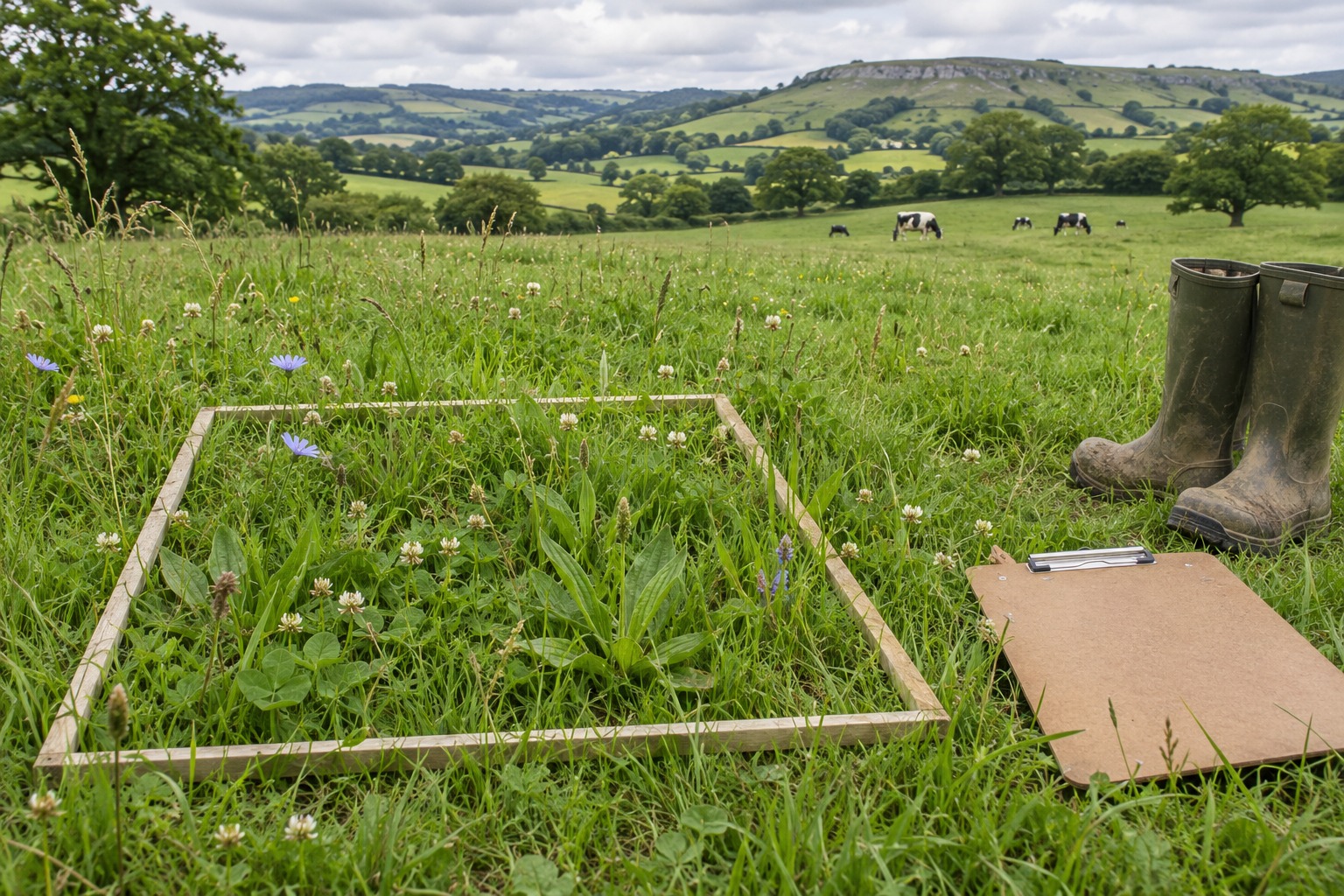
Featured image: AI-generated conceptual pasture-monitoring scene, not a photograph of Rough Grounds Farm or a documented field sample.
This guide turns those evidence gaps into an adviser-led monitoring plan. It includes two deliberately blank chart templates, an explanatory evidence map and four free CSV record sheets. The empty plots contain no observations, expected gains or fitted relationships. Research checked on 9 November 2026.
What the herbal ley establishment case actually reports
The primary source is AHDB’s Rough Grounds Farm case study, published 3 November 2026. It reports establishment difficulties, less reliable plate-meter readings in mixed swards and earlier mixtures becoming too open by year three. The farmers describe lower fertiliser use alongside broadly comparable dry-matter yields. These are reported experiences, not a replicated quantified treatment effect.
| Item | What the source establishes | What remains missing |
|---|---|---|
| 96ha | Size of the milking platform; almost all was reseeded | Experimental replicate count and field-level treatment allocation |
| Fertiliser and dry matter | Reported direction of input change and broadly comparable output | Complete numerical series, matched controls and uncertainty |
| Persistence | Reported difficulties and earlier mixtures opening by year three | Repeated species-cover dataset under a specified sampling method |
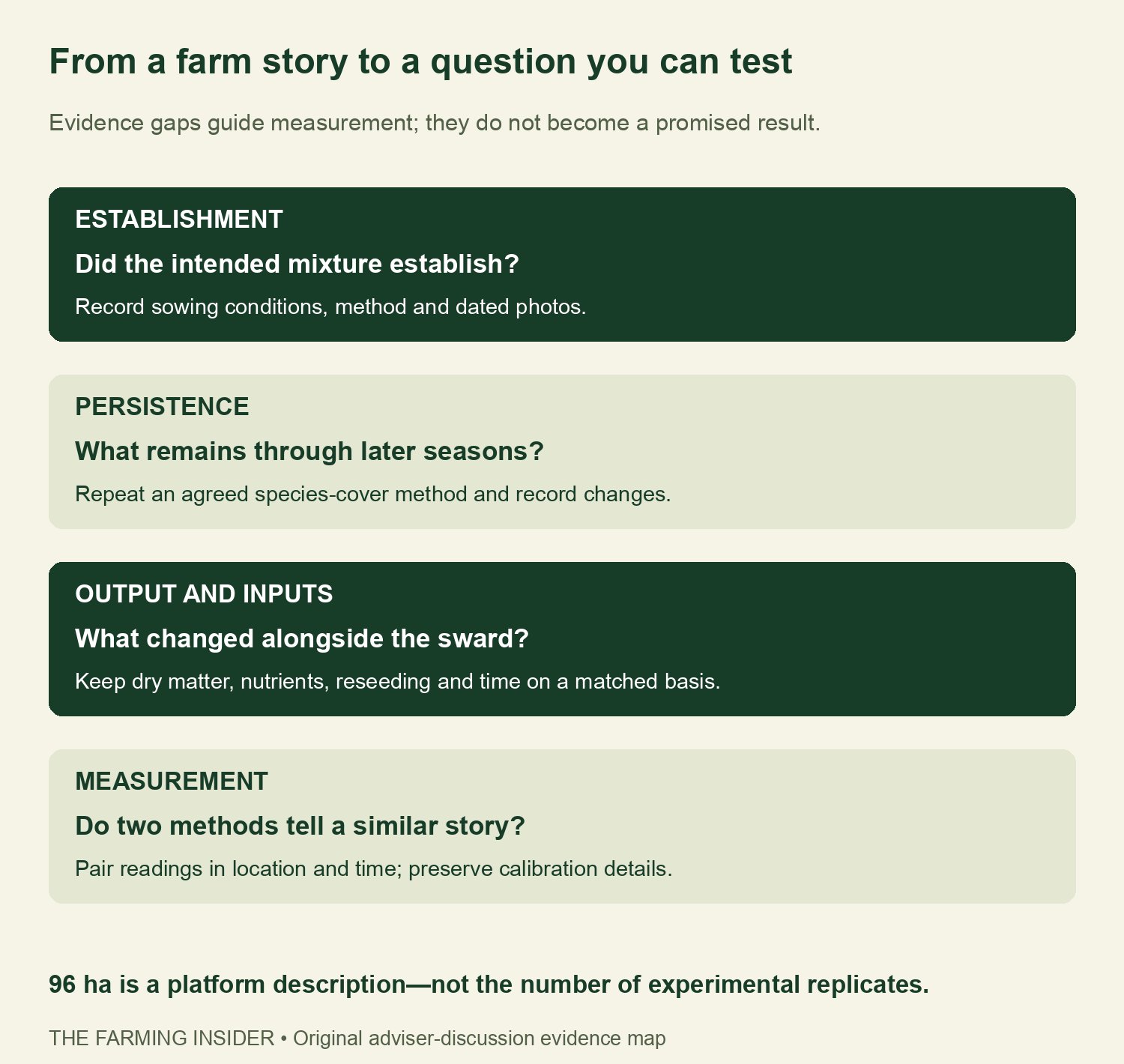
Do not convert the platform area into a sample size. Ninety-six hectares does not mean 96 independent experiments. It also does not establish the exact area successfully established in each mixture. Keep the farm description beside its scope rather than treating it as statistical replication.
Plan herbal ley establishment records before measuring results
Begin with a private field identifier, area and the intended seed mixture. Record the units used for each component and preserve the seed-lot reference. Add the sowing date, relevant soil-test record and a description of conditions. These fields document what was attempted; they do not certify that a mixture is suitable for another farm.
Agree an establishment-assessment method with an appropriate adviser before collecting observations. Use dated photos as supporting records, not as an automatic yield measurement. Record the method and the result separately. If a visit is missed or a method changes, retain that gap instead of filling it with an optimistic value.
Measure persistence with a consistent cover definition
Establishment and persistence answer different questions. An early assessment may show that plants emerged, while a later visit asks what remains. Use an agreed species or cover-group definition, sampling locations, observation dates and stage notes. Repeating a label is not enough if the method underneath it has changed.
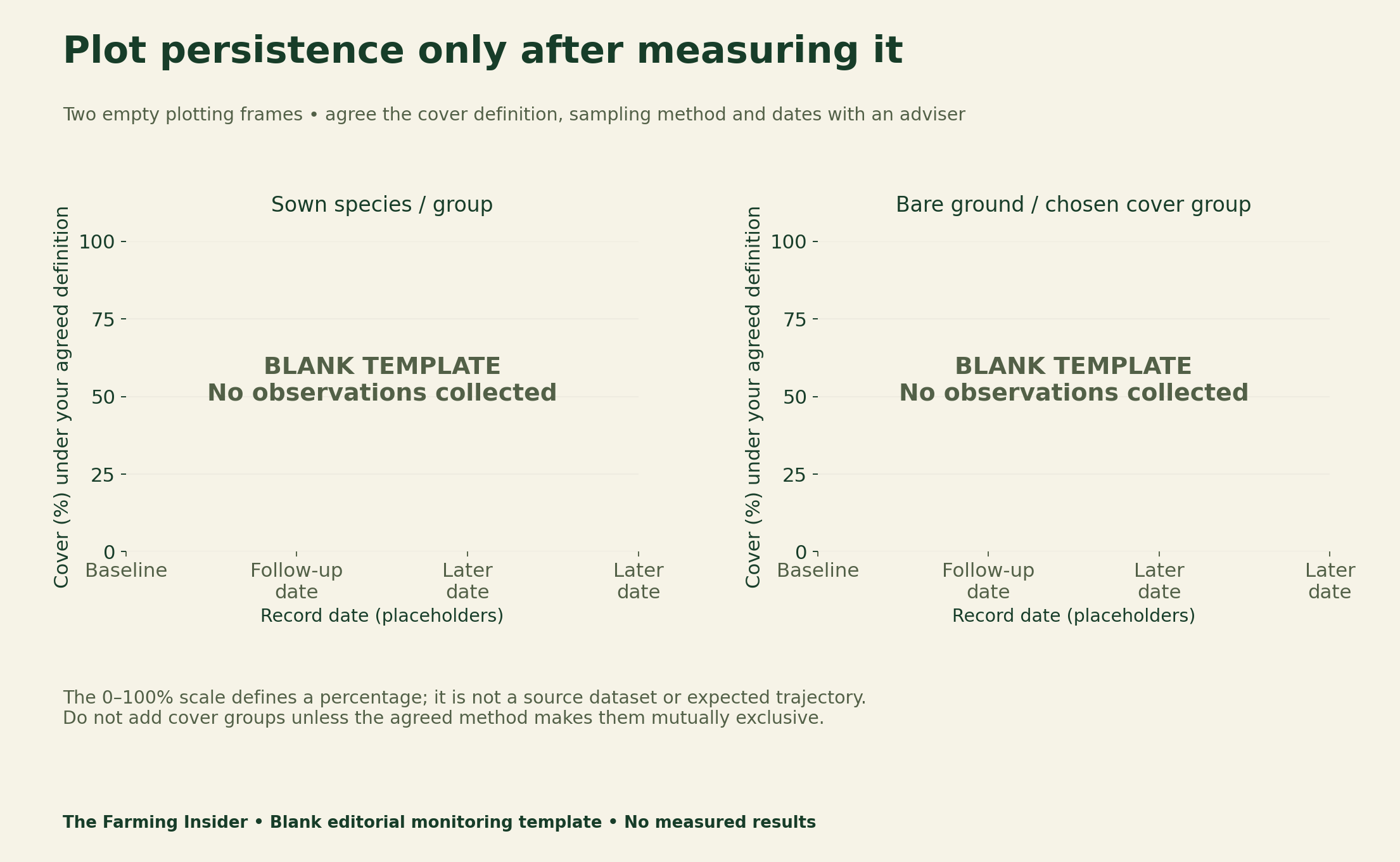
The templates leave the dates to the local plan. They do not prescribe a visit schedule or imply that four visits are sufficient for a conclusion. Cover categories may overlap under some methods. Do not add them unless the agreed definition makes them mutually exclusive and the intended total is meaningful.
Keep management between visits beside the cover record. A change in grazing, cutting, weather or reseeding can complicate interpretation. A line drawn through repeated observations would describe those records; it would not automatically isolate the effect of the original seed mixture.
Keep output, nutrient inputs and management time together
A useful comparison needs more than one output number. The blank sheet keeps dry matter per hectare beside its measurement method and period. It also provides separate fields for fertiliser nutrients, other nutrient inputs, reseeding costs and management time. Preserve units and do not substitute fresh weight for dry matter.
Choose comparison fields with an adviser and record their differences. Matching an area does not match soil, weather, previous management or crop stage. A before-and-after change can reflect several influences. Describe it as an observed difference unless the design and analysis justify a stronger conclusion.
There is no complete financial dataset in the news account, so we do not calculate a percentage saving, a yield uplift or an investment return. A blank budget field is a request for evidence. It is not permission to insert a plausible-looking industry average and present it as this farm’s result.
Check the measurement method in a mixed sward
The reported plate-meter difficulty makes measurement a separate question. A local method-comparison sheet should retain the raw reading, units, calibration version and the independent sampling method. Pair records in time and location where the agreed protocol requires that. Document composition and sward stage rather than treating every reading as interchangeable.
Once suitable paired measurements exist, an adviser can decide how to assess agreement and uncertainty. A visually close pair of numbers does not prove that either method is error-free. Do not select only the most favourable pairs or hide excluded records. The worksheet includes an exclusion-reason field to keep that decision visible.
Transform Your Agribusiness
Unlock your farm's potential with expert advice tailored to your needs. Get actionable steps that drive real results.
Get StartedUse the evidence map to choose the next question
Our evidence map separates establishment, persistence, output and inputs, and measurement. It is an editorial discussion framework, not an agronomic protocol. Its purpose is to make the missing record explicit before a farm story becomes a scaling decision. The appropriate next measurement depends on the farm and the adviser’s plan.
Species selection and grazing decisions need farm-specific agronomic and veterinary guidance. This article does not turn the case study’s management observations into instructions for another herd. Keep questions about animal health and safe grazing with appropriately qualified advisers rather than extrapolating a regimen from a news story.
For related evidence tools, see our rainfall and fieldwork log, which separates regional context from local observations. Our farm-support statistics guide also shows why a headline measure should not be inserted directly into an individual business calculation.
Download four blank monitoring sheets
Each file contains a header and an empty record row. They are blank templates, not collected research data. Keep field identifiers, photos and business records private. If examples are later published, obtain permission and preserve the method, units, dates, missing values and comparison limitations beside any chart.
- Blank herbal ley establishment register (CSV)
- Blank repeated species-cover log (CSV)
- Blank output and input comparison sheet (CSV)
- Blank paired measurement-method sheet (CSV)
Methods, limits and citation
We audited the case study’s reported observations and its missing numerical series, then designed records for adviser-led discussion. We did not collect field measurements, infer an exact reseeded area or fit a treatment model. The chart frames deliberately remain empty. They must not be cited as observed outcomes.
Suggested citation: The Farming Insider(9 November 2026), “Herbal Ley Establishment: Measure Before Scaling Up.” Cite AHDB, “Strengthening resilience with herbal leys,”3 November 2026, for the farm account. Attribute the blank monitoring sheets, chart frames and evidence map to this publication. No universal efficacy, drought-resilience or return-on-investment estimate is established here.