



Introduction to Climate Risks and Their Relevance in Agriculture
Climate risks describe potential harm from changing weather patterns.
These risks can directly reduce crop yields and harm livestock health.
Moreover, droughts, floods, and storms occur with increasing frequency.
As a result, climate variability creates greater uncertainty for agricultural productivity.
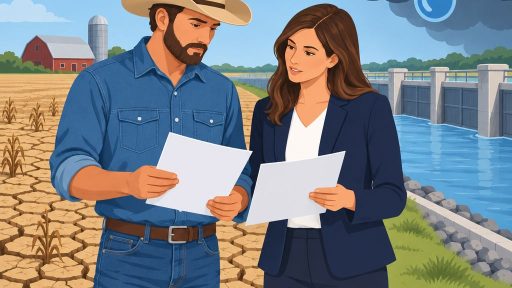
Therefore, farmers and investors must evaluate these uncertainties before acquiring agricultural land.
Impact of Climate Risks on Agricultural Land Value
Climate risks can reduce soil quality and limit water availability on agricultural land.
In addition, changing temperatures can alter growing seasons and affect crop viability.
Consequently, previously fertile land may become less productive over time.
This potential decline can directly reduce farmland’s economic value.
Thus, buyers can make better investment decisions by understanding these risks.
Factors Driving Climate Risks in Different U.S. Regions
Climate risks differ significantly across the United States.
For example, the Midwest faces increasingly intense heat waves and drought conditions.
Meanwhile, the Southeast experiences stronger hurricanes and more frequent flooding events.
Therefore, buyers must evaluate regional climate trends before purchasing land.
Local weather stations and climate models provide useful assessment tools.
Transform Your Agribusiness
Unlock your farm's potential with expert advice tailored to your needs. Get actionable steps that drive real results.
Get StartedWhy Assessing Climate Risks Supports Sustainable Farming
Climate risk assessments support long-term sustainability in farming operations.
They encourage farmers to diversify crops and improve irrigation practices.
Furthermore, these assessments support decisions that protect natural resources and biodiversity.
Farmers can strengthen resilience by managing climate risks before disruptions occur.
Ultimately, thorough evaluation benefits livelihoods and environmental health.
Climate Zones Shaping Agricultural Land
The USA contains diverse climate zones that influence farming outcomes.
From the arid Southwest to the humid Southeast, regional weather varies widely.
Consequently, farmers choose crops and techniques according to local conditions.
For example, California’s Mediterranean climate supports vineyards and fruit production.
Meanwhile, the Midwest’s continental climate favors corn and soybean production.
Regional Temperature and Precipitation Differences
Temperature patterns vary dramatically across the country throughout the year.
For instance, the Pacific Northwest experiences mild summers and wet winters.
In contrast, the Southern Plains regularly experience hot summers and limited rainfall.
Furthermore, the Northeast often experiences cold winters and snow that affects planting seasons.
Therefore, farmers need regional irrigation and soil management strategies.
Regional Impacts of Extreme Weather Events
Geographical location shapes the extreme weather events that agricultural areas experience.
For example, coastal regions face hurricanes and flooding risks during peak seasons.
Meanwhile, the central USA often encounters droughts and severe tornadoes.
In northern states, late frosts and unpredictable snowfall can affect agricultural planning.
As a result, investors should assess these conditions before purchasing agricultural land.
Interactions Between Soil Types and Climate
Climate and geography influence soil quality across the USA.
For instance, rich loamy soils in the Midwest benefit from temperate conditions.
Conversely, arid regions often contain sandy or saline soils that challenge farmers.
Understanding local soil responses to weather supports better agricultural land choices.
Showcase Your Farming Business
Publish your professional farming services profile on our blog for a one-time fee of $200 and reach a dedicated audience of farmers and agribusiness owners.
Publish Your ProfileClimate Data for Agricultural Land Evaluation
Detailed climate data can improve decisions about agricultural purchases.
State agencies and private firms such as GreenField Analytics offer relevant datasets.
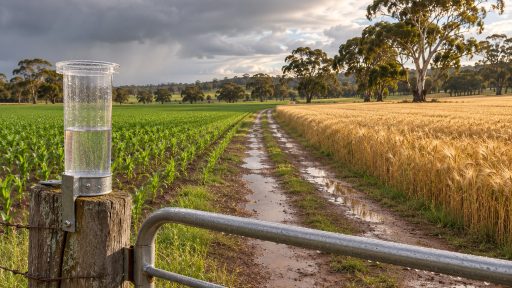
These datasets include rainfall averages, temperature trends, and weather extremes.
Moreover, forecasting models help predict future climate risks for specific plots.
Consequently, this information supports land selections with sustainable farming prospects.
Key Climate Risks to Consider
Three hazards deserve close review when evaluating agricultural land.
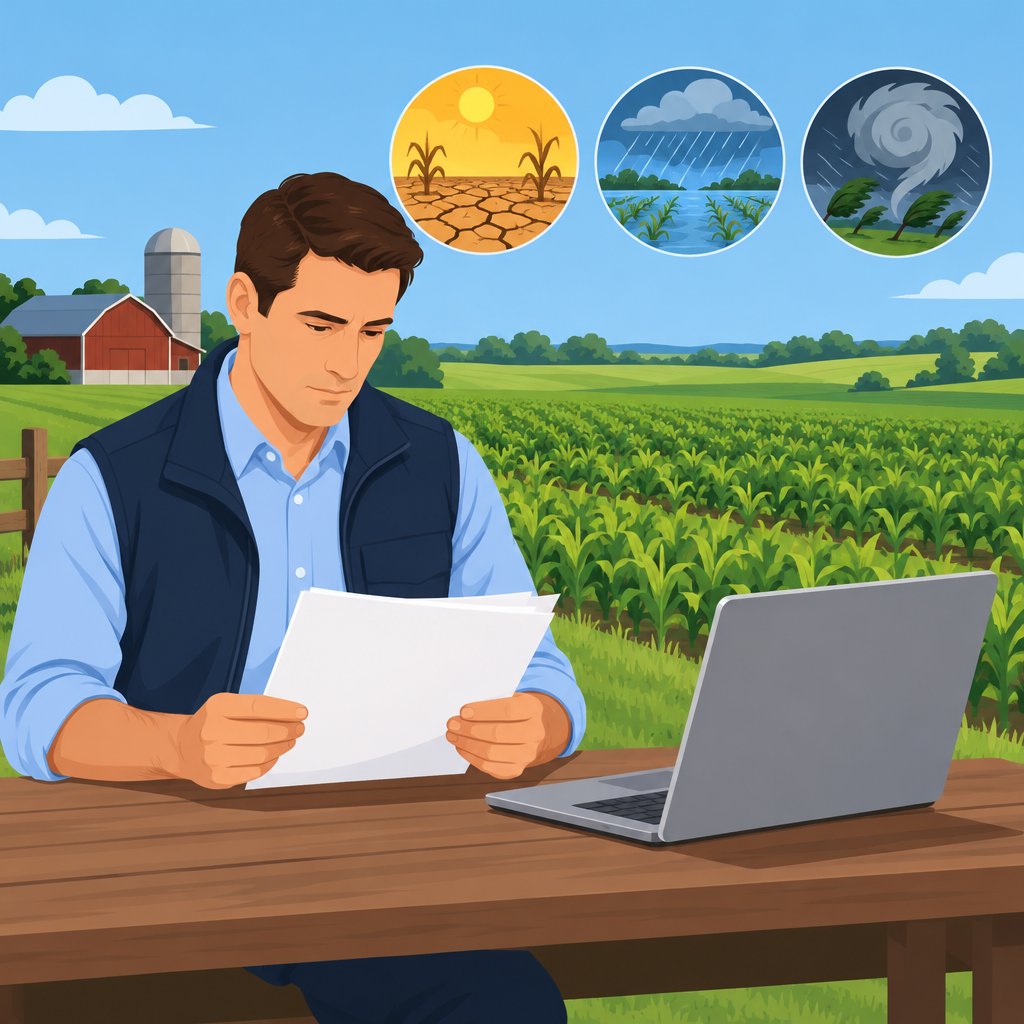
Drought, flooding, and extreme weather can affect productivity and farming operations.
Each hazard requires different records, safeguards, and financial planning.
Drought Conditions and Agricultural Productivity
Drought represents a serious threat to agricultural land productivity.
It significantly reduces water availability for crops and livestock.
Consequently, farmers often face decreased yields and increased costs during droughts.
Moreover, prolonged droughts can degrade soil health over time.
Therefore, historical drought patterns help investors gauge future risks.
Areas like California’s Central Valley frequently experience severe drought conditions.
As a result, water rights and irrigation infrastructure become crucial factors.
In addition, climate models predicting drier conditions can inform land purchasing decisions.
Flooding Risks for Farmland
Flooding can cause immediate damage to crops and farmland infrastructure.
It also increases soil erosion and nutrient loss, affecting long-term fertility.
Flood-prone zones along the Mississippi River illustrate common agricultural challenges.
Investors must examine floodplain maps and historical flood data carefully.
Furthermore, climate change intensifies extreme rainfall and raises flooding risks.
Effective drainage and flood control measures can mitigate some impacts.
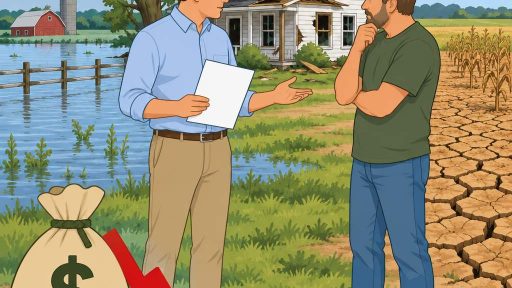
However, repeated flooding may substantially reduce land value and productivity.
Thus, flood risk assessments support informed decisions before buying land.
Extreme Weather Threats to Farm Operations
Extreme weather events include hailstorms, tornadoes, hurricanes, and heatwaves.
These events can destroy crops, damage equipment, and disrupt farming operations.
The Midwest remains particularly vulnerable to tornadoes and severe storms.
Similarly, coastal regions face heightened hurricane risks during warmer seasons.
Heatwaves contribute to crop stress and lower agricultural yields.
Therefore, farmers and buyers should review local weather trends thoroughly.
Moreover, crop insurance and disaster preparedness plans can reduce financial impacts.
Understanding local weather threats supports careful agricultural land investment planning.
Uncover the Details: Why Farmland Owners Must Prepare for More Frequent Climate Disasters
Evaluating Soil Health and Its Relationship to Climate Resilience
Soil health connects productive farming with stronger responses to climate stress.
Assessing soil conditions helps buyers judge land quality before making agricultural investments.
Furthermore, soil information supports decisions about management, resilience, and long-term crop viability.
Importance of Soil Health in Agriculture
Healthy soil supports robust crop growth and improves farm productivity.
It enhances water retention, reducing irrigation needs during droughts.
Moreover, nutritious soil fosters beneficial microorganisms that protect plants.
Farmers like Daniel Harper recognize soil as a critical asset for sustainable farming.
Showcase Your Farming Business
Publish your professional farming services profile on our blog for a one-time fee of $200 and reach a dedicated audience of farmers and agribusiness owners.
Publish Your ProfileTherefore, assessing soil health remains fundamental before purchasing agricultural land.
Key Indicators of Soil Health
Soil texture significantly affects drainage and root penetration.
Organic matter content drives nutrient availability and soil structure.
Additionally, soil pH influences nutrient uptake and microbial activity.
Soil biodiversity also promotes resilience against pests and diseases.
Experts from Greenfields Agronomy recommend comprehensive testing for these factors.
Soil Health and Climate Resilience
Healthy soil effectively buffers crops against extreme weather events.
It stores carbon, helping mitigate climate change impacts locally.
Furthermore, better soil structure prevents erosion during heavy rains.
Consequently, resilient soil supports stable yields despite climate fluctuations.
Environmental scientist Maria Vega highlights soil health as a climate adaptation tool.
Practices to Enhance Soil Health
Crop rotation diversifies soil nutrients and disrupts pest cycles.
Cover cropping reduces erosion and adds organic matter.
Meanwhile, reduced tillage preserves soil structure and microbial habitats.
Composting sustainably enriches soil fertility.
Farm Consultant Lucas Montgomery advises evaluating management practices before buying land.
Using Soil Health Data in Land Purchase Decisions
Request recent soil testing reports from landowners or local agencies.
Consider hiring soil scientists for detailed analyses.
Next, compare soil indicators with regional benchmarks and historical climate data.
Then, factor soil resilience into long-term investment strategies.
For example, Red Oak Farming Group integrates soil data to forecast crop viability.
Discover More: Real Estate Challenges of Farming in High-Risk Climate Zones
Reliable Climate Data Sources
Farmers and investors should obtain reliable climate data before purchasing agricultural land.
Trusted sources include the National Oceanic and Atmospheric Administration and the United States Geological Survey.
Additionally, WeatherSafe Analytics provides detailed regional climate reports.
Accessing current data helps buyers understand local historical weather patterns accurately.
This information creates a foundation for assessing climate-related risks effectively.
Predictive Climate Models
Predictive models use historical data to forecast future climate scenarios for targeted locations.
For example, the Coupled Model Intercomparison Project provides valuable climate projections.
Moreover, regional climate models provide higher-resolution predictions for farm-scale decisions.
These tools help buyers anticipate shifts in temperature, precipitation, and extreme events.
Consequently, buyers reduce uncertainty when evaluating potential land acquisitions.
Interpreting Climate Data for Agriculture
Careful analysis connects climate projections with potential agricultural impacts.
Agronomist Laura Greene helps investors connect climate trends with crop performance.
Experts evaluate drought, flooding, and heat stress risks for specific crops.
This insight helps buyers adjust land values according to expected climate resilience.
As a result, buyers support decisions aligned with long-term agricultural viability.
Climate Risk in the Land Buying Process
Incorporating climate risk data early improves strategic land evaluation.
For instance, Horizon Land Advisors includes climate risk in its reports.
Buyers should request risk profiles covering current and future climate threats.
Showcase Your Farming Business
Publish your professional farming services profile on our blog for a one-time fee of $200 and reach a dedicated audience of farmers and agribusiness owners.
Publish Your ProfileFurthermore, combining climate data with soil quality and water availability creates a complete picture.
This approach helps buyers anticipate challenges and strengthen investment sustainability.
Tools Supporting Climate Risk Assessment
Several user-friendly platforms simplify climate risk evaluation for land buyers.
AgroClimate Insights and TerraPredict provide dashboards with customizable data views.
Additionally, ClimateSure Technologies offers mobile apps with real-time weather risk alerts.
These technologies improve accessibility and provide buyers with actionable information.
Therefore, integrating these tools improves assessment speed and accuracy.
You Might Also Like: Extreme Weather Patterns and Their Impact on Rural Property Values
Assessing Local Agricultural Practices and Climate Adaptability
Local farming techniques determine how well agriculture can cope with changing climates.
For example, Nebraska farmers use crop rotation to maintain soil fertility and reduce pests.
Similarly, many California growers use drip irrigation to conserve water resources.
Understanding these methods helps investors assess resilience against droughts and floods.
Moreover, farmers using no-till practices improve soil carbon retention.
These techniques often increase adaptability by reducing environmental stress.
Adopting Climate-Resilient Crop Varieties
Farmers increasingly select crop varieties that tolerate extreme weather conditions.
For instance, Iowa producers plant drought-tolerant corn hybrids from GreenField Seeds LLC.
Additionally, some regions favor heat-resistant soybean varieties for warmer temperatures.
This shift reduces losses and stabilizes yields during climate uncertainty.
Furthermore, Prairie Ag Innovations offers seeds bred for climate challenges.
Integrating Technology for Climate Adaptation
Farmers apply advanced technologies to monitor and respond proactively to climate risks.
In Kansas, remote sensing and soil moisture sensors support precise irrigation management.
Meanwhile, weather forecasting platforms provide data for optimizing planting schedules.
Horizon AgTech supplies these tools to local agricultural operators.
Consequently, technology improves decision-making and reduces weather-related damage.
Strengthening Community Support and Knowledge Sharing
Strong local networks promote resilience through shared learning and resources.
For example, the Heartland Farming Cooperative regularly conducts climate adaptation workshops.
Besides education, cooperatives provide equipment access and funding for sustainable practices.
Collaborative efforts strengthen farmers’ capacity to respond to environmental changes.
Therefore, investors should evaluate community involvement when considering land investments.
Reviewing Agricultural Policy Incentives
Government policies significantly influence agricultural adaptation strategies.
The USDA offers programs supporting cover cropping and conservation tillage.
Additionally, Oregon provides incentives for renewable energy adoption on farms.
These frameworks encourage climate-smart methods without creating excessive financial risk.
Investors should analyze these policies when evaluating long-term sustainability prospects.
Explore Further: The Role of Drought in Shaping Agricultural Real Estate Trends
The Importance of Water Resources and Management Strategies in Climate Risk Planning
Water resources strongly influence agricultural investment decisions and long-term farm performance.
Effective management helps investors reduce climate-related losses and protect the value of productive land.
Therefore, buyers should evaluate water conditions before committing to an agricultural property.
Water Resources as a Critical Factor in Agricultural Land Investment
Water availability directly influences agricultural productivity across the United States.
Therefore, understanding local water resources is essential before purchasing land.
Showcase Your Farming Business
Publish your professional farming services profile on our blog for a one-time fee of $200 and reach a dedicated audience of farmers and agribusiness owners.
Publish Your ProfileClimate change increasingly disrupts traditional water supply patterns.
For instance, droughts have become more frequent in the Midwest and Southwest.
These conditions heighten the risk of crop failure and economic loss.
Likewise, excessive rainfall can lead to soil erosion and nutrient runoff.
Thus, assessing both water quantity and quality is vital for risk management.
Evaluating Water Sources and Rights
Investigate all available water sources on the agricultural property.
These may include groundwater wells, surface water, and rainfall.
Moreover, review water rights and legal entitlements carefully.
Water law varies significantly between states and local jurisdictions.
Consulting water resource experts helps clarify complex regulatory issues.
Additionally, consider the potential for future water restrictions or allocations.
Implementing Effective Water Management Strategies
Good water management minimizes climate risks and maximizes land value.
Farmers like Lisa Hernandez implement drip irrigation to save water efficiently.
This method reduces evaporation and delivers water directly to crop roots.
Furthermore, rainwater harvesting systems provide supplemental irrigation sources.
Cover cropping and conservation tillage improve soil moisture retention over time.
Using these strategies collectively enhances resilience against drought.
Technology and Innovation in Water Management
Modern tools support precise water monitoring and management.
For example, soil moisture sensors help farmers adjust irrigation schedules promptly.
Both public agencies and private companies promote smart water technologies.
HarvestField AgTech recently launched affordable irrigation controllers for small farms.
Similarly, satellite imagery offers real-time data on water stress conditions.
These innovations enable proactive responses to climate-related water challenges.
Community and Regional Collaboration on Water Issues
Water resources often cross property boundaries and require joint management.
Local water districts organize stakeholders to coordinate sustainable use.
Farmers join cooperatives to share water-saving equipment and knowledge.
Such collaboration facilitates stronger adaptation to climate variability.
Finally, engaging with local authorities ensures compliance with evolving water policies.
Case Studies of Agricultural Land Purchases Based on Climate Assessments
Climate assessments help agricultural buyers compare weather patterns, hazards, and adaptation needs before committing funds.
These case studies show how careful analysis can support resilience and profitability.
They also reveal how overlooked risks can create operational and financial pressure.
Success Stories in Climate-Conscious Land Investments
Harrison Farms in Nebraska purchased land after completing a detailed climate risk analysis.
Their team examined long-term rainfall patterns and temperature shifts before buying.
They selected land that historically resisted drought conditions.
Consequently, crop yields remained steady despite recent climate variability.
Additionally, the farm invested in irrigation improvements aligned with future climate projections.
These efforts minimized water stress and improved farm profitability over time.
Meanwhile, Evergreen Orchards in Washington State avoided flood-prone regions by using climate data.
The owners reviewed flood frequency maps and soil drainage reports during due diligence.
They chose elevated plots with favorable microclimates for fruit tree cultivation.
Showcase Your Farming Business
Publish your professional farming services profile on our blog for a one-time fee of $200 and reach a dedicated audience of farmers and agribusiness owners.
Publish Your ProfileAs a result, Evergreen Orchards reduced crop losses and soil erosion risks.
The owners also changed planting schedules as conditions required.
This proactive planning strengthened orchard resilience and market output.
Challenges from Overlooked Climate Risks in Agricultural Purchases
The Bennett family acquired Texas farmland without completing a thorough climate risk assessment.
They underestimated increasing heat waves and prolonged drought intensity in the region.
Consequently, traditional crops suffered significant yield declines year after year.
Water shortages forced the family to make costly investments in alternative irrigation solutions.
Moreover, insufficient adaptation accelerated soil degradation.
These difficulties forced the family to reconsider its land management approach.
Copper Ridge Vineyards in California also faced challenges after neglecting climate analysis.
The buyers overlooked rising wildfire risks when purchasing land near forested areas.
During subsequent seasons, fires encroached dangerously close to the vineyards.
This event damaged vineyard infrastructure and reduced grape quality.
Meanwhile, insurance premiums increased dramatically and weakened financial sustainability.
Eventually, the owners adopted rigorous fire prevention and monitoring systems.
Key Takeaways from Climate Risk-Based Land Decisions
Successful land buyers integrate climate forecasts into their decision-making processes.
They select properties that align with predicted future environmental conditions.
In contrast, buyers who ignore climate risks face operational disruptions and financial setbacks.
Proactive adaptation often separates thriving farms from struggling operations.
Therefore, climate experts can strengthen agricultural land acquisition strategies.
Potential investors should also use technology for continuous climate monitoring.
Making Informed Decisions for Sustainable Agricultural Investments
Sustainable agricultural investments require careful decisions about land, climate, farming practices, and long-term stewardship.
Investors can combine risk assessment, adaptive methods, and technology when evaluating agricultural opportunities.
This approach connects financial planning with productive farmland and environmental responsibility.
Recognizing Climate Risks in Land Acquisition
Investors must thoroughly evaluate climate risks before purchasing agricultural land.
Understanding regional weather patterns helps investors anticipate potential challenges.
Moreover, analyzing flood zones and drought history protects investments from unexpected losses.
Consulting climatologists or agricultural advisors improves the accuracy of risk assessments.
Strategies for Mitigating Climate Impact
Adopting climate-resilient farming practices enhances land sustainability.
In addition, selecting crops suited to evolving conditions reduces vulnerability.
Implementing soil conservation and water management techniques preserves ecosystem health.
Partnering with GreenFields Agro Solutions provides access to innovative mitigation tools.
Leveraging Data and Technology
Using satellite imagery and climate modeling informs strategic land-use planning.
Digital platforms enable continuous monitoring of environmental changes on farmland.
Furthermore, data-driven decisions support adaptive management amid climate variability.
For instance, AgriSense Analytics offers insights tailored to specific farm locations.
Long-Term Benefits of Informed Investments
Making well-informed choices boosts agricultural productivity and resilience.
This approach safeguards financial returns and environmental integrity.
Additionally, it promotes sustainable food production and rural community stability.
Ultimately, prudent investments contribute to a more secure agricultural future.
Showcase Your Farming Business
Publish your professional farming services profile on our blog for a one-time fee of $200 and reach a dedicated audience of farmers and agribusiness owners.
Publish Your Profile