






The New Zealand wool levy proposal cost for 2027 is an indicative calculation, not a bill. At the announced range of NZ$0.02–0.03 per kilogram, a hypothetical 10,000 kilograms of levy-liable greasy wool would imply NZ$200–300. The liable quantity and final terms still matter.
Beef + Lamb New Zealand’s 10 November announcement describes a proposal ahead of a grower vote in February–March 2027. It says the structure, rate and programme are being finalised. The government’s 12 November response welcomes the planned vote; that statement does not turn the proposal into an enacted charge.
New Zealand wool levy proposal cost: reproduce the arithmetic
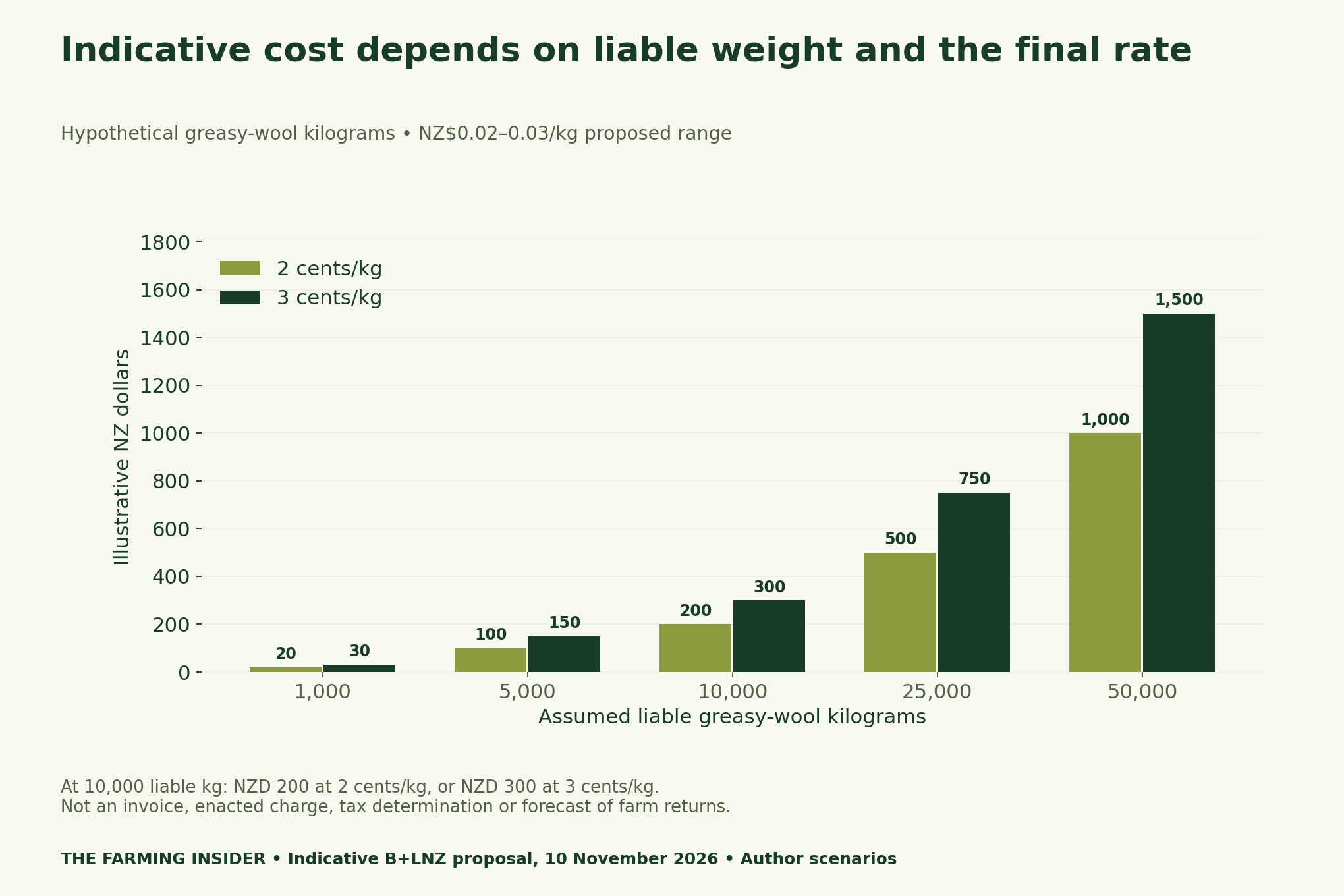
The calculation is quantity in liable greasy kilograms multiplied by the assumed rate in New Zealand dollars per kilogram. For the 10,000-kilogram example, 10,000 × 0.02 gives 200; using 0.03 gives 300. The units cancel to New Zealand dollars.
Do not enter clean-wool kilograms merely because a sales report displays them prominently. First confirm the proposal’s final weight basis and what falls within it. A correct multiplication using the wrong quantity still produces the wrong planning assumption.
Our downloadable scenario file retains weight, rate and result as separate columns. It also labels the figures as hypothetical. That allows a reader to change an input while preserving what the example does—and does not—claim.
Use sensitivity to expose assumptions
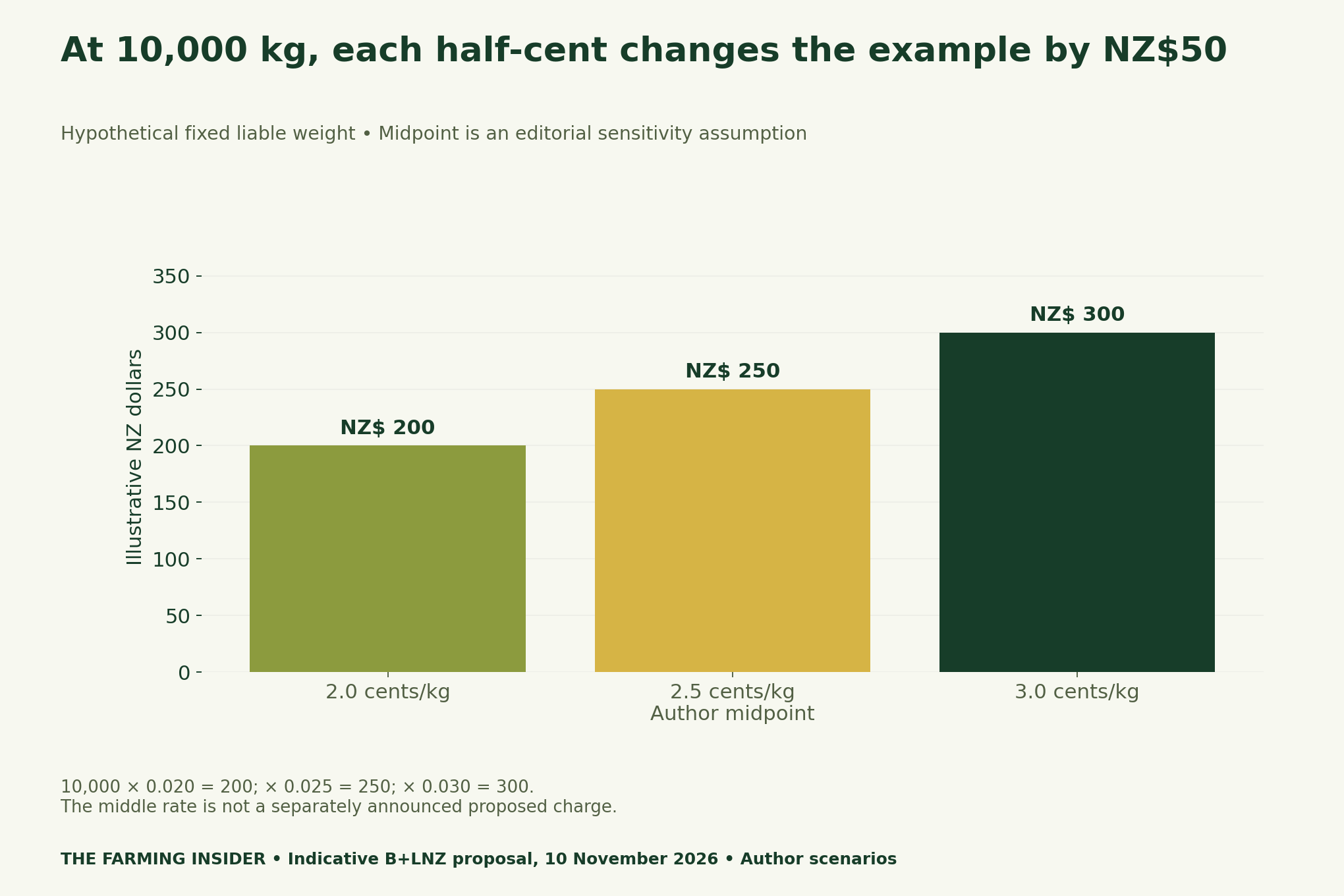
Holding weight fixed isolates the effect of the rate assumption. Here, each half-cent per kilogram changes the arithmetic by NZ$50. Holding the rate fixed and changing weight answers a different question. Keep those two exercises separate when discussing affordability.
The blank worksheet asks for the weight source, rate document, date and unresolved adjustments. It intentionally leaves unknown fields blank. A planning example should not quietly decide collection timing, tax treatment or other terms that the final documents have not established.
Proposal, vote and collection are different stages
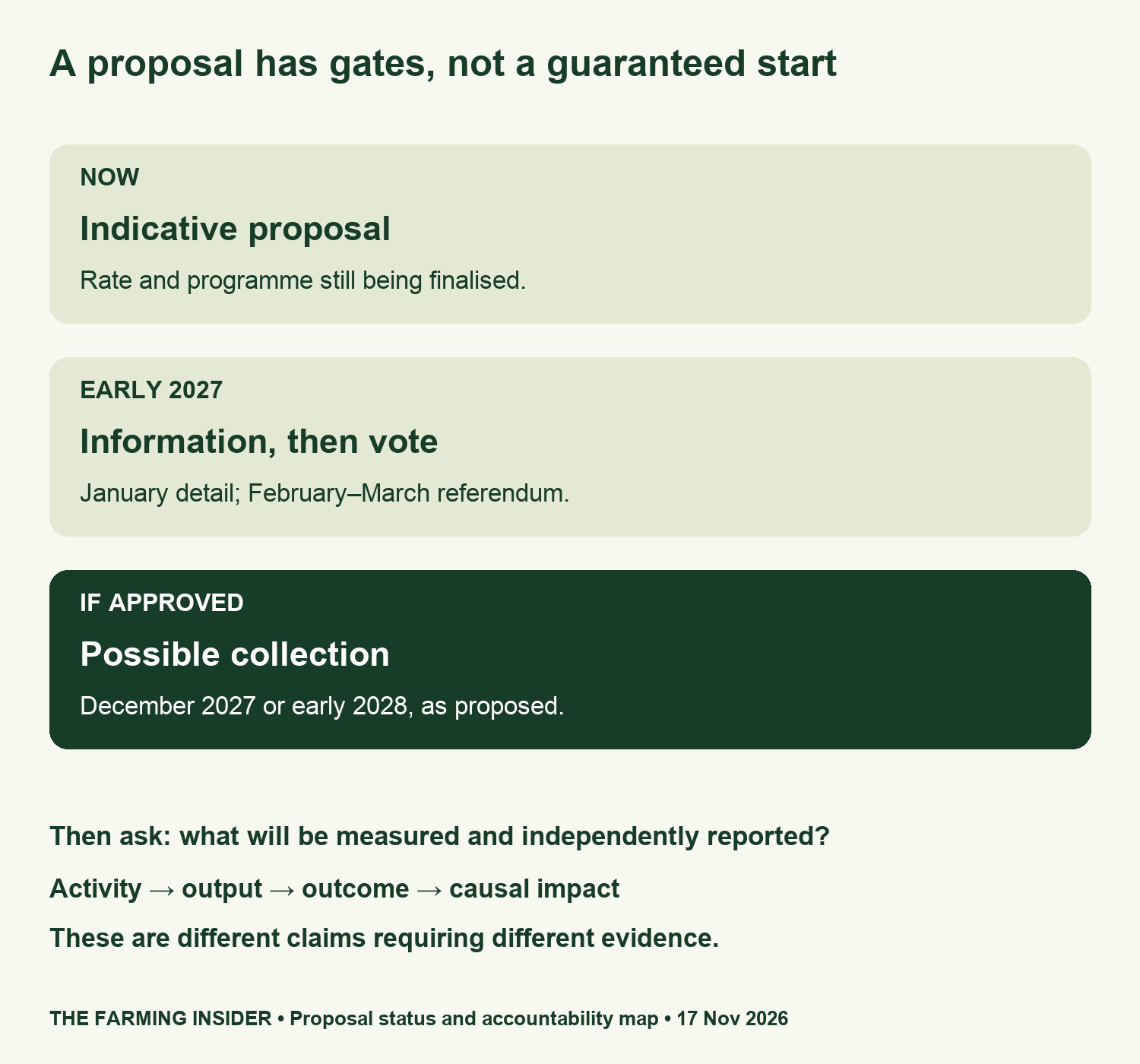
B+LNZ indicates fuller information from mid-January, ahead of the referendum. Its announcement places possible collection in December 2027 or early 2028, if approved. Treat those dates as proposed stages, rather than collapsing them into a statement that growers already owe a charge.
Keep a dated status register when the final information arrives. Record which terms changed and which remain unsettled. This gives the later calculation a traceable basis instead of leaving a provisional range permanently embedded in a budget.
Ask what success would mean
A programme can deliver activity without demonstrating an outcome. For example, holding a training session is an activity; documented completion is an output. A defined change in practice or market access is a different claim. Attributing higher farmgate returns requires stronger evidence still.
Our scorecard separates those levels and leaves space for a baseline, target, reporting date and independent check. The examples are questions for evaluating a future programme. They are not agreed targets, verified achievements or a guarantee that the proposed spending will pay for itself.
A useful reporting plan states who measures an outcome, which denominator is used and what could explain a change besides the programme. Without those details, an attractive before-and-after chart may confuse market conditions with programme impact.
Read proponent claims as claims to examine
B+LNZ is involved in advancing the proposal. Its expected benefits and administrative-efficiency arguments therefore deserve attribution and scrutiny. A government welcome is also a statement of support, rather than an independent evaluation of the eventual programme’s results.
Ask about administration, co-funding conditions, rate variation, delivery milestones and reporting. Distinguish a commitment to fund a team from evidence of incremental grower benefit. The unresolved-terms register helps retain questions without supplying invented answers.
Method, limits and four CSV tools
We checked the two primary announcements on 17 November 2026 and calculated the scenario table from five hypothetical weights. Two cost charts show endpoint and midpoint sensitivity. The infographic separates conditional stages and levels of evidence. No survey, grower invoice or programme-impact study was performed.
Transform Your Agribusiness
Unlock your farm's potential with expert advice tailored to your needs. Get actionable steps that drive real results.
Get StartedThis article makes no voting recommendation, tax determination or forecast of wool prices. For a parallel example of separating a benchmark from a farm result, see our dairy forecast and milk-statement analysis.
- Hypothetical greasy-wool levy cost scenarios (CSV)
- Blank liable-weight and rate worksheet (CSV)
- Unresolved collection and programme questions (CSV)
- Blank programme accountability scorecard (CSV)
Suggested citation: The Farming Insider, “New Zealand Wool Levy Proposal: Calculate the Cost, Then Ask What Success Means”, 17 November 2026. Sources: B+LNZ proposal announcement and government response. Calculations and editorial tools by this publication.


