




Introduction to Smart Irrigation Technology
Smart irrigation technology optimizes water use for landscaping and agriculture.
Sensors, weather data, and automated controls adjust watering schedules.
Unlike traditional methods, these systems reduce unnecessary water use.
Moreover, smart irrigation systems respond dynamically to environmental conditions.
Companies like Evergreen Solutions and TerraWater Innovations develop these technologies.
Importance of Smart Irrigation in Land Development
Smart irrigation supports sustainable land development projects.
It improves water efficiency and reduces pressure on local water supplies.
Consequently, developers can better meet environmental regulations and green building standards.
Additionally, precise watering supports healthier plants.
Soil and weather data guide each watering decision.
Landscaper Michael Reynolds reports lower maintenance costs and water bills.
Environmental Benefits of Smart Irrigation
Smart irrigation technology significantly reduces water waste.
Furthermore, accurate watering volumes minimize runoff and soil erosion.
This control also reduces pollution risks from fertilizers and pesticides.
Healthier plants can increase carbon sequestration and support climate benefits.
Transform Your Agribusiness
Unlock your farm's potential with expert advice tailored to your needs. Get actionable steps that drive real results.
Get StartedEnvironmental scientist Dr. Elena Martinez connects these systems with global sustainability goals.
Economic Advantages for Developers and Communities
Smart irrigation lowers long-term operating costs for land developers.
Reduced water consumption immediately lowers utility expenses.
Moreover, these systems extend landscaping and crop lifespans.
That durability can improve property value.
Community managers report greater satisfaction with healthy, vibrant green spaces.
Developer Lucas Bennett says smart irrigation attracts eco-conscious investors and homeowners.
Integration with Modern Land Development Practices
Smart irrigation integrates with smart city and green building technologies.
For instance, it operates alongside solar-powered pumps and IoT monitoring platforms.
This integration supports real-time decisions and predictive maintenance.
Design firms such as GreenScape Innovations prioritize smart irrigation during master planning.
As a result, land development becomes more resilient and adaptive.
It also becomes more environmentally responsible.
Overview of Sustainable Land Development and Its Key Principles
Sustainable land development balances environmental, social, and economic needs.
It promotes responsible land use that supports community well-being.
Moreover, it connects conservation efforts with practical development objectives.
This approach reduces negative environmental impacts while supporting long-term resource protection.
Core Principles Guiding Sustainable Land Development
Several principles guide decisions about sustainable land development.
These principles connect environmental protection with responsible economic and social planning.
Together, they help communities manage land resources for present and future needs.
Environmental Stewardship
Environmental stewardship prioritizes ecosystem protection and biodiversity conservation.
It encourages communities to reduce pollution and conserve water and soil.
Additionally, it supports habitat restoration to maintain natural balance.
Efficient Resource Management
Efficient resource management uses land, water, and energy wisely.
Showcase Your Farming Business
Publish your professional farming services profile on our blog for a one-time fee of $200 and reach a dedicated audience of farmers and agribusiness owners.
Publish Your ProfileConsequently, it reduces waste and limits resource depletion.
It also supports renewable energy and sustainable water use strategies.
Community Engagement and Social Equity
Community engagement includes local voices in planning and decision-making.
It promotes social equity by addressing diverse community needs.
Furthermore, collaboration helps communities pursue shared development goals.
Economic Viability
Sustainable land development supports economic growth without sacrificing natural resources.
It encourages investments that deliver long-term benefits.
Moreover, green technologies can improve productivity while supporting sustainability.
Goals of Sustainable Land Development
Sustainable land development establishes clear goals for environmental protection and community well-being.
These goals guide decisions about habitats, soil, emissions, climate resilience, and public health.
Therefore, measurable priorities can connect development activities with long-term sustainability.
- Protect natural habitats and preserve biodiversity.
- Maintain soil fertility and prevent erosion.
- Minimize greenhouse gas emissions through efficient practices.
- Enhance resilience to climate change impacts.
- Support community health and well-being.
Role of Planning and Policy
Effective planning guides sustainable land use and development patterns.
Policies encourage environmentally friendly practices and responsible innovation.
Furthermore, regulations enforce standards that conserve natural resources.
Successful implementation requires ongoing monitoring and adaptive management.
How Smart Irrigation Technology Works
Smart irrigation combines sensors, automated controls, and data analytics.
These connected tools monitor conditions and guide precise water delivery.
Together, they support efficient irrigation and sustainable land management.
Sensors Monitoring Soil and Environmental Conditions
Smart irrigation systems begin with advanced sensors placed throughout the land.
These sensors continuously measure soil moisture, temperature, and nutrient levels.
They also track rainfall, humidity, and sunlight intensity.
Consequently, these measurements reveal the land’s current needs.
Engineers at GreenLeaf Technologies design these sensors for accuracy and durability.
Automation in Water Delivery Systems
Automation connects sensor data with irrigation valves and pumps.
Smart controllers adjust water flow according to real-time soil conditions.
As a result, automation prevents overwatering and significantly reduces water waste.
Moreover, the system responds immediately to sudden weather changes, including unexpected rain.
FarmTek Solutions uses automated scheduling to optimize irrigation times for different crops.
Data Analytics Driving Efficient Irrigation
Collected data travels to cloud-based platforms for comprehensive analysis.
Data scientists analyze patterns and predict future water requirements.
This information helps land managers and developers make informed decisions.
Additionally, machine learning algorithms refine irrigation practices over time.
Experts from AquaSmart Analytics develop tailored reports that strengthen sustainability efforts.
Integrated Technologies for Sustainable Land Use
Combining sensors, automation, and analytics creates an efficient irrigation network.
This integration minimizes water consumption without sacrificing crop health.
It also supports sustainable land development by preserving natural resources.
For example, Evergreen Growth Partners uses smart irrigation to meet environmental standards.
Therefore, smart irrigation technology supports sustainable land management today.
See Related Content: Sustainable Irrigation Methods for Preserving Agricultural Land Value
Benefits of Smart Irrigation in Conserving Water Resources
Smart irrigation conserves water by matching delivery to plant needs.
Showcase Your Farming Business
Publish your professional farming services profile on our blog for a one-time fee of $200 and reach a dedicated audience of farmers and agribusiness owners.
Publish Your ProfileIt limits waste from overwatering, runoff, and poor watering schedules.
These benefits support responsible development and protect valuable water resources.
Precision Water Management
Smart irrigation systems regulate water use according to real-time soil and weather data.
This technology prevents overwatering and conserves valuable water resources.
Additionally, adjusted watering schedules give plants the water they need.
Consequently, landscape developers reduce unnecessary water waste efficiently.
Reduction of Water Runoff and Waste
These systems use sensors to measure soil moisture levels accurately.
Therefore, irrigation stops when the soil contains adequate moisture.
This approach prevents runoff that could contaminate nearby water bodies.
As a result, smart irrigation protects ecosystems and preserves clean water supplies.
Adaptive Responses to Weather Changes
Smart controllers use weather forecasts to adjust irrigation timing automatically.
They delay watering during rain events and increase it during dry spells.
This adaptability reduces consumption while maintaining healthy plant growth.
Moreover, it helps developers follow local water restrictions and regulations.
Long-Term Environmental and Economic Impact
Smart irrigation lowers overall water demand in urban and rural developments.
This reduction preserves groundwater and surface water reserves for wider community use.
Environmentally, the technology reduces strain on natural water cycles and habitats.
Economically, GreenTech Landscapes can reduce expenses through lower water bills.
Supporting Sustainable Land Development Practices
Smart irrigation supports sustainable development goals centered on resource efficiency.
Landscape architects like Sophia Martinez advocate these systems to promote resilience.
Additionally, smart irrigation demonstrates responsible water stewardship.
Ultimately, this technology helps developers create thriving, sustainable environments.
Uncover the Details: Sustainable Irrigation Systems for Drought-Resistant Farming
Impact of Smart Irrigation on Crop Yield and Quality
Smart irrigation can influence both crop yield and produce quality through precise water management.
It also supports sustainable farming by linking irrigation decisions with crop needs and environmental conditions.
Together, these effects help farmers maintain productive fields under changing conditions.
Enhancement of Crop Yield Through Precise Water Management
Smart irrigation systems optimize water delivery according to crop needs.
They use soil moisture sensors to prevent overwatering and underwatering.
Consequently, crops receive ideal water amounts during key growth stages.
Farmers like Miguel Torres from VerdeAgri Farms report higher yields after adopting smart irrigation.
Moreover, automated irrigation reduces water stress and supports healthier plant growth.
Thus, smart irrigation enables consistent and increased crop production.
Improvement in Crop Quality with Technological Integration
Smart irrigation technology contributes to superior crop quality by maintaining optimal hydration.
This technology helps maintain uniform soil moisture across fields.
It enhances nutrient uptake, leading to better flavor and appearance in produce.
For example, Lakeside Orchards saw improved fruit size and sweetness using smart irrigation.
Additionally, this method reduces disease susceptibility caused by water imbalances.
Therefore, crops grow more while improving their marketable quality.
Environmental and Economic Benefits Supporting Sustainable Growth
Smart irrigation decreases water waste and conserves valuable agricultural resources.
Consequently, it lowers energy consumption associated with pumping water.
Showcase Your Farming Business
Publish your professional farming services profile on our blog for a one-time fee of $200 and reach a dedicated audience of farmers and agribusiness owners.
Publish Your ProfileFarmers like Emma Chen of GreenField Agro save money on water and electricity bills.
Also, improved yields translate into higher profits and stronger market competitiveness.
Furthermore, reducing excess water minimizes nutrient runoff and soil erosion.
Thus, smart irrigation supports sustainable land and crop management practices.
Adaptation to Climate Variability and Stress Conditions
Smart irrigation systems adjust watering schedules according to weather forecasts.
This responsiveness helps crops endure droughts and heatwaves more effectively.
Justin Ramirez, an agronomist with EcoGrow Systems, emphasizes its role in climate resilience.
Moreover, data-driven irrigation minimizes crop losses during unexpected dry spells.
It promotes stable yields even under fluctuating environmental conditions.
Therefore, this technology acts as a vital tool in sustainable agricultural practices.
Learn More: The Role of Sustainable Irrigation in Mitigating Climate Change
Water Savings at Greenfield Agricultural Cooperative
Greenfield Agricultural Cooperative adopted smart irrigation systems in 2021.
The cooperative used soil moisture sensors and weather-based controllers for precision watering.
Consequently, water usage fell by 35 percent during the first year.
Farm manager Lucas Martinez reported improved crop health alongside water conservation.
Additionally, these technologies reduced electricity costs associated with pumping water.
The cooperative’s success attracted neighboring farms considering similar upgrades.
Restoring Oakview Park with Smart Irrigation
Oakview Park implemented smart irrigation to rejuvenate its urban green spaces.
Parks director Emily Nguyen coordinated the installation of automated sprinkler systems.
These systems adjust watering schedules using real-time weather data.
As a result, the park reduced water waste during rainy seasons.
Moreover, turf quality and tree health improved noticeably over eighteen months.
Community members praised the lush appearance and fewer dry patches.
Landscape Development Efficiency at Sunrise Estates
Sunrise Estates incorporated smart irrigation into its new residential landscape design.
Developer Meridian Homes paired drip irrigation with smart controllers.
This combination minimized runoff and prevented common overwatering problems.
Landscape architect Carla Simmons emphasized the environmental benefits during project meetings.
Sunrise Estates demonstrated how sustainable landscaping can enhance property value.
Consequently, potential homebuyers showed greater interest in eco-friendly neighborhood features.
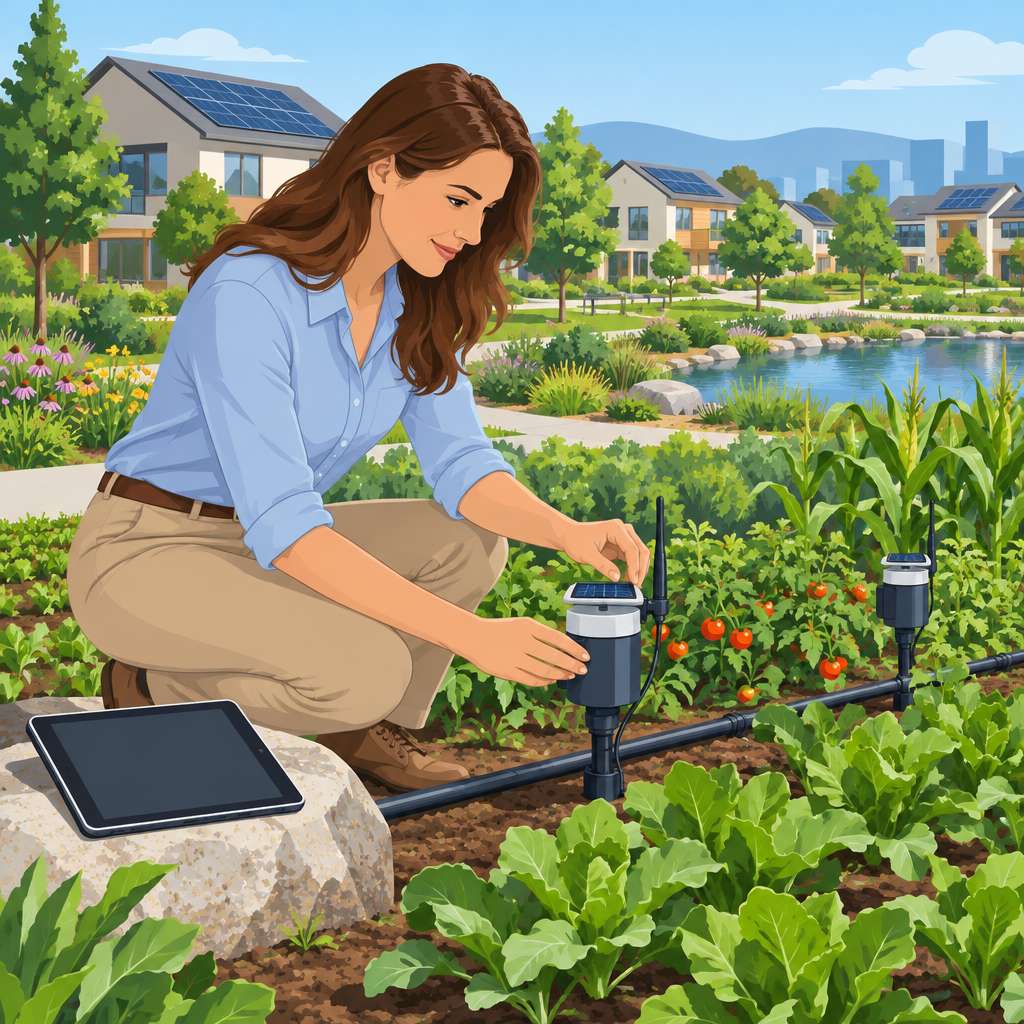
Vineyard Management Improvements at Sunnyvale Vineyard
Sunnyvale Vineyard integrated smart irrigation technology to optimize grape production.
Vineyard owner Antonio Ramirez used evapotranspiration data for targeted irrigation.
This practice improved water allocation across different vineyard blocks.
Consequently, grape quality and yield increased without additional water use.
The vineyard also reduced labor costs by automating irrigation scheduling.
Industry experts recognized the vineyard’s leadership in sustainable viticulture.
Shared Benefits Across Smart Irrigation Projects
- Significant reductions in overall water consumption
- Enhanced plant health through precise watering techniques
- Lower operational costs from energy and labor savings
- Improved community and stakeholder satisfaction
- Greater resilience against drought and weather uncertainties
These examples highlight smart irrigation’s role in sustainable land development.
They support responsible environmental and economic decision-making.
Furthermore, they demonstrate practical gains from adopting irrigation technology.
Delve into the Subject: Eco-Friendly Irrigation Solutions for Sustainable Farmland Management
Technical and Infrastructure Barriers
Smart irrigation systems often require reliable internet connectivity for effective operation.
Showcase Your Farming Business
Publish your professional farming services profile on our blog for a one-time fee of $200 and reach a dedicated audience of farmers and agribusiness owners.
Publish Your ProfileHowever, rural areas may experience limited or unstable network access.
This limitation can interrupt data transmission and control commands.
Furthermore, some irrigation hardware may not match existing infrastructure.
Upgrading equipment requires significant financial and time investments.
Consequently, small-scale farmers may struggle to adopt these systems.
Remote locations also make maintenance and technical support more difficult.
High Initial Costs and Economic Constraints
Smart irrigation solutions often require substantial initial investments.
Many land developers face budget constraints when implementing new systems.
Besides hardware, expenses include software licenses and installation fees.
Although users may save money over time, upfront expenses restrict adoption.
Additionally, unclear returns on investment may discourage potential users.
Financial incentives and subsidies remain limited in many regions.
Therefore, economic accessibility remains a significant limitation.
Data Accuracy and Environmental Variability
Smart irrigation depends heavily on accurate sensor data for effective operation.
Yet, sensor malfunctions or calibration errors can produce misleading information.
Environmental factors can also complicate consistent water application.
For example, soil types and microclimates vary across growing areas.
Moreover, unpredictable weather events can reduce forecasting reliability.
As a result, irrigation schedules may not match actual crop needs.
System algorithms need continuous refinement to manage diverse conditions.
Privacy and Data Security Concerns
Smart irrigation systems collect and transmit sensitive data over networks.
Unauthorized access to this information can threaten user privacy and security.
Cyberattacks against agricultural technology may disrupt water management operations.
Many developers still lack robust cybersecurity measures for internet-connected devices.
Consequently, weak protections can expose irrigation data to unauthorized users.
Therefore, data protection requires comprehensive security solutions.
Knowledge Gaps and User Adoption
Farmers and land developers often need training to operate smart systems.
Without proper education, users may misuse or underuse the technology.
Resistance to change can also slow adoption rates.
Meanwhile, support programs and outreach initiatives can help bridge this gap.
Local expertise should adapt solutions to cultural and regional contexts.
Building trust and confidence encourages broader acceptance and continued use.
Future Trends in Smart Irrigation Technology and Sustainability Initiatives
Future irrigation systems will connect intelligent controls with broader sustainability initiatives.
These developments will help farmers respond to changing conditions with greater precision.
Furthermore, collaboration and policy support can expand responsible adoption across agricultural communities.
Integration of Artificial Intelligence in Irrigation Systems
Artificial intelligence increasingly optimizes irrigation scheduling.
It continuously analyzes weather data, soil moisture, and crop needs.
Consequently, precise water application can reduce waste significantly.
Moreover, AI helps predict plant water requirements in advance.
Leading agritech firms, such as GreenStream Solutions, invest heavily in AI-enhanced irrigation.
Showcase Your Farming Business
Publish your professional farming services profile on our blog for a one-time fee of $200 and reach a dedicated audience of farmers and agribusiness owners.
Publish Your ProfileExpansion of IoT Connectivity for Real-Time Monitoring
Internet of Things devices enable constant monitoring across irrigation zones.
Connected sensors collect detailed data about soil and environmental conditions.
Meanwhile, farmers receive immediate alerts about system anomalies or water inefficiencies.
This connectivity supports proactive maintenance and timely decision-making.
Companies like TerraLink Innovations develop IoT platforms for smart irrigation.
Use of Renewable Energy to Power Irrigation Systems
Solar-powered irrigation pumps have become more economically viable and widespread.
This shift reduces reliance on fossil fuels and lowers operating costs.
Additionally, renewable power supports remote land development where grid access remains limited.
Farms can integrate sustainable energy sources with smart irrigation controls.
Energy-conscious enterprises, including SunFlow Agrotech, lead this sustainability effort.
Advancements in Data Analytics for Water Conservation
Advanced data analytics reveal patterns in water consumption and plant growth.
Decision-makers can optimize irrigation strategies using predictive insights.
This analytical approach promotes efficient water use throughout crop cycles.
It also supports compliance with increasingly strict environmental regulations.
Agri-data firms such as EcoWaters Analytics offer specialized conservation tools.
Collaboration Between Technology Innovators and Sustainability Advocates
Industry leaders partner with environmental organizations to promote sustainable practices.
Together, these groups develop guidelines for responsible smart irrigation adoption.
Such collaborations raise awareness about irrigation’s environmental benefits.
Furthermore, partnerships encourage scalable and eco-friendly irrigation solutions.
Examples include alliances like the WaterWise Initiative, led by Verdant Horizons Group.
Policy Support Encouraging Smart Irrigation Adoption
Governments implement incentives for water-efficient irrigation technologies.
Grants and subsidies reduce financial barriers for land developers and farmers.
Public agencies also promote education about best irrigation practices.
As a result, regulatory support accelerates sustainability goals nationwide.
Notably, the Sustainable Agriculture Council actively champions these initiatives.


