




Farm diesel costs in 2026 can change a custom-work quote by several dollars an acre. But a fuel-price increase should apply to the gallons used for the job, not automatically to the whole machinery bill. Our Illinois-based calculation adds about $3.00 an acre for corn combining when diesel rises from $3.00 to $5.76 per gallon.
This report gives you the formula, five charts and a copyable worksheet. Use it to check a proposed surcharge or update your own budget. Every amount below is in US dollars, gallons are US gallons, and the acreage examples are hypothetical.
Farm diesel costs: what the October report actually measures
The USDA Illinois Production Cost Report for the week ending October 16, 2026 lists No. 2 farm diesel at an average of $5.76 per gallon. The reported range is $5.39–$6.01, and the change column shows an increase of $0.13.
These are Illinois fuel-distributor asking prices on an F.O.B. basis. They are not a national average or a delivered invoice for your farm. The report does not state tax treatment. Therefore, use a comparable actual quote when you negotiate a job.
The University of Illinois analysis published October 20 explains how to adjust machinery costs for diesel. Its worked surcharge examples use $5.60 per gallon. Our calculations instead use the USDA report’s $5.76 benchmark and identify the inputs below.
Calculate a farm diesel surcharge in three steps
Additional diesel cost per acre = (new fuel price − fuel price already included) × gallons used per acre.
- Find the fuel price already included in the starting rate. Do not assume every contractor uses $3.00.
- Subtract that price from a comparable new price. Here, $5.76 − $3.00 = $2.76 per gallon.
- Multiply the difference by fuel use per acre. Then multiply by the acres covered by that operation.
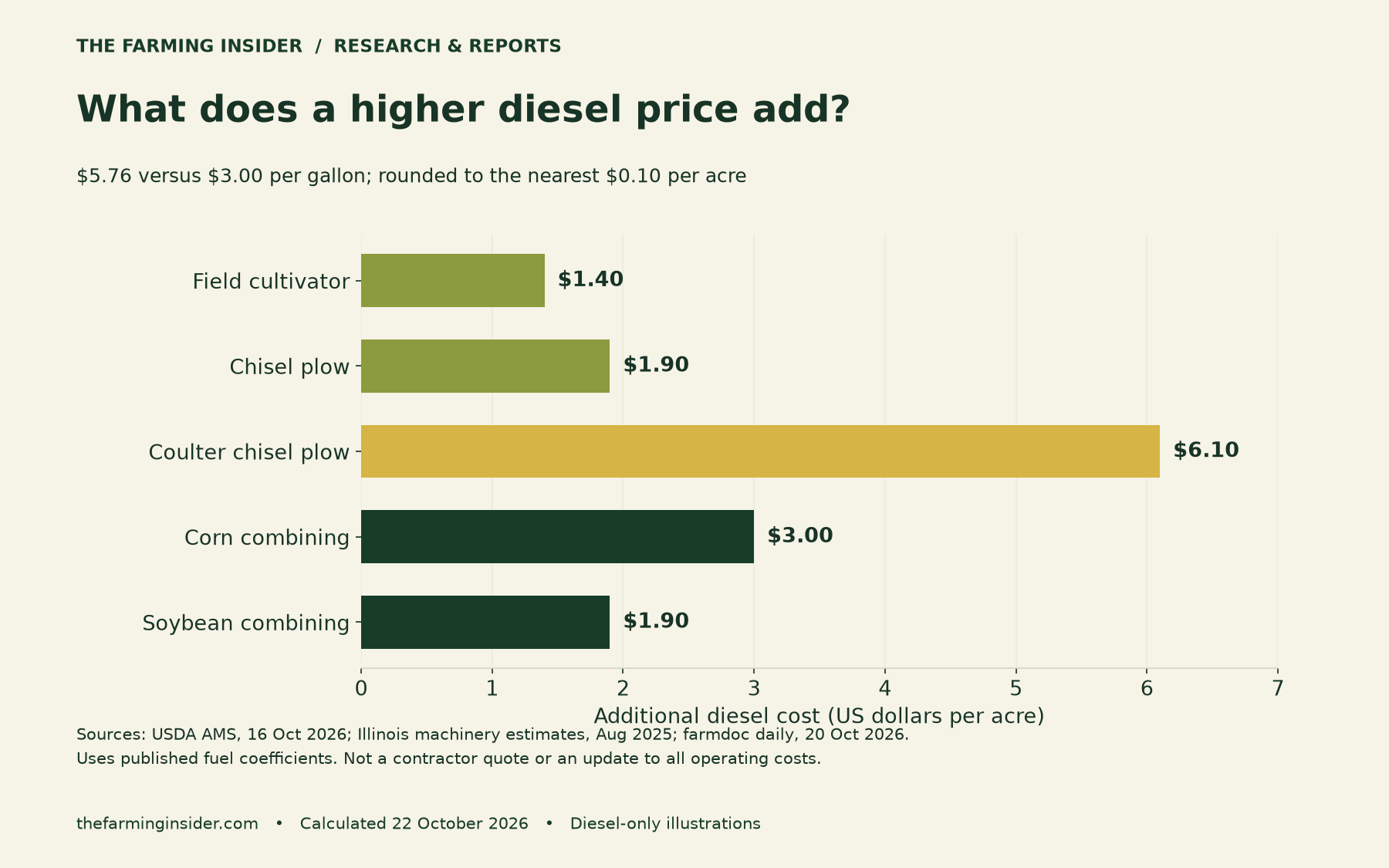
For corn combining, the published coefficient is 1.07 gallons per acre. Thus, $2.76 × 1.07 gives $2.9532 per acre. Rounded to the nearest ten cents, that is $3.00. For soybeans, 0.70 gallons per acre produces $1.932, or $1.90 after the same rounding.
Copyable operation table
| Operation | Gallons/acre | Exact extra $/acre | Rounded extra $/acre |
|---|---|---|---|
| Field cultivator | 0.50 | 1.3800 | 1.40 |
| Chisel plow | 0.70 | 1.9320 | 1.90 |
| Coulter chisel plow | 2.20 | 6.0720 | 6.10 |
| Corn combining | 1.07 | 2.9532 | 3.00 |
| Soybean combining | 0.70 | 1.9320 | 1.90 |
The first three fuel coefficients come from the Illinois machinery summary dated August 2025, Table 2. The combining coefficients come from the October 20 analysis. These are published estimates, not measurements of your machine.
Test several fuel prices before agreeing a rate
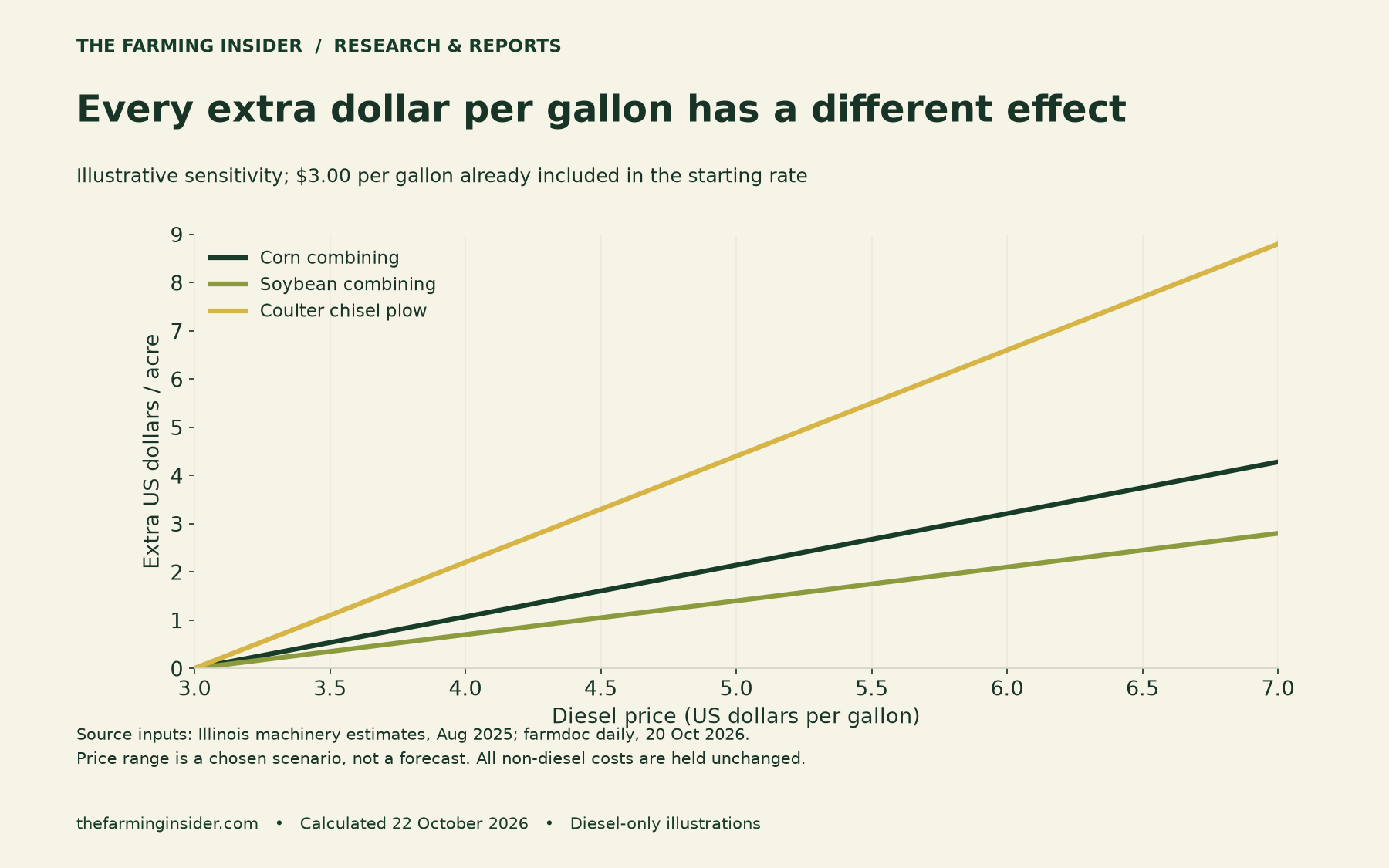
A sensitivity check shows how farm diesel costs change at different prices. Each additional dollar per gallon adds $1.07 per corn-combining acre at the chosen coefficient. It adds $0.70 per soybean-combining acre and $2.20 per coulter-chisel acre.
Consequently, a single flat surcharge across different jobs can conceal different fuel demands. Ask for the calculation behind it. Equally, do not choose a tillage system from fuel cost alone: soil conditions, field needs and the wider production plan still matter.
Why a 92% diesel rise does not justify a 92% bill rise
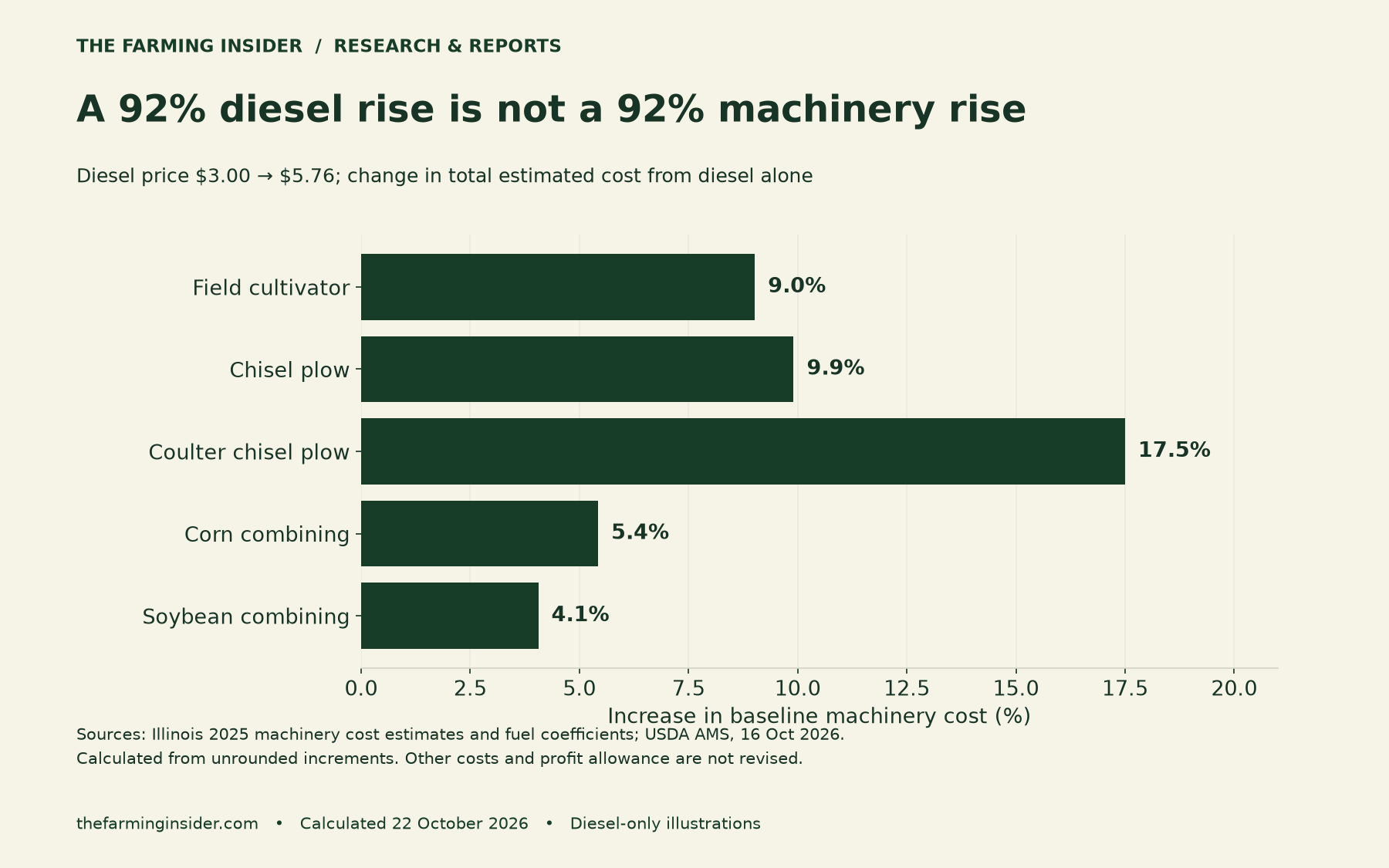
The move from $3.00 to $5.76 is a 92% increase in the fuel price. However, diesel is only one part of machinery cost. Applying that percentage to the entire bill would also increase costs that this calculation has not measured.
For example, the 2025 corn-combining estimate is $54.40 per acre. Adding the exact $2.9532 diesel increment brings the illustration to $57.3532. That is a 5.4% increase in the starting machinery estimate, with all other components held unchanged.
Using the rounded surcharge instead gives $57.40 per acre. Neither result is a market quote, a recommended selling price or a complete 2026 cost update. Labour, repairs, ownership and any profit allowance need their own review.
A 1,000-acre harvest example: where rounding matters
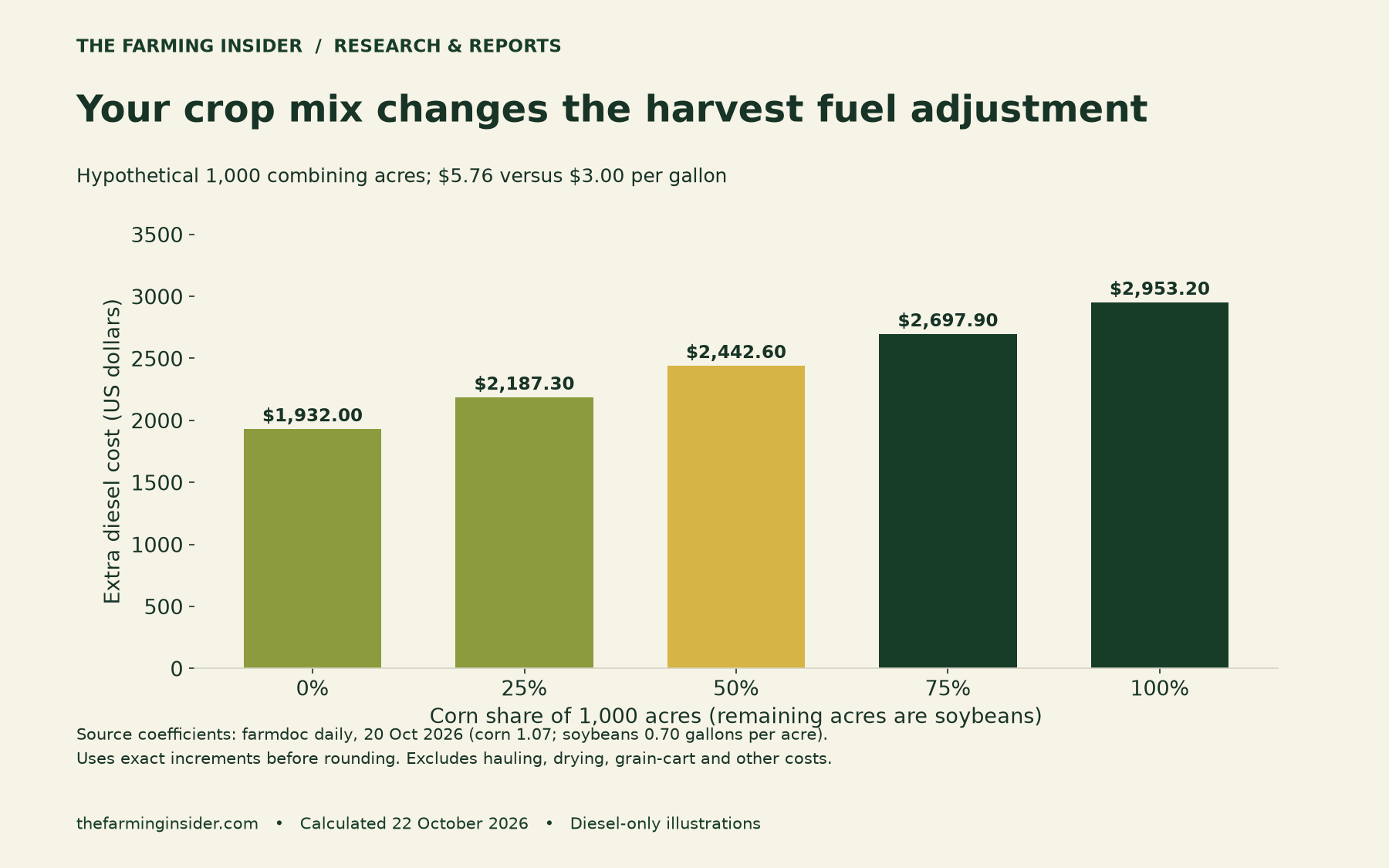
Consider a hypothetical job covering 500 acres of corn and 500 acres of soybeans. The unrounded corn increment totals $1,476.60. The soybean increment totals $966.00. Together, the additional diesel cost is $2,442.60.
If the agreement rounds each per-acre surcharge first, the same acreage gives $1,500 plus $950, or $2,450. The $7.40 difference is a rounding choice. Agree the method before billing, and use it consistently.
Transform Your Agribusiness
Unlock your farm's potential with expert advice tailored to your needs. Get actionable steps that drive real results.
Get StartedCrop mix also changes farm diesel costs. At these coefficients, shifting 250 of the same 1,000 acres from soybeans to corn adds $255.30 to the diesel adjustment. This comparison changes crop mix only; it does not estimate the cost of changing crops.
Replace the benchmark with your actual fuel quote
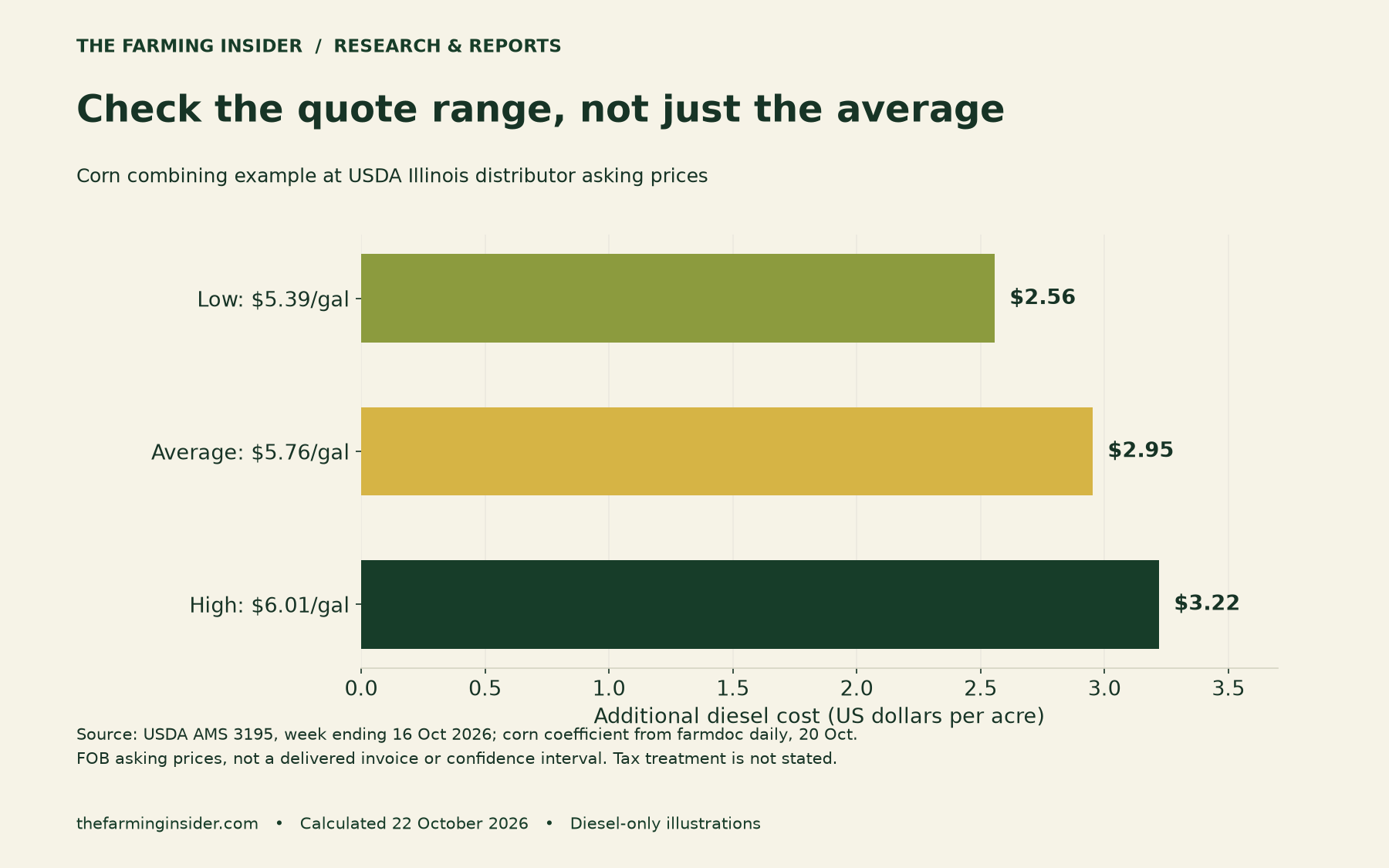
Even within the USDA report, the low and high asking prices give different results. For corn combining, they imply about $2.56–$3.22 extra per acre, shown to the nearest cent. The average price produces about $2.95 before ten-cent rounding.
This range is not a confidence interval. Nor does it guarantee that either price is available nearby. Compare delivery terms, quantities and tax treatment before replacing an invoice with a published benchmark.

Your farm diesel cost worksheet
Copy this layout into a notebook or spreadsheet. Keep one row per operation so you do not mix gallons per acre with gallons per hour.
| Input or result | Worked corn example | Your job |
|---|---|---|
| A. New price ($/gallon) | 5.76 | Enter comparable quote |
| B. Included price ($/gallon) | 3.00 | Check starting rate |
| C. Fuel use (gallons/acre) | 1.07 | Use suitable records |
| D. Acres | 500 | Enter job acreage |
| E. Extra $/acre = (A − B) × C | 2.9532 | Calculate before rounding |
| F. Extra total = E × D | 1,476.60 | Apply agreed rounding |
For example, if cells B2 through B5 contain A through D, enter =(B2-B3)*B4 in B6. Then enter =B6*B5 in B7. These formulas preserve the exact calculation before rounding. If you agree to round the rate to ten cents first, use =ROUND(B6,1)*B5 for the total instead.
If the new price is below the included price, the formula returns a negative adjustment. Discuss how the agreement handles that case. Do not silently convert it into a positive surcharge.
For the wider budget, our guide to financial analysis tools for farmers explains how to organise farm accounts. You can also review our overview of farming cost reduction for broader planning context.
Methodology, sources and limits
The Farming Insider calculated these scenarios on October 22, 2026. A saved copy of the dated USDA PDF preserves the evidence because its live URL may later show a newer release. Our farm diesel costs model uses its $5.76 average; the university article illustrates $5.60 instead.
The selected machinery estimates and fuel coefficients come from the linked primary sources. To calculate each adjustment, we multiplied the price difference by the coefficient. Results show exact arithmetic where useful, while the headline surcharge table rounds to the nearest $0.10. The chart of machinery-cost percentages uses unrounded increments.
Some examples in the October analysis do not reproduce exactly from the older rounded coefficients. Our table follows the stated inputs above; it does not claim to replicate every published example. The calculations also hold fuel use constant when price changes.
These scenarios exclude changes in lubricants, labour, repairs, ownership costs, transport, drying and profit. Actual fuel use varies with machinery and working conditions. Use your own records and agreed job terms when available. This report is a transparent budgeting illustration, not a contractor-rate survey.