




The SFIS letter of offer deadline for Northern Ireland’s first October batch is 5 November 2026, according to DAERA’s 22 October reminder. If you received separate offers for low emission slurry spreading equipment (LESSE) and other equipment, one acceptance does not cover both. Check each letter and preserve each decision’s evidence.
Checked on 29 October 2026, this guide combines the official dates with five figures and four downloadable CSV tools. The registers are editorial recordkeeping aids. They do not assess your eligibility, accept an offer or predict a payment date. Round 1 is closed to new applications; this is a guide for existing applicants and offer holders.
Which SFIS letter of offer deadline applies?
DAERA’s official deadline announcement links the first £15 million of offers to an 8 October issue date and a 28-day acceptance window. Unaccepted offers expire. The amount describes offers, not money already paid to farms. Check your own letter rather than applying this batch’s date to an unrelated offer.
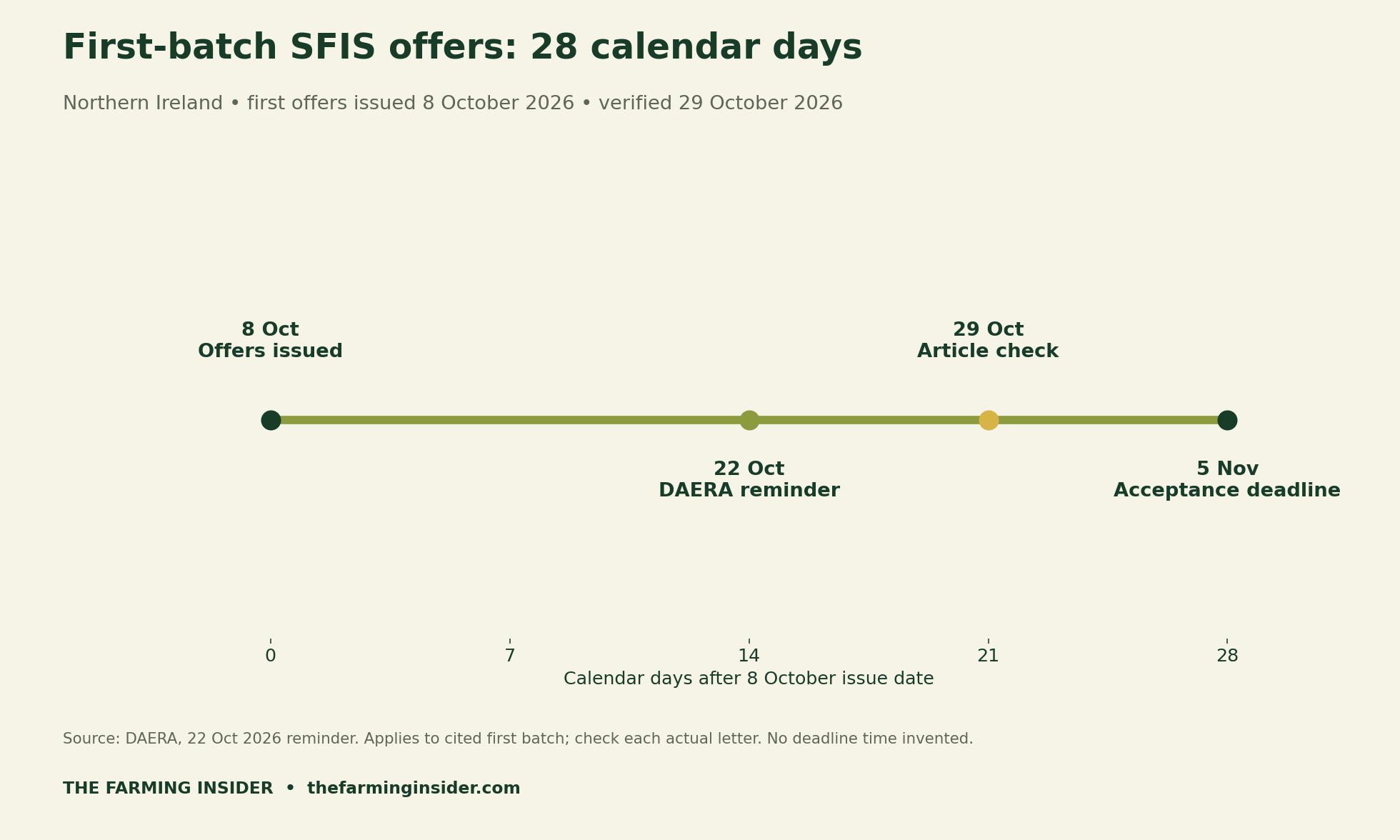
The date difference is reproducible: 5 November minus 8 October equals 28 calendar days. Our timeline uses elapsed days from the issue date, not a live countdown. After the deadline, this dated first-batch reminder should be treated as historical; the underlying document-control method can still support later offers.
Give each offer its own acceptance record
The current scheme hub explains the separate LESSE and non-LESSE dashboards. Letters appear under Documents, with decisions made through Actions. If proceeding with both offers, handle them separately. Use the official portal linked from that hub, and retain the confirmation associated with each reference.
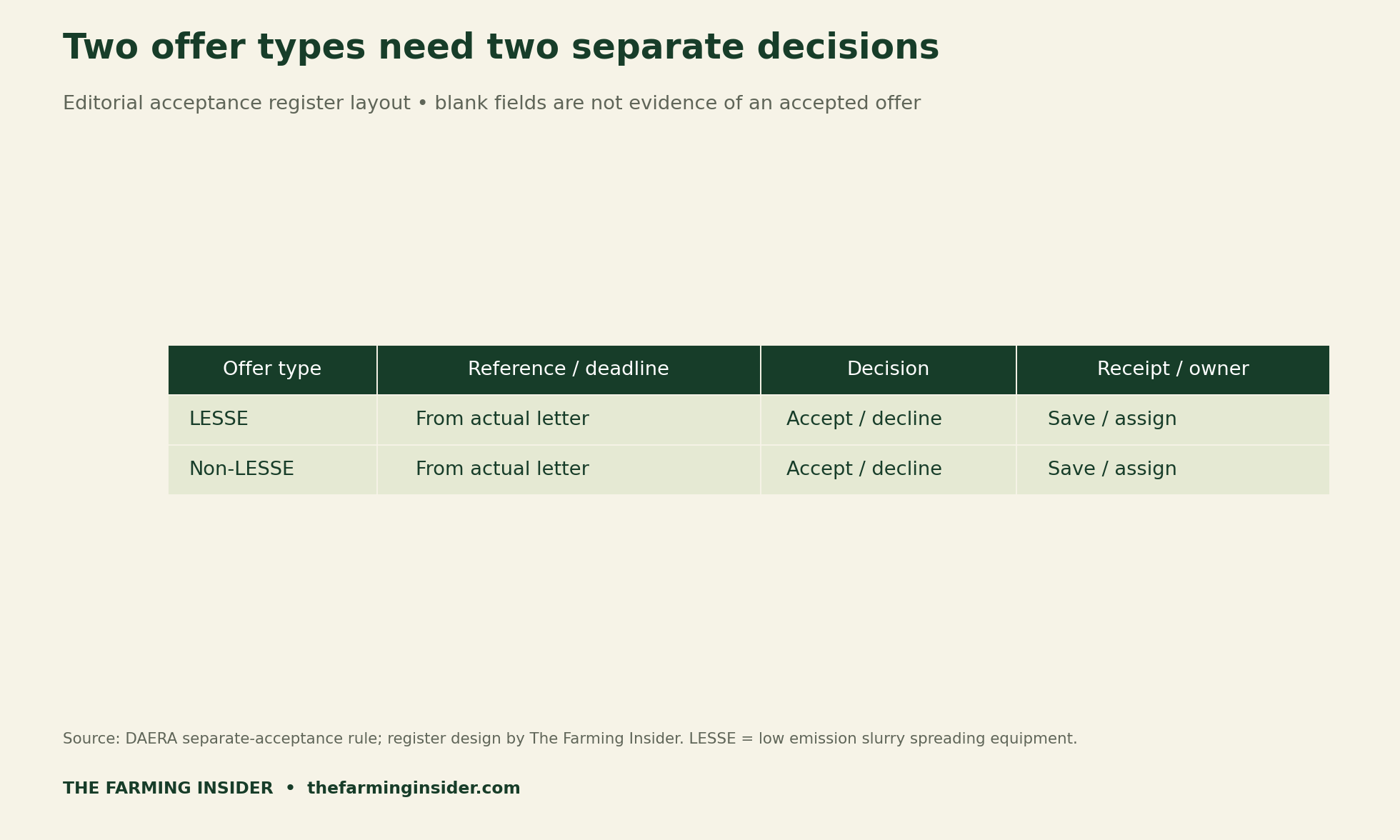
Start one row per letter. Copy the reference exactly, record the deadline printed in that document and assign a responsible person. Leave missing information blank and flag it for follow-up. A file name such as “grant accepted” is weak evidence if nobody can connect it to the correct reference and portal receipt.
When another person checks the record, they should be able to locate the letter and confirmation without relying on memory. Keep a stable folder for each reference and a separate place for unresolved questions. If you decide not to proceed, record that decision clearly instead of leaving an ambiguous blank that another person might mistake for unfinished administration.
Separate application, offer, acceptance and payment
The reminder distinguishes Application Submitted, where the outcome remains unconfirmed, from Letter of Offer Issued. Our status checklist adds separate evidence fields for acceptance and payment. Do not mark a submitted application as approved or an accepted offer as cash received. Each label should describe what the documents actually establish.
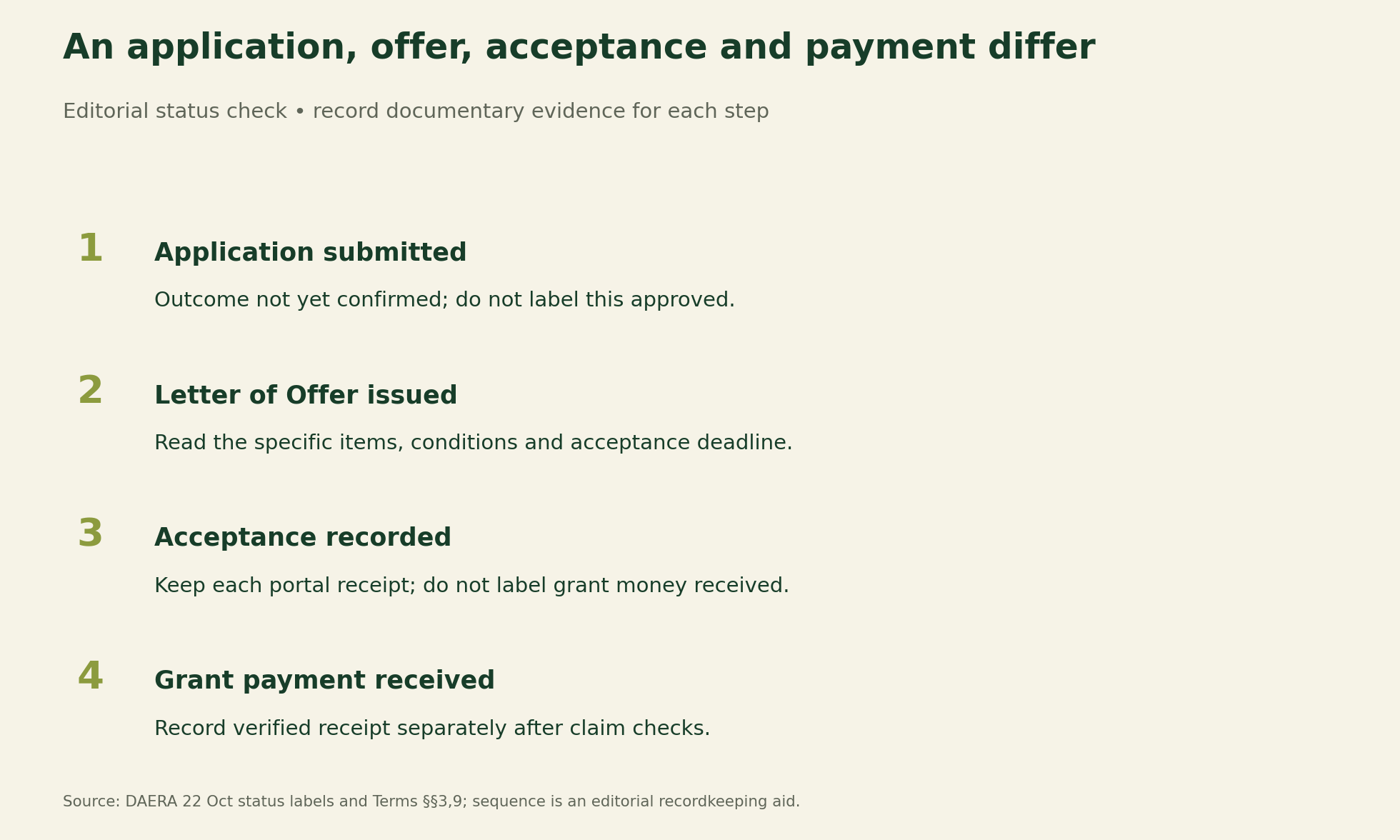
This distinction helps a farm discuss its position with advisers and suppliers. For example, an equipment quotation and an offer letter answer different questions. Neither replaces proof of payment. Preserve the original document when its status changes, so the record shows both the earlier position and the later evidence.
Review purchase dates before committing cash
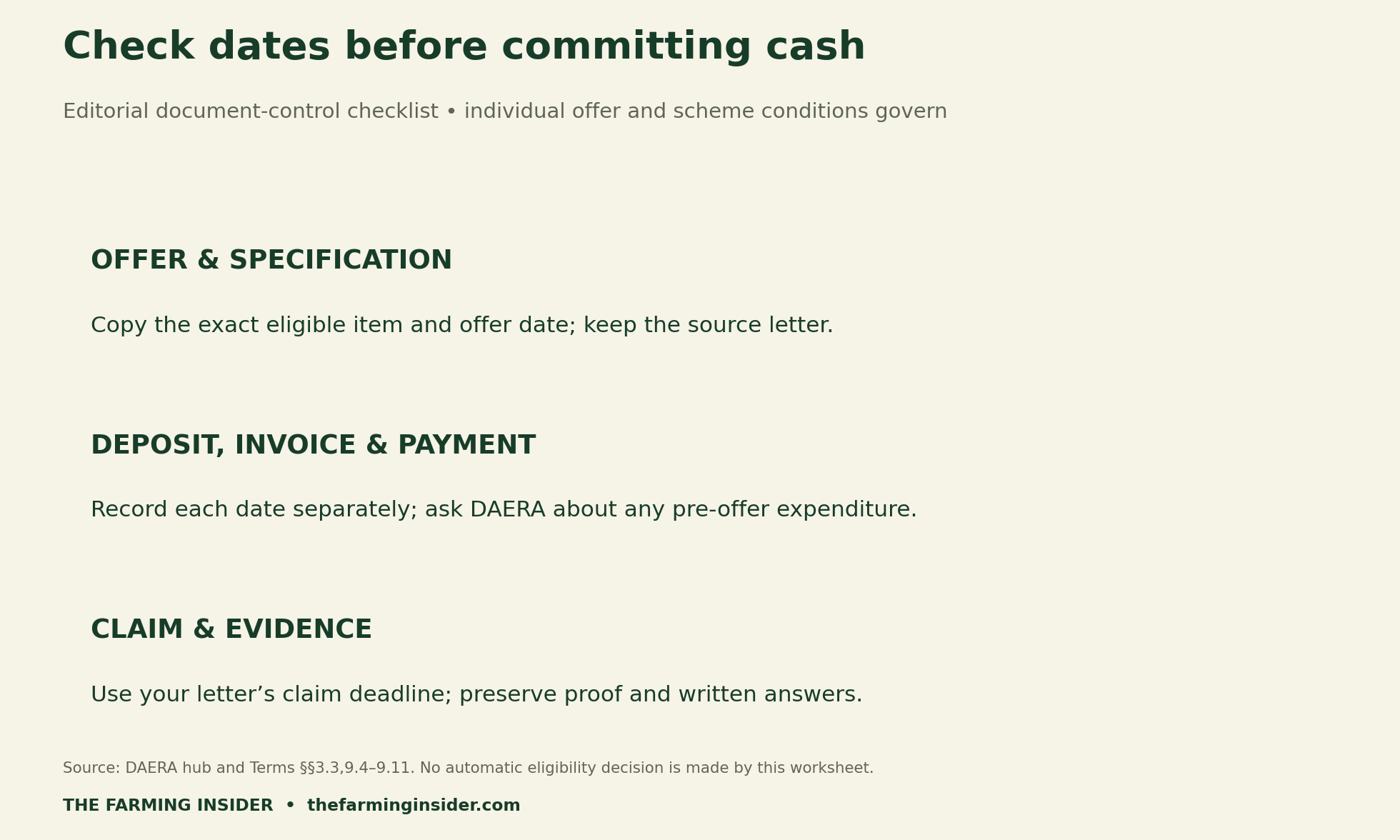
DAERA’s hub says purchases before the offer date are not grant-payable. It also warns that a pre-offer deposit or invoice causes the full item amount to be deducted from a claim. The Round 1 terms, clause 9.4, describe possible whole-item or project ineligibility. Ask DAERA about any uncertain expenditure before relying on support.
The commitment register keeps offer, deposit, invoice and payment dates in different columns. It also retains the item’s exact approved description, quoted cost, offer-specific grant amount and written replies. Copy the relevant wording rather than reducing an unfamiliar condition to a yes/no tick. This worksheet does not make an eligibility decision.
Distinguish purchase cash from eventual net cost
Under clauses 9.5 and 9.9–9.11, items must be fully paid, payment cleared and equipment ready for use before a claim; DAERA then checks the claim before payment. The claim deadline comes from the individual letter under clause 3.3. Those requirements do not supply a guaranteed date when money reaches your account.
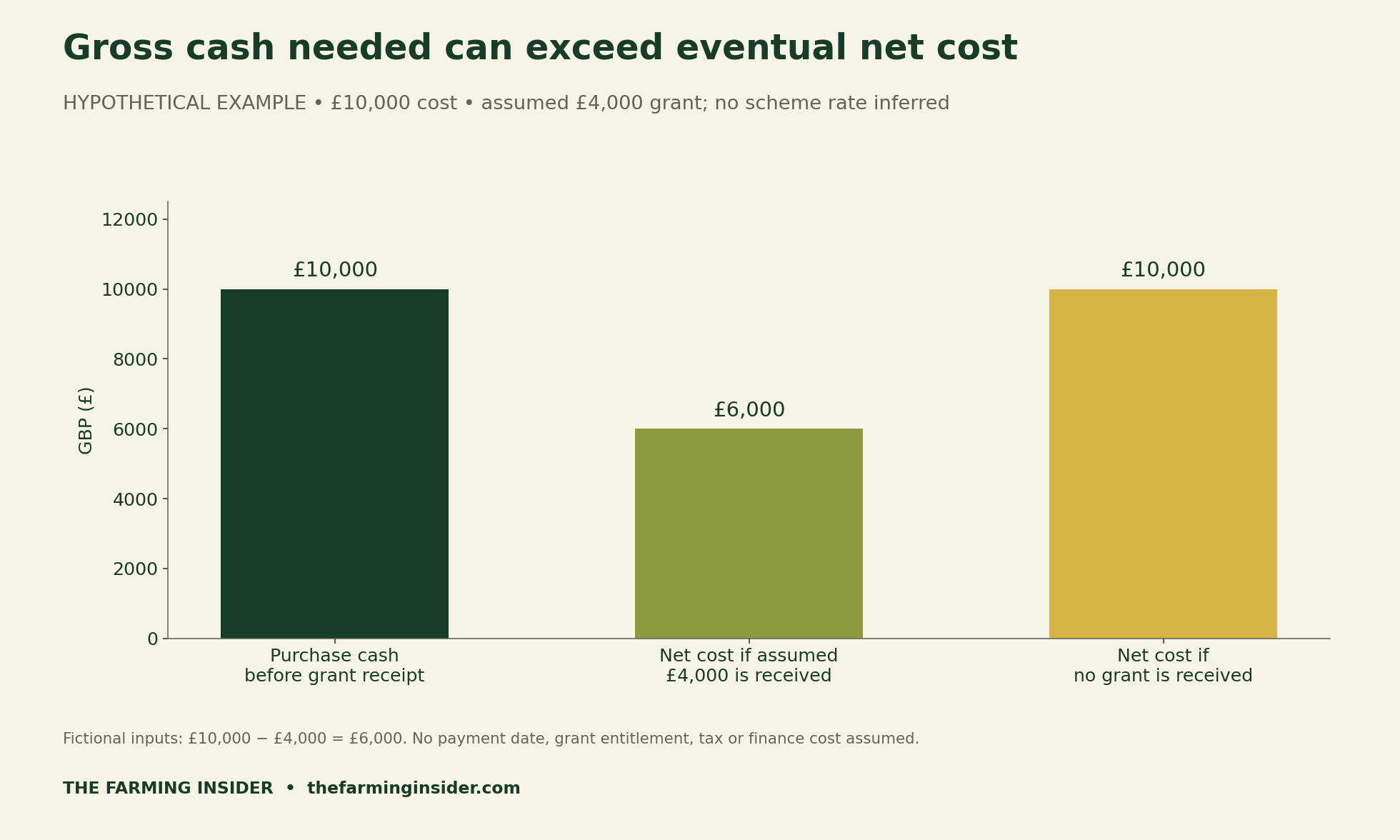
Suppose a fictional purchase costs £10,000 and a separately assumed grant receipt is £4,000. The purchase still requires £10,000 before that receipt. Eventual net cost would be £6,000 if the assumed amount arrives, or £10,000 if none arrives. The calculation excludes borrowing, taxes, VAT recovery and other costs; it does not establish affordability.
For a real worksheet, use the actual quote and letter rather than copying those invented inputs. Record when supplier payments fall due and keep the grant-receipt date unknown until verified. Discuss a cash gap using your business’s records. A useful register exposes uncertainty instead of replacing it with an optimistic reimbursement date.
Preserve the evidence and unresolved questions

Before closing a file, check whether every important entry points to evidence. Keep the person responsible and next action beside unanswered questions. The official SFIS contact page provides the current route for scheme queries. This article does not submit or sign anything on a reader’s behalf.
Transform Your Agribusiness
Unlock your farm's potential with expert advice tailored to your needs. Get actionable steps that drive real results.
Get StartedThe same audit habit appears in our corn forecast version-control report and orchard estimate validation guide: preserve inputs, keep changes visible and separate evidence from assumptions. Those examples concern different subjects and do not determine grant eligibility.
Download the timeline and blank registers
- First-batch deadline timeline and source (CSV)
- Blank LESSE and non-LESSE acceptance register (CSV)
- Blank item and cash-commitment register (CSV)
- Hypothetical cash examples and assumptions (CSV)
Methods, limitations and citation
The Farming Insider checked the linked DAERA announcement, scheme hub, contact page and 10 July 2026 terms on 29 October. We reconciled the 28-day interval and the fictional cash arithmetic. The official guide PDF linked from its landing page returned an error. We therefore publish no unverified grant rate, cap, universal claim deadline or payment timetable.
No applicant files were reviewed and no legal or individual eligibility assessment was performed. Blank registers contain no private farm data. Suggested citation: The Farming Insider (29 October 2026), SFIS Letter of Offer Deadline: Two-Letter Checklist for November 2026. Cite DAERA for scheme rules and identify our figures and registers as editorial aids.


