




Zespri grower returns 2026 look different when the unit changes. In November’s forecast, RubyRed has a higher return per tray than SunGold, while SunGold has a higher return per hectare. A grower comparing the headline figures needs both units—and a separate record of their own costs and payment timing.
The issuer’s 18 November media statement and Canopy forecast table cover the 2026 New Zealand season. We compare selected point forecasts, calculate the unit differences and track Green’s August-to-November revision. Two multi-panel charts, a three-layer infographic and four CSV tools preserve the distinction between a forecast, an orchard calculation and money received.
Zespri grower returns 2026: compare like units
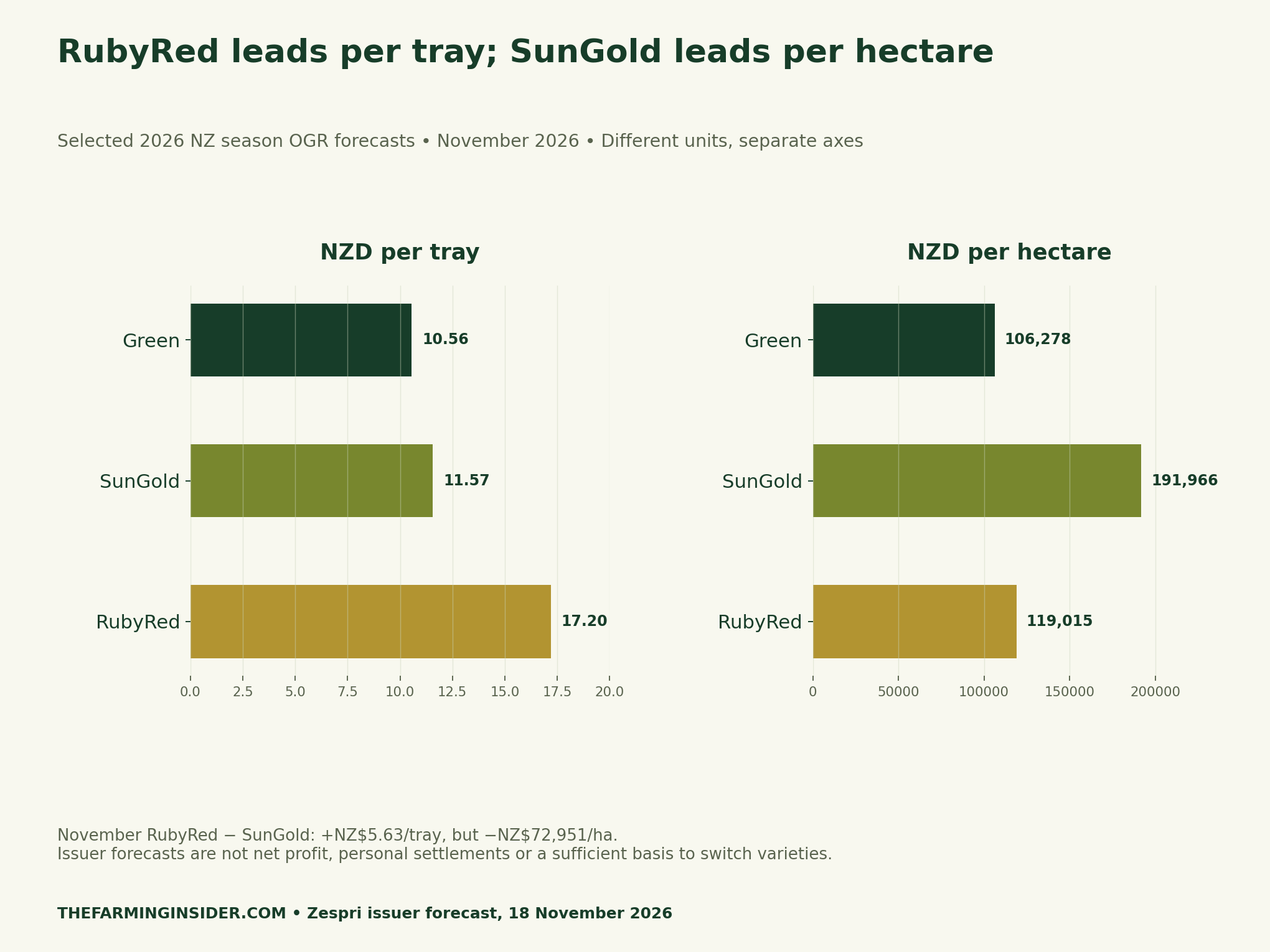
RubyRed’s published November figure is NZ$17.20 per tray, compared with SunGold’s NZ$11.57. The difference is NZ$5.63 per tray. However, their per-hectare forecasts are NZ$119,015 and NZ$191,966 respectively. RubyRed is therefore NZ$72,951 lower on that published area-based measure. The order reverses when the unit changes.
That reversal is the useful finding. A tray-based figure describes one denominator; an area-based figure describes another. Neither should be inserted into a comparison labelled simply “returns” without the unit. Use separate columns, chart panels and headings so a reader can see which question each number answers.
| Selected category | November NZ$/tray | November NZ$/ha |
|---|---|---|
| Green | 10.56 | 106,278 |
| SunGold | 11.57 | 191,966 |
| RubyRed | 17.20 | 119,015 |
Zespri grower returns 2026: read a revision as a revision
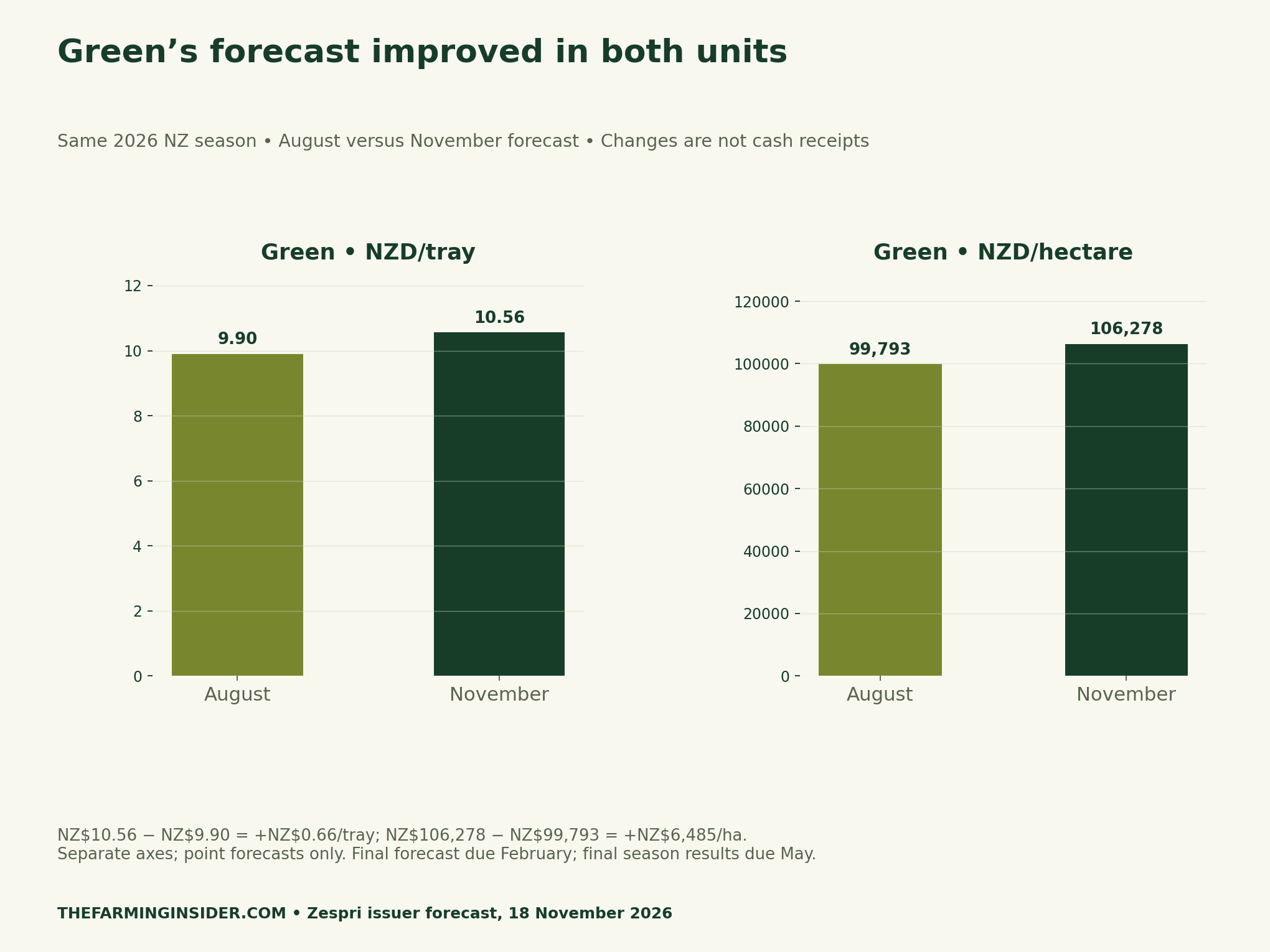
Green moves from NZ$9.90 to NZ$10.56 per tray between the August and November forecasts. The arithmetic change is NZ$0.66 per tray. On the per-hectare measure, NZ$106,278 minus NZ$99,793 gives NZ$6,485. Keep the forecast issue dates with both calculations; do not relabel them as growth in actual receipts.
A later forecast for the same season is different from a comparison of final results across seasons. It updates an expectation rather than measuring a completed change in one grower’s bank account. The statement says the final forecast is due in February and final season results in May. An individual payment schedule still needs its own source.
Keep orchard gate return separate from net profit
The release labels its measure OGR, or orchard gate return. We do not treat it as a grower’s net profit. Before using it in a business calculation, establish which costs, adjustments and volumes the chosen metric includes. Then identify the costs outside that metric in the orchard’s own records. A familiar currency symbol does not make two accounting measures interchangeable.
For a comparison between varieties, add the relevant area definition, establishment or licensing commitments, capital needs and timing from appropriate records. None of those have been assessed in this article. The difference between two forecast columns cannot settle whether changing a variety makes sense for a particular orchard.
Do not back-calculate an exact physical yield
Dividing a published per-hectare forecast by a per-tray forecast produces a numerical ratio. It does not automatically establish an orchard’s exact physical yield. That interpretation would require compatible aggregation, area and return definitions. The report supplies no such orchard-level reconciliation, so our charts do not label a derived ratio as observed trays per hectare.
Use the blank worksheet to record the orchard’s own eligible trays and producing area, including their definitions. If a future calculation multiplies a return assumption by a volume, label it as a separate scenario and retain the assumption’s source. Do not present that multiplication as the issuer’s per-hectare methodology or as a guaranteed settlement.
Keep the assumptions visible in a grower discussion
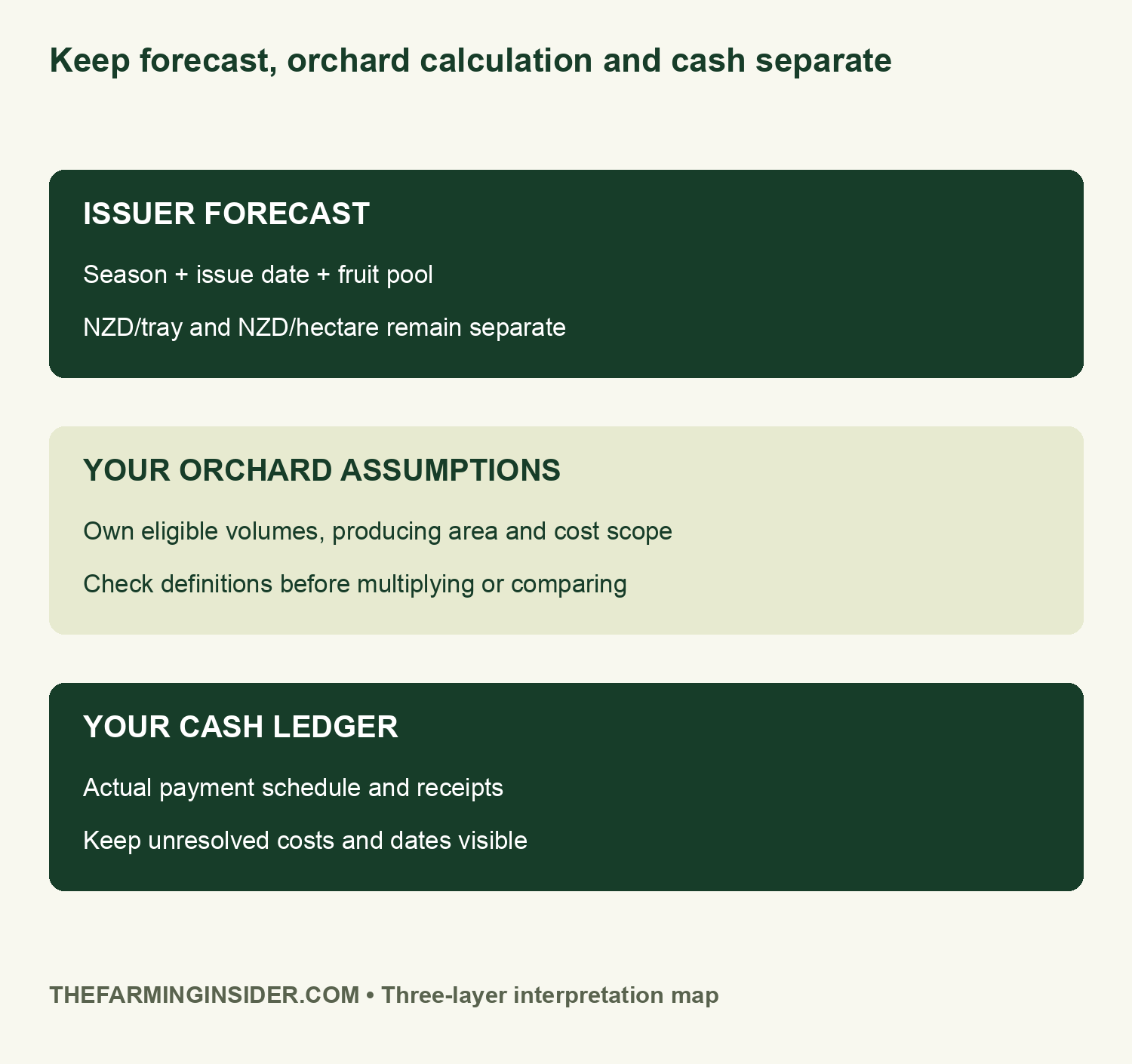
Begin with the fruit category, season and forecast issue date. Next record the unit and the exact measure used. Put volume and area evidence in different fields, then identify unresolved costs and payment dates. This creates a useful agenda for an adviser or the relevant business contact without pretending that the public release assessed the orchard.
Our file also separates expected timing from actual receipts. Record a payment when it occurs, with its statement or other appropriate evidence, rather than using a forecast revision as a receipt. Keeping those ledgers separate makes a later reconciliation easier and reduces the risk of counting the same expectation as cash twice.
Methods, limitations and downloadable working files
We transcribed selected Green, SunGold and RubyRed point forecasts, checked them against the issuer’s original table image and calculated simple differences within each unit. The two chart panels use a consistent category order and independent axes. No exchange-rate conversion, volume forecast, investment return or individual orchard assessment has been added.
Some displayed indicative ranges contain formatting irregularities. We omit all ranges and use verified point figures only; we do not repair a missing digit by guesswork. These selected categories are not the issuer’s full fruit-pool list. The CSV retains the exact columns used so another reader can reproduce each difference.
Read related Agribusiness Strategies coverage and our Research & Reports archive. When final results appear, compare measures on matching definitions and retain this November version as a forecast snapshot. Do not silently overwrite it with later realised figures.
Transform Your Agribusiness
Unlock your farm's potential with expert advice tailored to your needs. Get actionable steps that drive real results.
Get Started- Selected issuer point forecasts and dates (CSV)
- Unit comparisons and Green forecast revisions (CSV)
- Blank orchard assumption and cash-source worksheet (CSV)
- Forecast, method and cash dictionary (CSV)
Sources: Zespri, media statement, 18 November 2026, and Canopy November OGR forecast table. Original charts and differences use selected point forecasts only. Suggested citation: The Farming Insider, “Zespri Grower Returns 2026: Per Tray Is Not Per Hectare”, 21 November 2026. This report is an interpretation and reproducibility guide, not orchard-specific financial advice.


