




The Australia kiwifruit import review is at the draft consultation stage, not the end of an approval process. Australian growers and advisers can examine the proposed pest controls now. However, a draft report cannot be used as permission to import fruit or as proof that a pathway carries no risk.
This guide provides two substantive count charts, a proposal-to-permission infographic and four CSV tools. It helps readers separate the list of pests, proposed controls and remaining decision gates. Research checked on 13 November 2026; no stakeholder submission or import application has been made by this publication.
Australia kiwifruit import review: what is currently proposed?
DAFF published Biosecurity Advice 2026-P11 on 12 November 2026. It concerns commercially produced fresh kiwifruit from China and proposes entry subject to biosecurity requirements. The published consultation closing date is 25 January 2027. The geographic question here is the Australian import-risk decision.
Use the word proposed when describing the measures. Consultation comments can inform the final report, and later implementation steps remain separate. Before quoting a deadline or status, recheck the official notice. A headline that omits the draft stage can mislead readers even if it correctly names the fruit and origin.
Count the fourteen listed pests without ranking risk
The advice lists one fruit fly, three mealybugs, two moths, three scales, two spider mites and three thrips. Adding those mutually exclusive groups gives fourteen listed pest taxa. The downloadable register preserves their names and the proposed-route mapping.
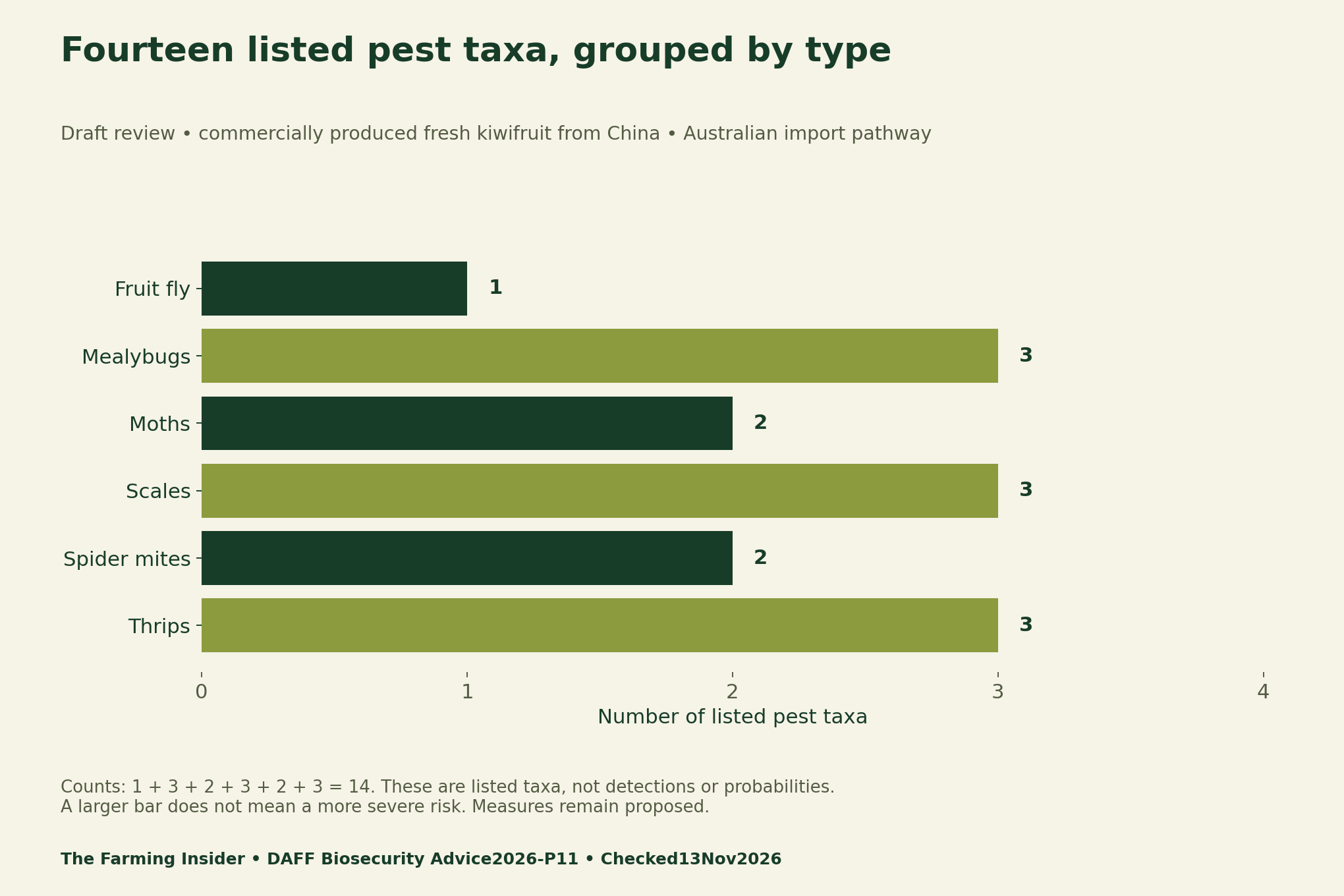
For example, three taxa in one group do not mean three times the risk of a group with one. A risk comparison would need information about the pathway, exposure, consequences and the performance of controls. The count chart supplies none of those probabilities, so it should not be reused as a risk ranking.
Kiwifruit review: read the proposed control alternatives
The fruit-fly proposal allows pest-freedom routes or effective fruit treatment. The European grapevine moth proposal allows pest-freedom routes or visual inspection with action if detected. The other twelve listed taxa fall under the inspection-and-remedial-action wording in the advice. DAFF also describes an operational system.
| Editorial route | Applies to | Proposed approach |
|---|---|---|
| A | Oriental fruit fly | Pest-free area, place or site; OR effective treatment such as cold treatment or irradiation. |
| B | European grapevine moth | Pest-free area, place or site; OR pre-export visual inspection with remedial action if detected. |
| C | Summer fruit tortrix and the listed mealybugs, scales, spider mites and thrips | Pre-export visual inspection with remedial action if detected. |
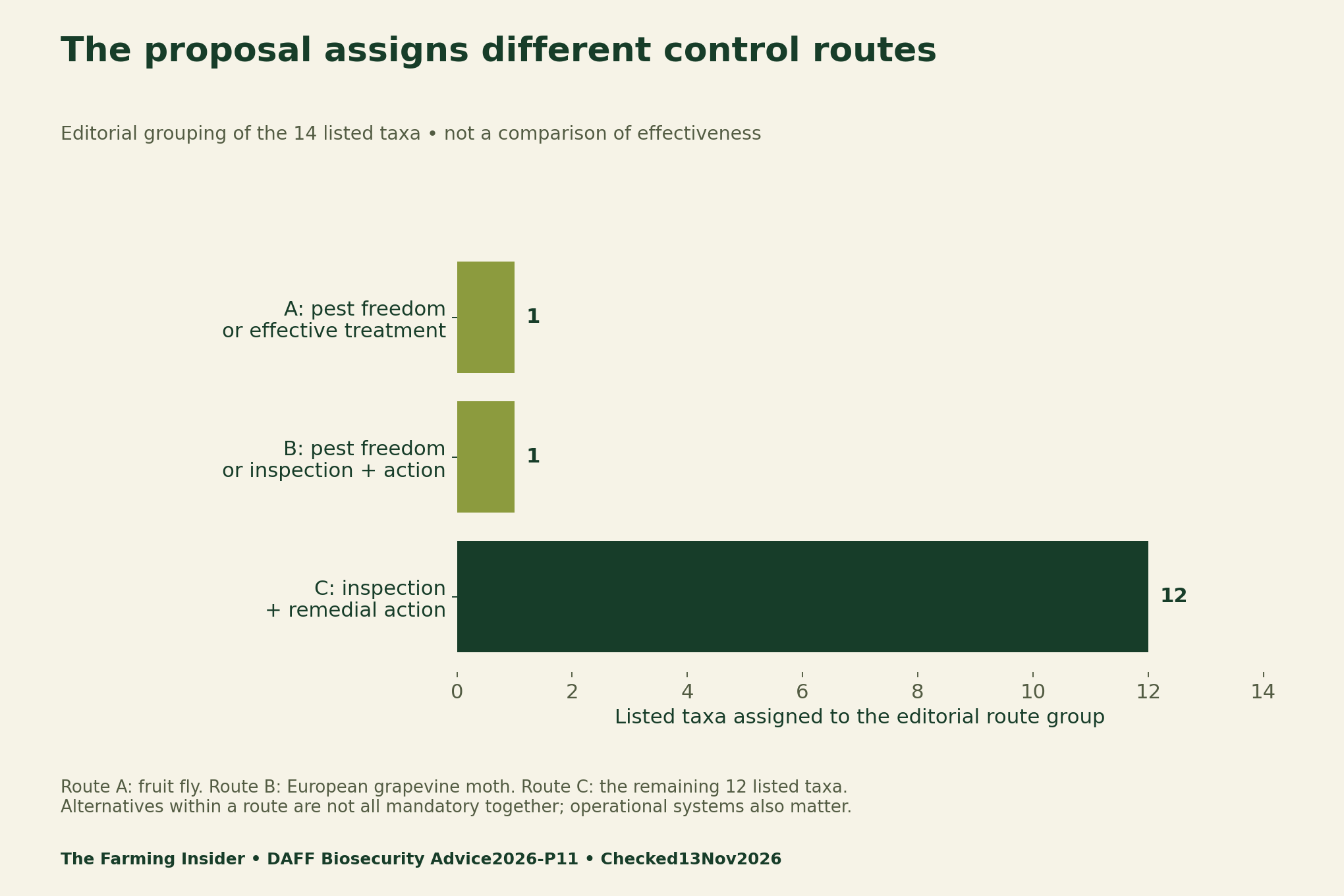
Keep the alternative wording intact. Replacing or with and would change what the proposal says. Equally, the phrase remedial action is not a complete treatment instruction. Do not invent a temperature, exposure time, inspection frequency or clearance rule from this short summary.
Follow the remaining evidence gates
The official risk-analysis page distinguishes consultation, a final report, verification that the country can meet recommended measures, and development and publication of import conditions in BICON. These are different records to look for, rather than one event with several interchangeable names.
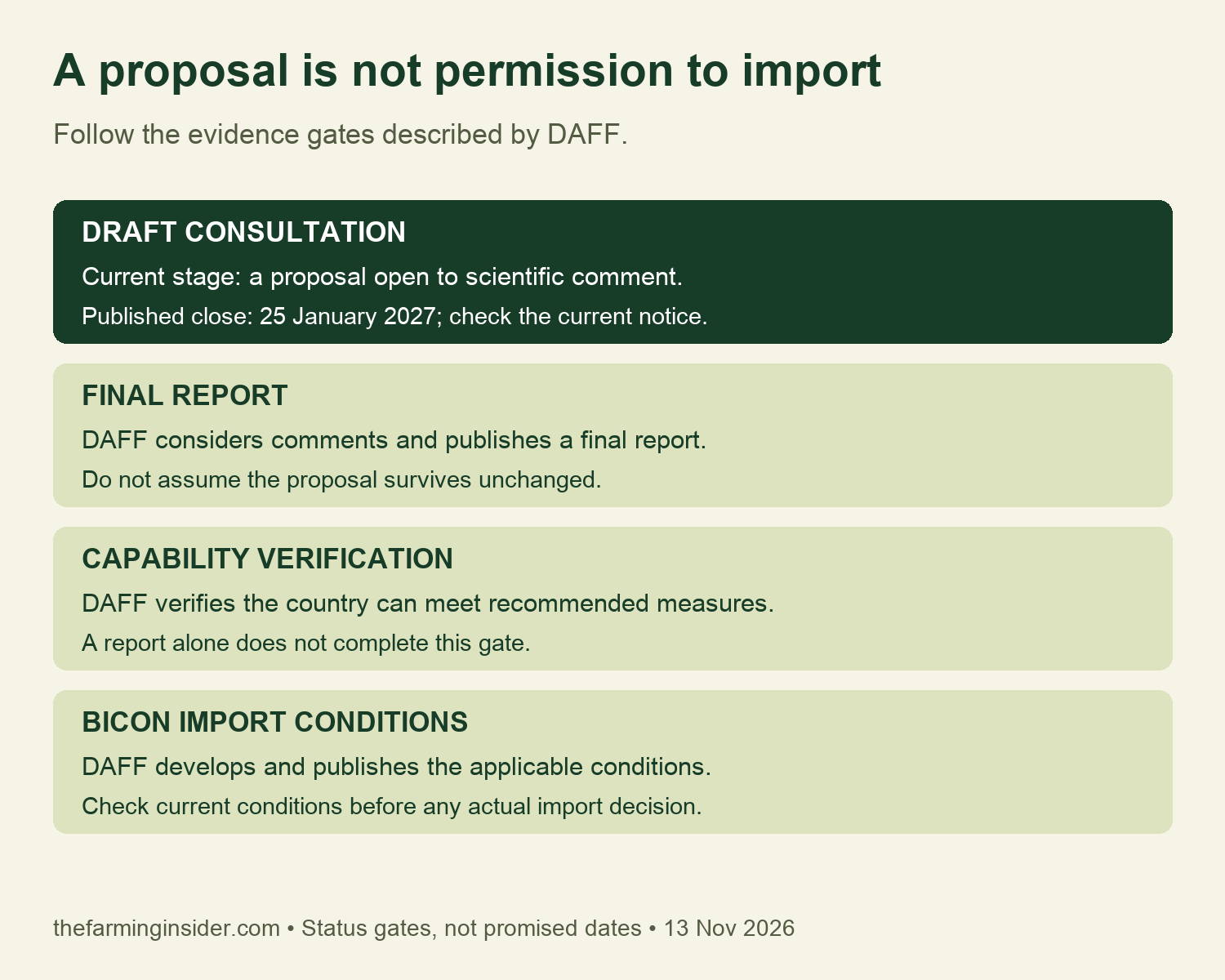
The page gives an indicative final-report timeline in the second half of 2027, subject to change. That is not a guaranteed approval or shipment date. A reader should check what actually has been published and which conditions currently apply before any operational decision.
Turn concerns into evidence questions
Use the private question log to identify the exact pest, pathway or draft section behind a concern. Next, record the scientific reference and what it does establish. Keep an unresolved issue separate from a confirmed finding. This makes a discussion with a qualified biosecurity adviser more useful than an unsupported claim of certainty.
For instance, a question about how a proposed measure is verified needs different evidence from a question about a pest’s potential consequences. Avoid converting either question into a predicted farm loss. This review is not a completed assessment of an individual Australian grower’s revenue or costs.
Our buyer-channel evidence guide uses a similar habit of recording the question, evidence and unknowns separately. Its UK cereal figures do not apply to Australian kiwifruit; only the record-keeping principle transfers.
Download the four review tools
The pest register and route map make the counting and classification reproducible. The blank question log is for private research notes. The status checklist separates a proposal from later official records. None is an import permit, pest-management prescription or instruction to carry out a treatment.
- Listed draft-review pest register (CSV)
- Proposed control-route mapping and counts (CSV)
- Blank private biosecurity evidence-question log (CSV)
- Proposal-to-permission status checklist (CSV)
Method and limits
We transcribed the official pest list, assigned editorial route letters and checked the totals. Two charts answer distinct count questions; additional statistical charts would imply evidence not supplied here. The process infographic explains status rather than measuring the probability or speed of approval.
Transform Your Agribusiness
Unlock your farm's potential with expert advice tailored to your needs. Get actionable steps that drive real results.
Get StartedWe did not model pest-arrival probability, treatment effectiveness, future imports or grower losses. No proposed control is presented as a promise of zero risk. Use current official conditions and qualified advice for actual biosecurity or import decisions.
Suggested citation: The Farming Insider (13 November 2026), “Australia Kiwifruit Import Review: Draft, Not Approval”, selected-source analysis, original route mapping and reader tools. Retain the date, draft status and limitations with any reused figure.