




To validate orchard AI yield estimates, keep the machine’s original prediction, every human adjustment and the eventual measured outcome separate. A correction that sounds sensible may improve accuracy, leave it unchanged or make it worse. Preserving all three values makes that difference visible before the numbers guide labour or packing plans.
An October 2026 UC Davis announcement provides the timely starting point. Our contribution is a reusable audit method with five figures and four CSV downloads. No farm pilot was run for this report. The worked blocks, counts and checking times below are explicitly hypothetical teaching examples, not observations from the study.
What does the orchard research establish?
The 22 October UC Davis announcement describes how orchard technology still depends on people interpreting local conditions. It reports one manager lowering camera-derived counts by 14%, with a more accurate estimate in that example. That single adjustment is not an average accuracy gain or a rule to subtract 14% elsewhere.
The original Visser and Hernandez paper, first published on 27 September, describes a purposive study of 16 operations: seven in California and nine in Washington. Its methods specify 18 months of collection between 2023 and 2025, whereas the news describes a three-year study. These are different descriptions of the research period.
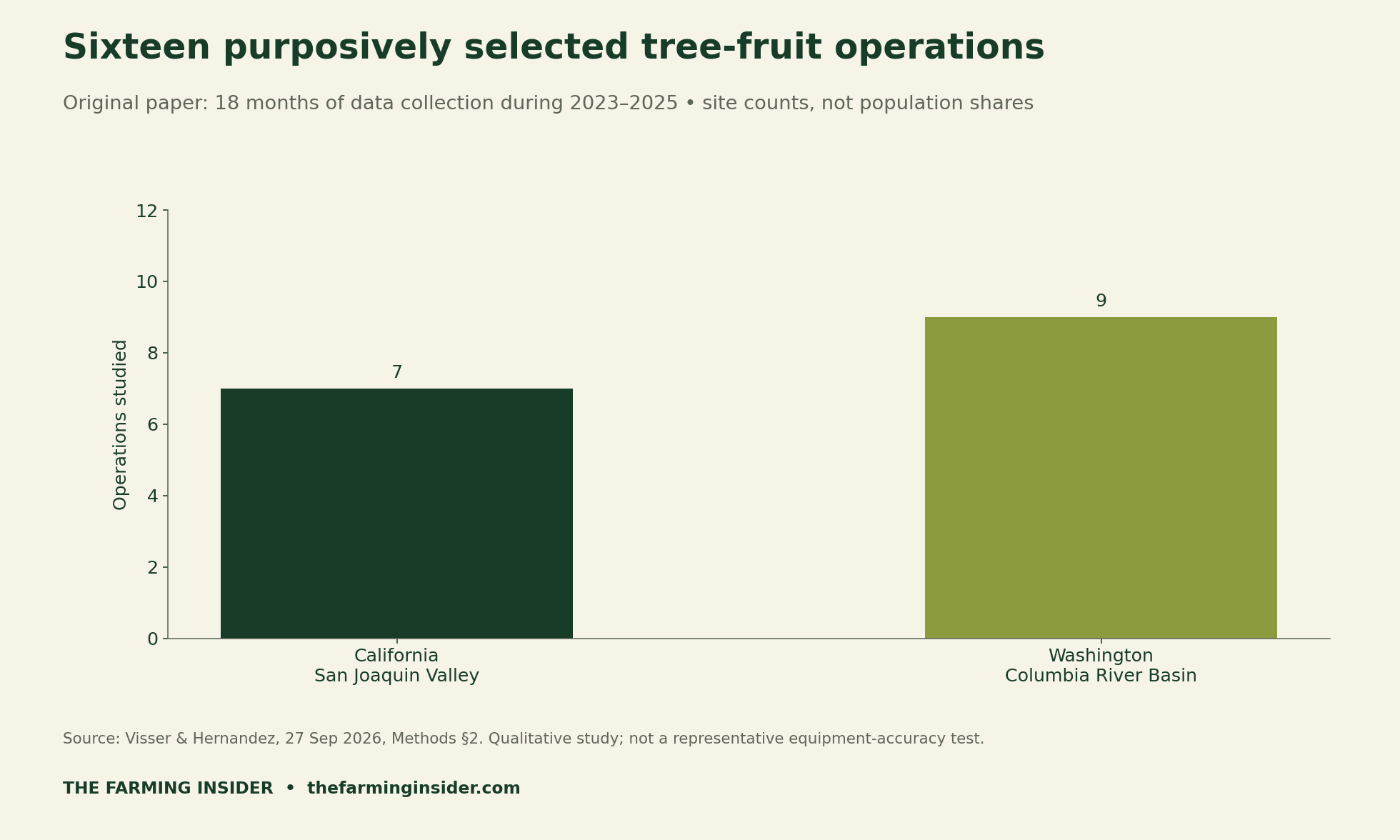
The paper states 165 interviews, but its listed subgroup counts—35, 45 and 86—sum to 166. We flag that inconsistency and do not calculate participant shares. The qualitative findings motivate questions; they do not supply a representative labour-savings estimate, a universal correction factor or a prediction of every farm job’s future.
Define the outcome before you validate orchard AI yield estimates
Choose the decision and measurement before testing. Is the tool estimating fruit on trees, harvested fruit, packed marketable fruit or bins? A raw fruit count cannot be checked against a different outcome without a documented conversion. Specify the block, variety, observation date and unit so the later comparison answers the intended question.
Agree how the actual outcome will be measured and who will check it. Record missing observations and changed conditions. Avoid comparing one estimate with an outcome from another block or time period. If fruit is lost, thinned or graded between the estimate and measurement, preserve those differences rather than silently calling them model errors.
Preserve the raw estimate and each human adjustment
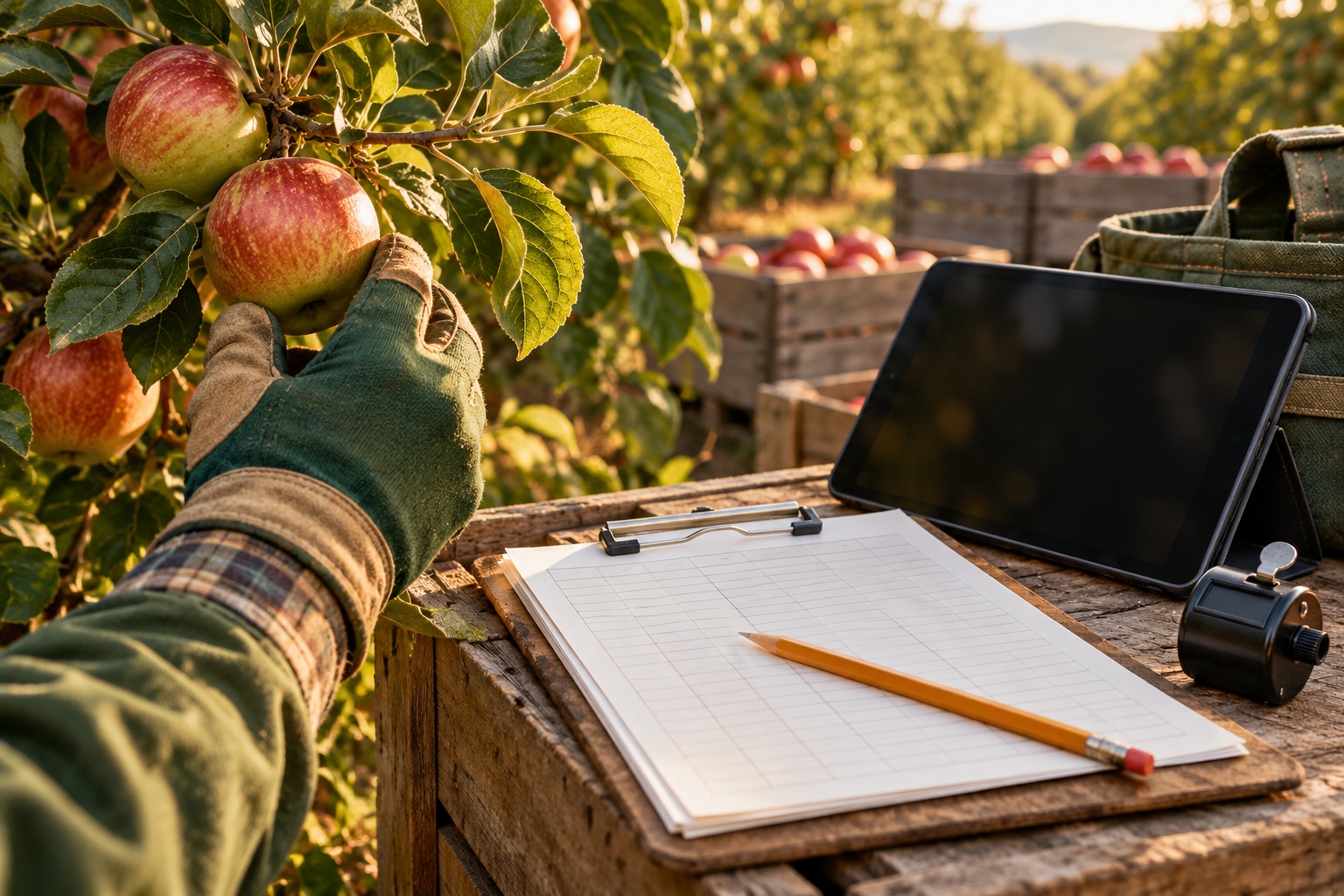
The blank block log retains the original machine value, adjusted value, explanation and observer role. Include worker and crew-leader observations alongside management and supplier information. The reason might concern the defined count or local conditions, but it remains a recorded explanation until the later outcome supports or challenges it.
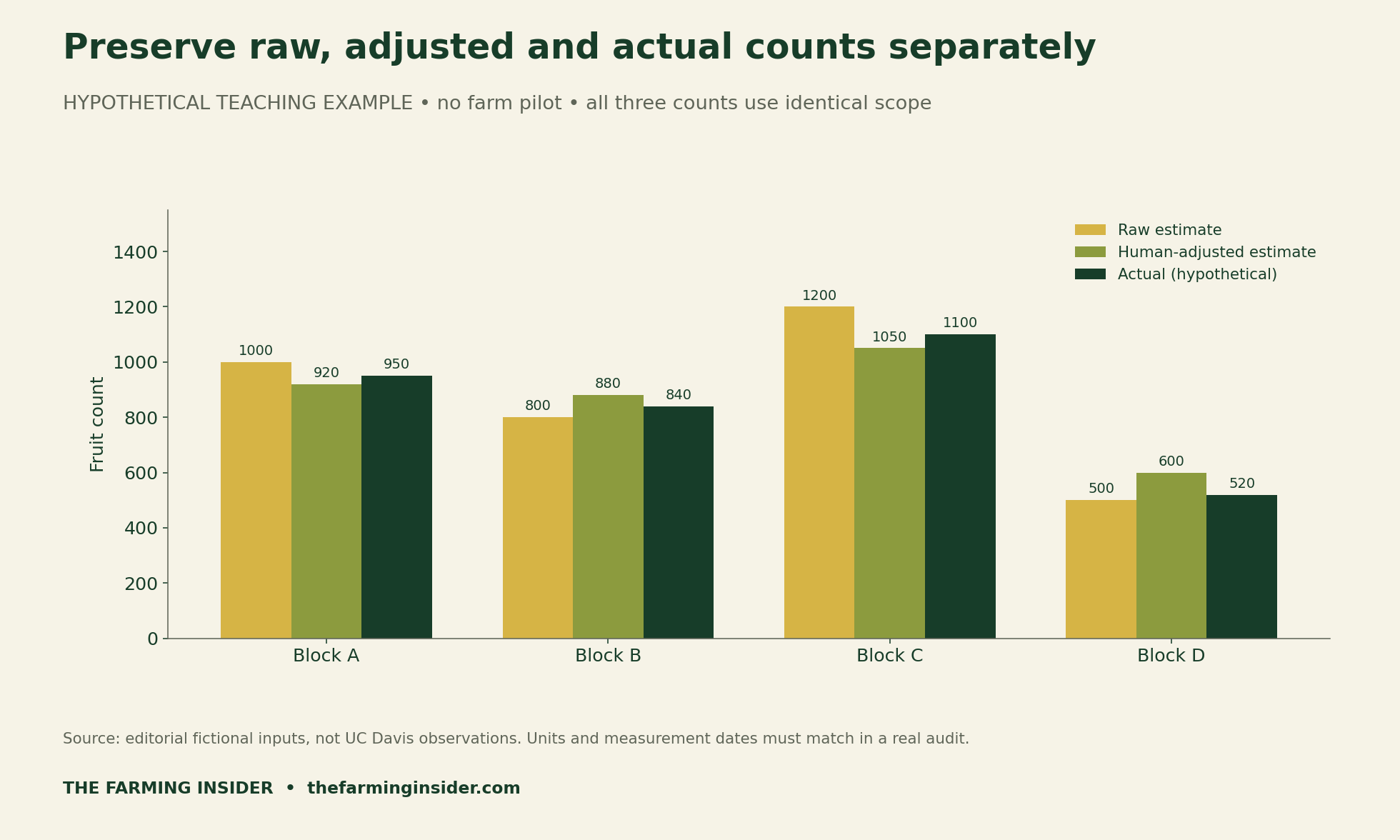
Do not overwrite an inconvenient original prediction. Keep a time-stamped correction history and distinguish a changed input from a changed model version. These records help explain whether an apparent improvement came from the tool, a human adjustment, a different measurement or a changed comparison.
Compare errors against the same measured outcome
For a positive actual count, absolute percentage error is |estimate − actual| ÷ actual × 100. Calculate it separately for the raw and adjusted estimates. Absolute error uses the same numerator without dividing; it remains in fruit-count units. Neither measure alone explains why an error occurred.
In fictional Block A, the raw count is 1,000, the adjusted count 920 and the actual-example count 950. Raw error is 50 fruit, or 5.26%; adjusted error is 30 fruit, or 3.16%. Those calculations illustrate the method. They do not establish how much an orchard should adjust a real forecast.
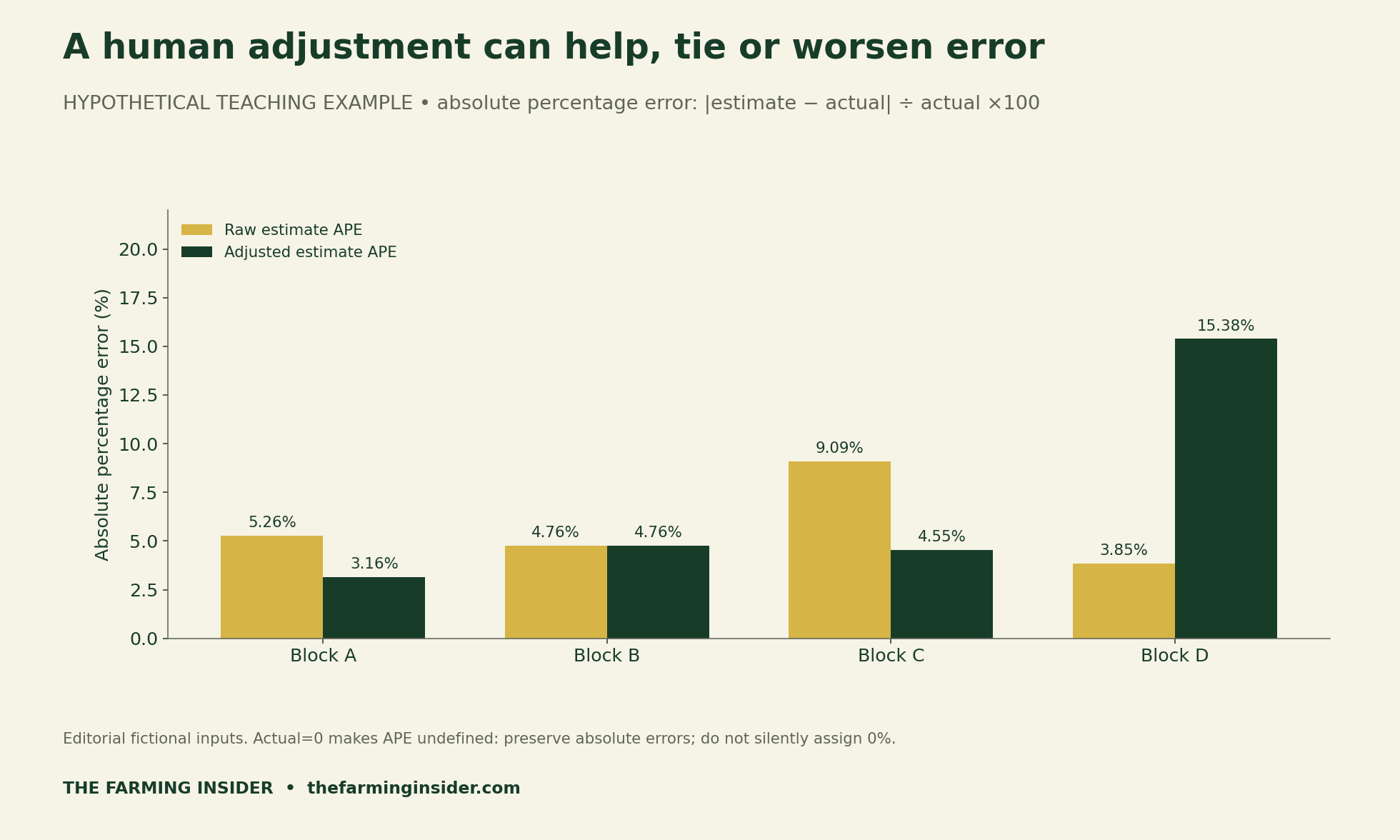
Block D deliberately shows a worse adjustment: 500 becomes 600 against an actual-example count of 520. The adjusted absolute error rises from 20 to 80 fruit. In a separate zero-outcome row, raw 10 and adjusted eight have absolute errors of 10 and eight, but percentage error is undefined. Do not silently assign zero percent or hide that row.
Record intervention time without inventing labour savings
Track time spent checking counts, resolving missing data, interpreting exceptions and recording changes. Keep task categories and unresolved problems in the intervention register. A lower prediction error can still require substantial work, while a quick adjustment can be wrong. Accuracy and checking effort are separate measures.
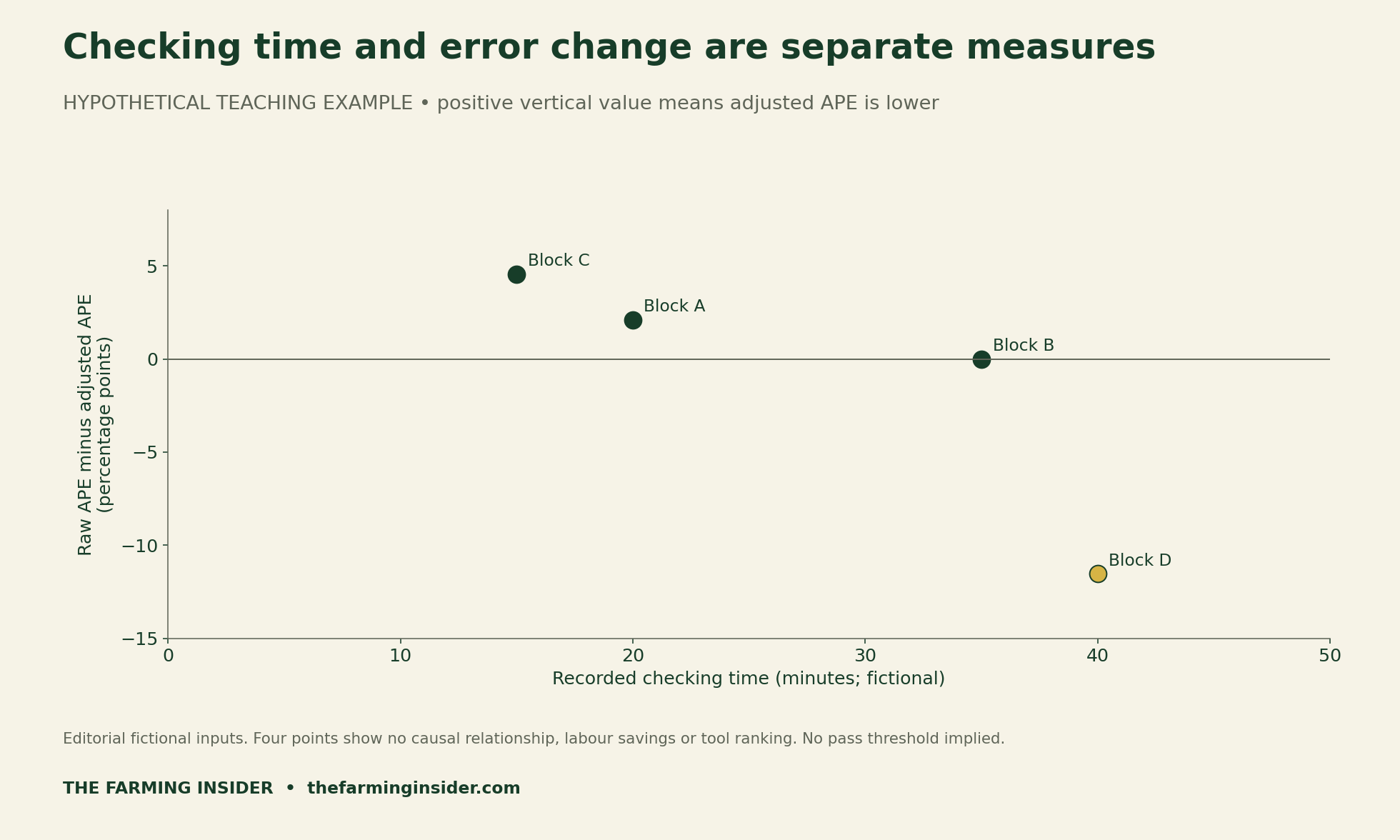
These minutes are not evidence of labour displaced, wages saved or a return on investment. A business comparison would need independently verified costs and a suitable baseline. Counting fruit also differs from physically harvesting it; evidence about a counting tool cannot certify a robotic harvester’s speed, quality or safety.
Set decision criteria before expanding a pilot
Write down the intended decision, the sample and the conditions the test covers before reviewing results. Agree who can query an adjustment and how disagreements will be recorded. Include the people who collect and interpret the data. Keep site-specific limits visible when discussing whether to expand, revise or stop the pilot.
Transform Your Agribusiness
Unlock your farm's potential with expert advice tailored to your needs. Get actionable steps that drive real results.
Get Started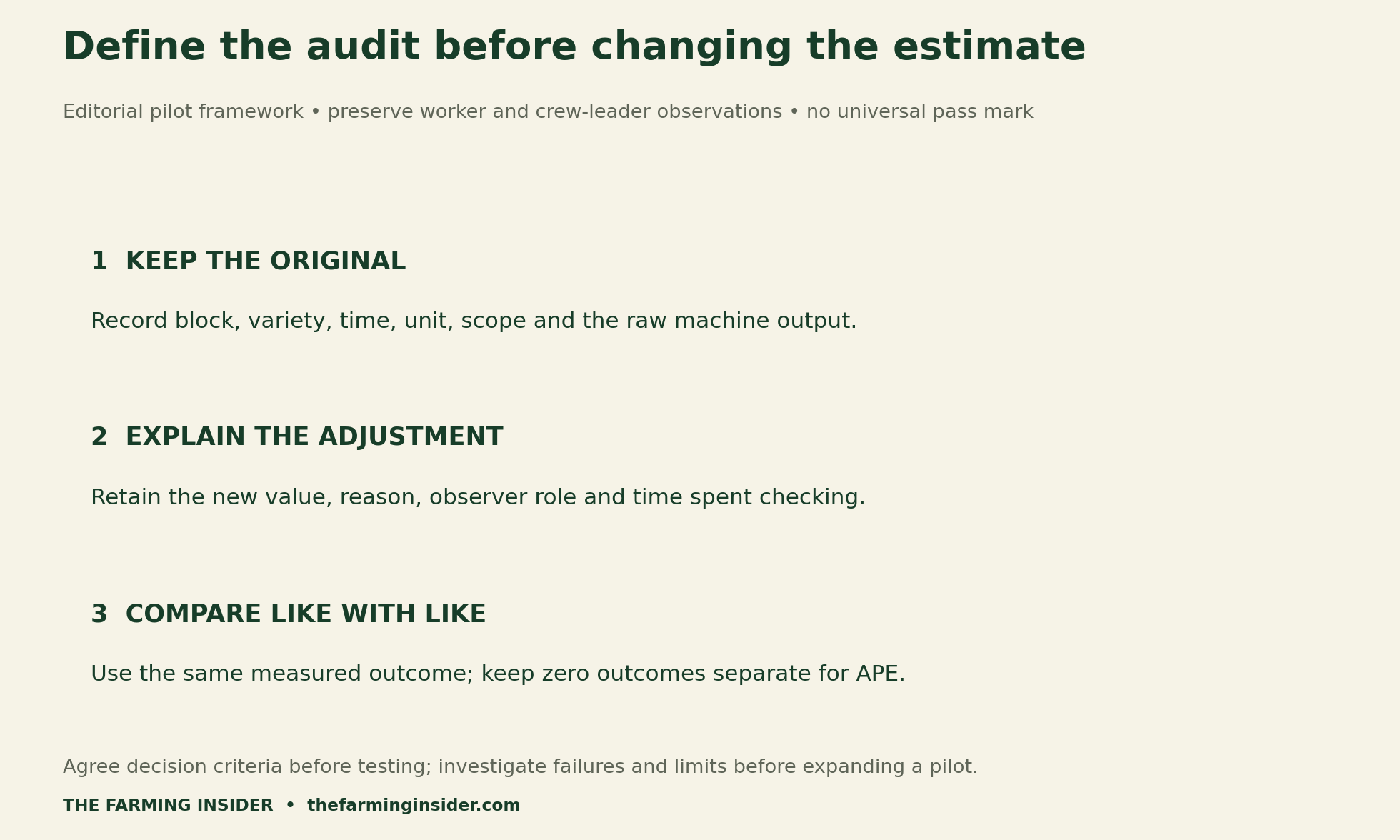
Our corn forecast version-control report offers a related example of preserving inputs. The cattle inventory reconciliation explains why units and definitions must stay attached to calculations. Neither national benchmark substitutes for an orchard’s own observations.
Download the evidence ledger and blank audit tools
- Study coverage and single-case evidence ledger (CSV)
- Hypothetical counts, errors and checking-time examples (CSV)
- Blank block-level estimate and outcome log (CSV)
- Blank intervention-time register (CSV)
Methods, limits and suggested citation
The Farming Insider reviewed the linked university news and original paper on 29 October 2026. Study facts and fictional examples remain in separate files. We checked the operation total, noted the interview-count inconsistency and calculated both error measures from identical example outcomes. Zero outcomes retain an explicit undefined-percentage label.
No new equipment, grower or worker was tested or contacted. The tools have no validated performance threshold and make no staffing, purchasing or productivity recommendation. Suggested citation: The Farming Insider (29 October 2026), Validate Orchard AI Yield Estimates: A Human-Correction Audit. Cite the original study for its qualitative evidence and identify our worked examples as hypothetical when reusing them.


