




England Water Management Grant round 3 has two application minima, but reaching either through arithmetic does not make a project eligible or funded. Tank-only applications start at £15,000; reservoirs, underground mains and eligible combinations start at £35,000. The next check is the lower of the reference contribution and 40% of eligible invoice costs.
The Rural Payments Agency published the round 3 guidance on 19 November 2026. Stage 1 opens on 30 November and closes at 11:59pm UK time on 23 February 2027. Invited Stage 2 applicants have until 11:59pm on 28 October 2027. Our analysis tests the contribution formulas and a fictional cash-flow example, rather than recommending an infrastructure size.
England Water Management Grant round 3: start with the asset class
The application minimum depends on what the project contains. A tank-only project uses the lower minimum. Adding a reservoir or an underground main changes the relevant category; do not carry the tank-only threshold into a mixed project. The programme cap is £300,000 per Single Business Identifier, including multiple applications.
The scheme is competitive, so an eligible application may still receive no award. Check applicant, location, water source, crop use and item requirements in the current guidance. Tenant applicants also need to check landlord agreement and tenancy conditions. A capacity calculation cannot settle those questions.
Test the reference contribution without applying 40% twice
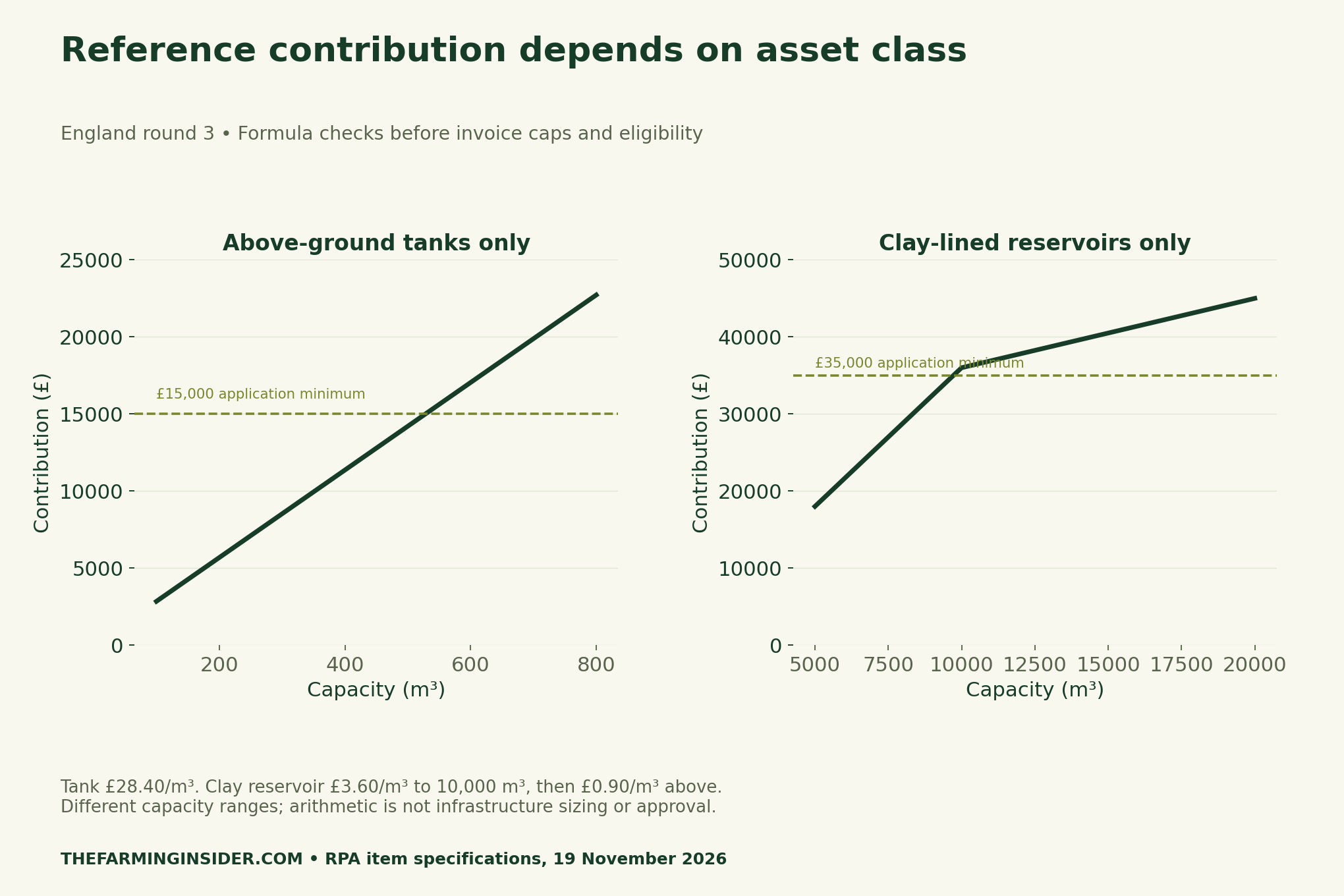
The item specification gives a tank contribution of £28.40 per cubic metre. That published contribution already incorporates the intervention rate. Multiplying it by 40% again would understate this side of the comparison. Keep the reference calculation separate from the invoice-cost ceiling.
| Tank capacity | Reference calculation | Before invoice cap |
|---|---|---|
| 528 m³ | 528 × £28.40 = £14,995.20 | £4.80 below tank-only minimum |
| 529 m³ | 529 × £28.40 = £15,023.60 | £23.60 above tank-only minimum |
| 600 m³ | 600 × £28.40 = £17,040 | Reference figure for our fictional case |
For a clay-lined reservoir, the first 10,000 m³ attracts £3.60 per cubic metre; capacity above that attracts £0.90 per cubic metre. Thus 10,000 m³ gives £36,000, while 15,000 m³ gives £40,500. Applying £3.60 to all 15,000 m³ would incorrectly give £54,000. A marginal rate is not a flat rate for the whole asset.
These numbers are formula checks, not reasons to enlarge a tank or reservoir. Start with a properly assessed irrigation need, suitable design and lawful water source. Then check the grant arithmetic for that proposal. Designing around a funding minimum can leave an unsuitable project with extra costs the grant does not cover.
Compare the invoice ceiling with the reference amount
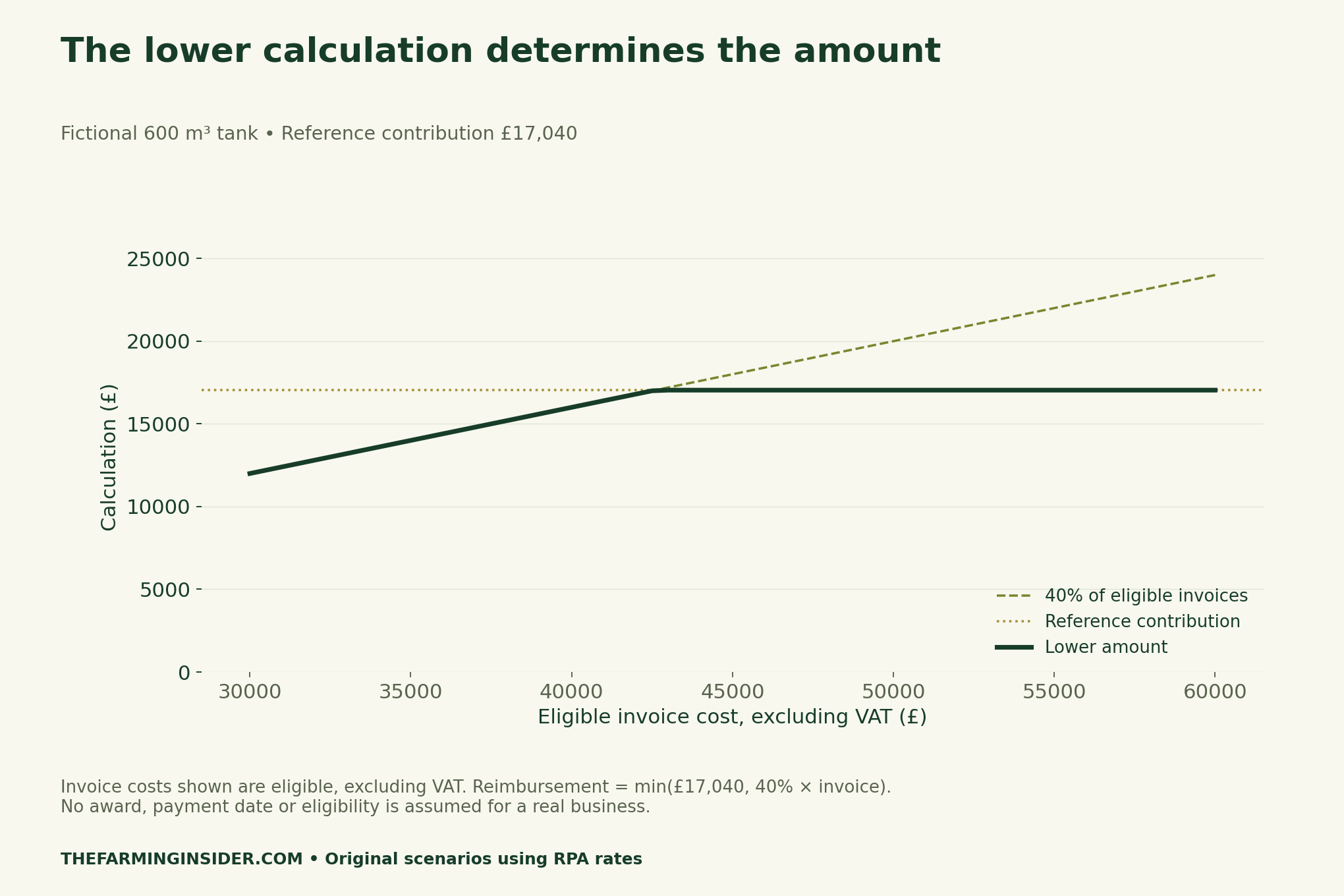
Take a fictional 600 m³ tank with £50,000 of eligible invoices excluding VAT. Its reference contribution is £17,040. Forty per cent of the invoices is £20,000, so the lower calculation is £17,040. The eligible net cost is therefore £32,960 after the assumed reimbursement, before VAT and other expenditure.
If the same reference amount faced £40,000 of eligible invoices, the invoice ceiling would be £16,000 and would bind instead. The equality point is £42,600 because £17,040 ÷ 0.40 = £42,600. This sensitivity check shows why a reference contribution is not an unconditional cheque.
Put the full invoice on the cash-flow plan
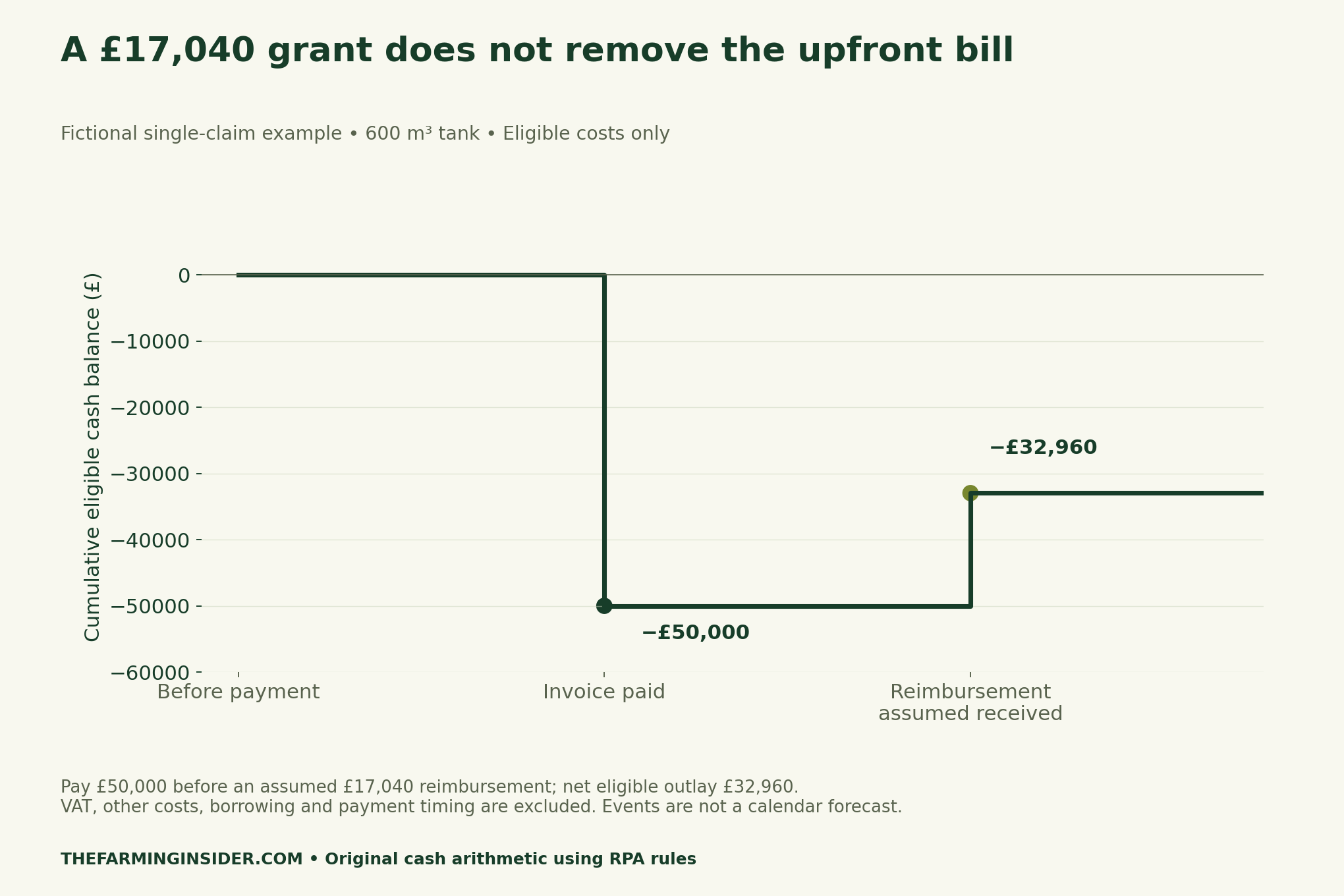
The grant is paid in arrears, with up to three claims. Work claimed must be finished and paid for. In our single-claim illustration, the business first pays £50,000 and later receives £17,040. The eventual net cost is smaller than the largest upfront outflow. A budget that shows only the net amount misses that financing question.
Use the blank worksheet to enter actual payment dates and a separately labelled reimbursement assumption. Include VAT, excluded items, professional fees and finance costs in the wider budget where relevant. Do not assume the scheme covers these because they relate to the project. Keep an uncertain reimbursement date visibly uncertain.
Keep permission and funding milestones on separate tracks
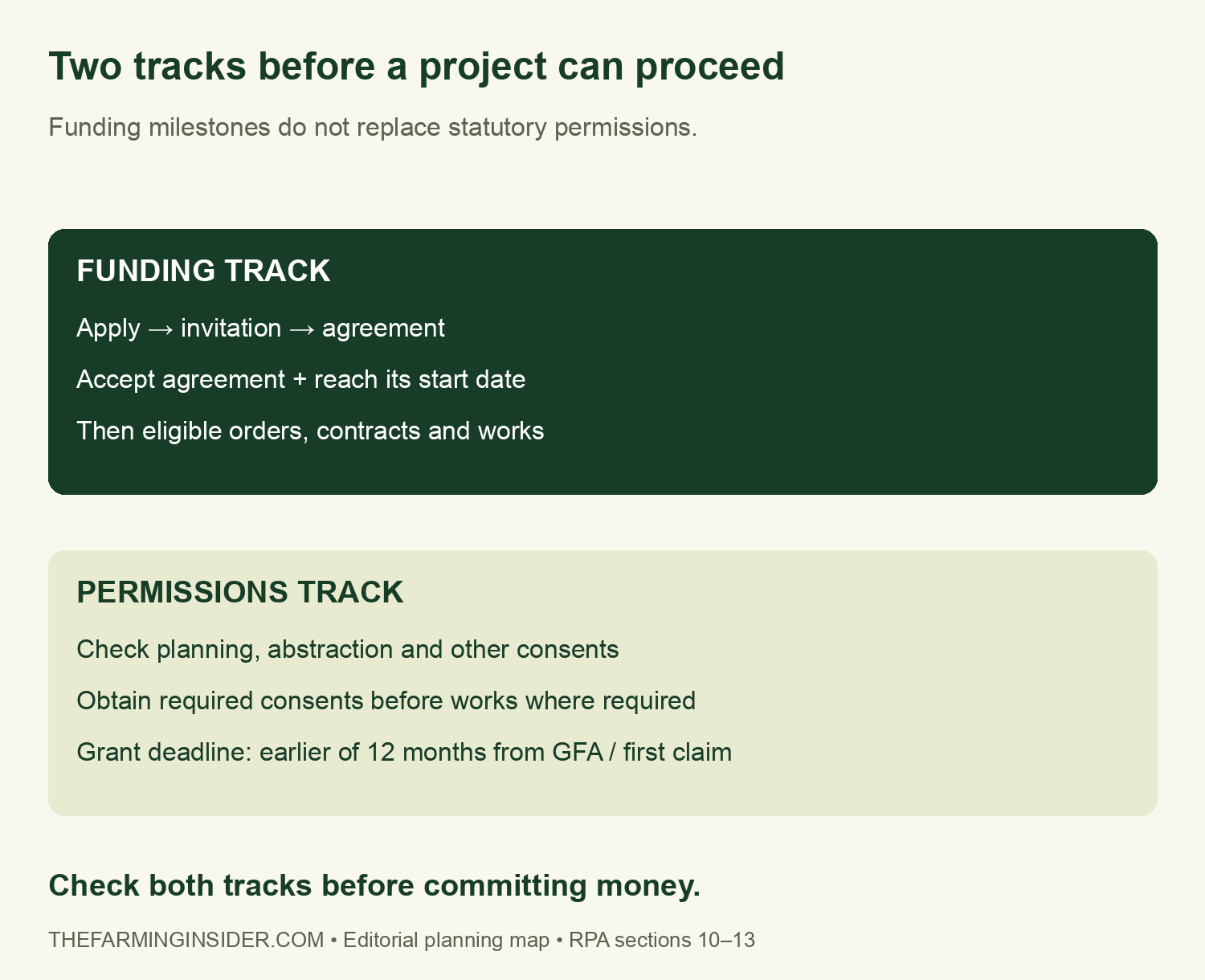
Under the project-start rules, wait until the agreement is accepted and its start date has arrived before eligible orders, deposits, project contracts or works. An application receipt or this worksheet does not authorise commitment. Read the scheme terms alongside the project-specific agreement.
For grant purposes, required planning permission and abstraction licences must be obtained by the earlier of twelve months from the agreement or the first claim. However, statutory rules and item specifications can require consents before works commence. Keep those obligations on a separate timeline; the later grant-evidence deadline is not permission to build first.
Methods, limitations and reusable worksheets
We transcribed the published rates and thresholds, then applied multiplication, the reservoir’s two-rate formula and a minimum-of-two comparison. All invoice and cash-flow scenarios are fictional. We have not assessed an applicant, surveyed a site, sized storage, checked a licence or estimated approval chances. The downloads preserve each assumption and its source.
For wider context, explore Agricultural Policies and Regulations and our Research & Reports archive. Rules from other countries are related reading, not substitutes for England’s current requirements. Use the official guidance for an application and ask the appropriate adviser or authority about unresolved project questions.
Transform Your Agribusiness
Unlock your farm's potential with expert advice tailored to your needs. Get actionable steps that drive real results.
Get Started- Asset-specific reference contribution calculations (CSV)
- Fictional invoice-cap and cash-flow examples (CSV)
- Blank project, cap and cash-date worksheet (CSV)
- Funding and permissions milestone register (CSV)
Sources: Rural Payments Agency, application guidance, item specifications and terms, published 19 November 2026. Contains public-sector information licensed under the Open Government Licence v3.0. Charts and worksheets add our calculations and fictional examples. Suggested citation: The Farming Insider, “England Water Management Grant Round 3: Test the Thresholds”, 21 November 2026.


