






US cotton ginnings in November 2026 were 19.52% lower than the comparable count a year earlier. That is a finding about cotton processed before a specific date. It is not, by itself, an estimate of the final harvest, proof of lost production or a measure of a grower’s queue at a gin.
The USDA NASS release dated 10 November 2026 reports 3,701,850 running bales before 1 November, compared with 4,599,950 at the same cut-off in 2025. Our calculation subtracts 898,100 bales, then divides by the earlier count. The result needs its date, unit and processing-stage label.
US cotton ginnings in November 2026: compare the same cut-off
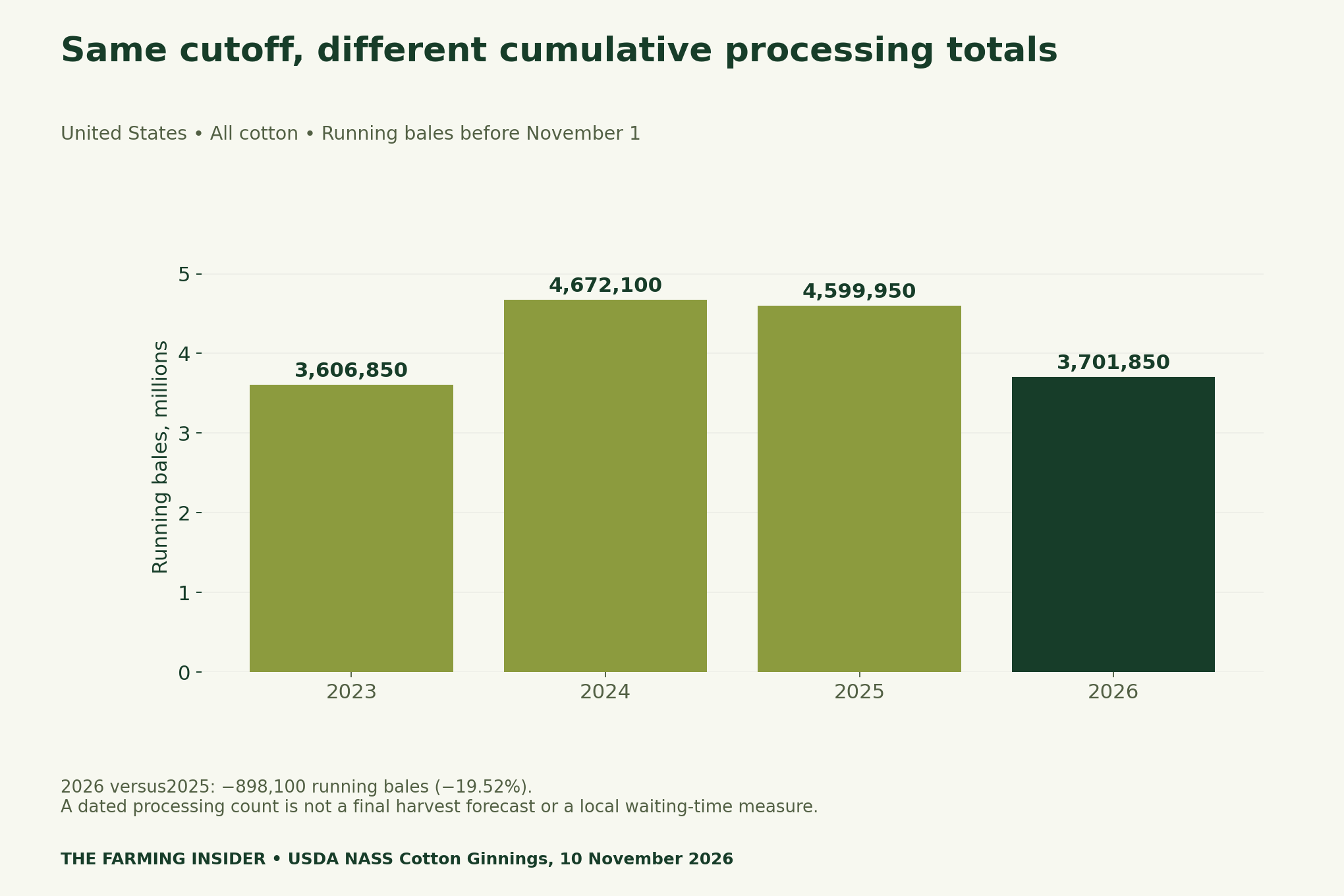
A cumulative total grows as processing continues. Therefore, match the cut-off before comparing years, and retain the report vintage. A later cumulative count answers a different question. Replacing one vintage without noting it can make a chart’s movement reflect both new processing and revised information.
The same calendar cut-off does not guarantee identical conditions. Harvest timing, arrivals and operating schedules can differ. Those are possible lines of investigation, not causes established by a national total. A responsible caption reports the change without filling those gaps with a confident story.
Reconcile the components without double counting
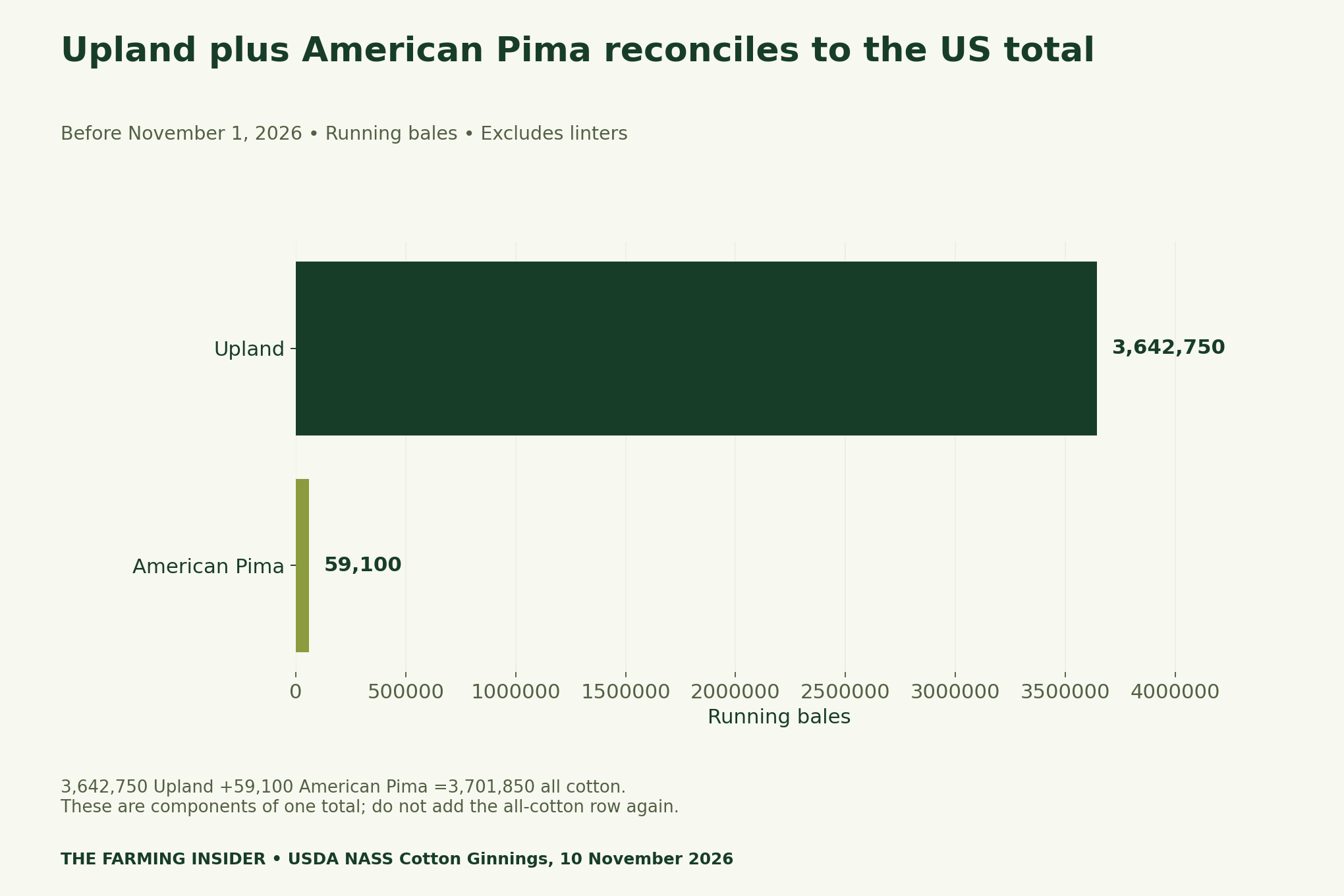
Keep the crop-type field when exporting the table. A subtotal belongs beside its components for validation, but it should not enter the same summation twice. This simple check matters when a spreadsheet or chart tool selects every numeric row automatically.
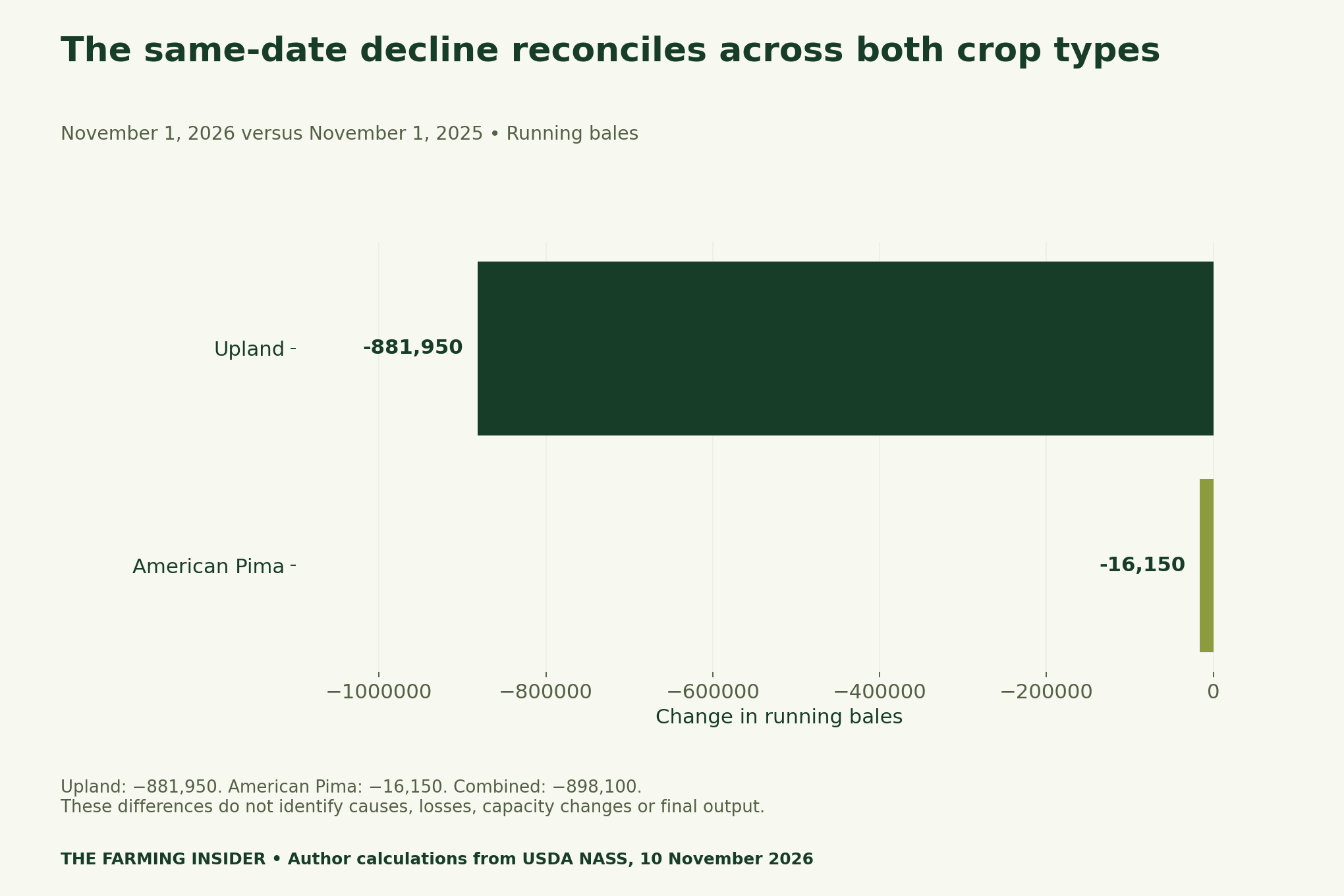
Our national-source CSV retains all three series and their cut-off dates. The calculation file uses the earlier count as the percentage-change denominator. It also shows each crop-type difference, allowing another reader to reproduce the national change without reconstructing suppressed state cells.
Ginned, harvested and dispatched are different records
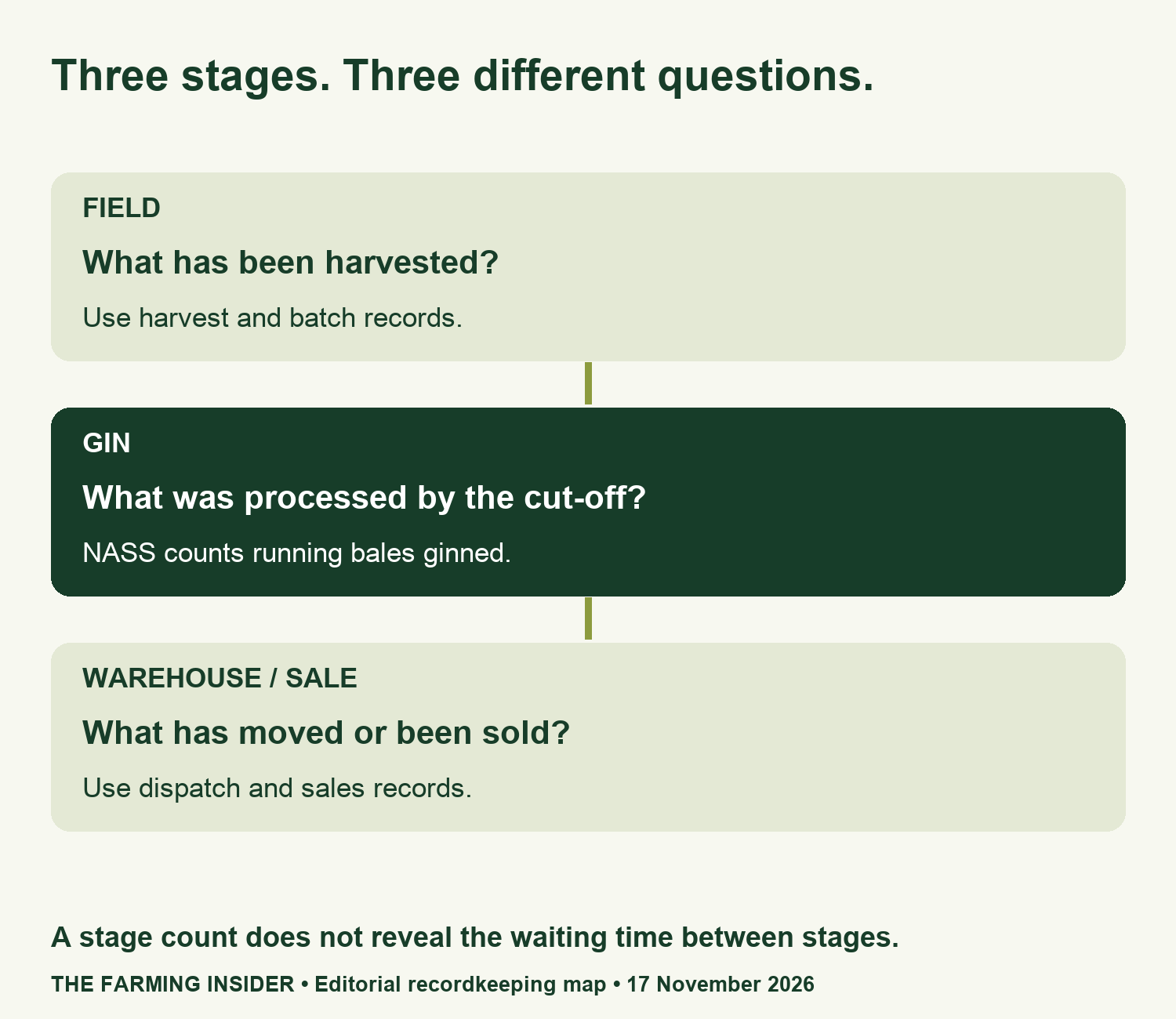
Cotton can be harvested without already appearing in a ginned-bale total. Likewise, a ginned bale need not already be dispatched or sold. Keep these records separate when explaining operational progress. Otherwise, a processing statistic can quietly become an unsupported claim about unsold stocks or field losses.
For a local scheduling question, record the batch identifier, arrival, start, finish and dispatch dates. Agree which interval you mean by waiting time. An arrival-to-start interval and an arrival-to-dispatch interval include different activities, so they should not share an unexplained label.
Running bales are not automatically 480-pound bales
This release counts running bales. A forecast expressed as standardized 480-pound bales uses a weight-equivalent unit. Do not divide one by the other to calculate harvest completion unless a valid, comparable weight conversion supports the operation. An identical word in two headings does not make their units identical.
Similarly, a bale count is not a cottonseed, lint-weight or revenue measure without the relevant additional records. Keep measured weight, count and transaction value in separate fields. Our unit dictionary states what each field permits and what an analyst should leave unresolved.
A census-based estimate can still contain uncertainty
NASS seeks reports from active gins and may estimate or impute missing responses. The methodology also allows later revision. A census frame does not eliminate reporting, processing, omission or duplication errors. Distinguish the source’s coverage claim from a claim that every published number is a direct, final observation.
A withheld value is not zero. In this source, “D” protects individual operations, while a dash represents zero. Preserve that distinction in the raw file and document any transformation. Do not back-calculate sensitive state values from national totals or neighbouring rows.
Method and four downloadable recordkeeping tools
We inspected the official text release and its methodology on 17 November 2026. Three charts show the same-date national series, current crop-type reconciliation and change components. We checked that Upland plus American Pima equals all cotton in each displayed year and that the component changes sum to the total change.
The optional local log is an editorial template, not evidence collected from a gin. It does not estimate waiting times or prescribe operating decisions. For a related baseline exercise, see our rice acreage-versus-yield analysis, which also separates a national total from individual farm performance.
- Same-date national cotton-ginnings counts (CSV)
- Crop-type and total comparison arithmetic (CSV)
- Blank local batch-processing log (CSV)
- Bale units and missing-data dictionary (CSV)
Suggested citation: The Farming Insider, “US Cotton Ginnings: Why a 19.5% Fall Is Not a Final Harvest Estimate”, 17 November 2026. Primary source: USDA NASS, Cotton Ginnings, 10 November 2026; charts and calculations by this publication.
Transform Your Agribusiness
Unlock your farm's potential with expert advice tailored to your needs. Get actionable steps that drive real results.
Get Started


