




Introduction to Sustainable Irrigation and Climate Change
Sustainable irrigation connects efficient water use with agricultural productivity.
It also helps farmers respond to climate variability while conserving freshwater resources.
Moreover, careful irrigation practices can support soil health and reduce agricultural emissions.
Understanding Sustainable Irrigation
Sustainable irrigation uses water efficiently to support agriculture.
It minimizes water waste through advanced technologies and practices.
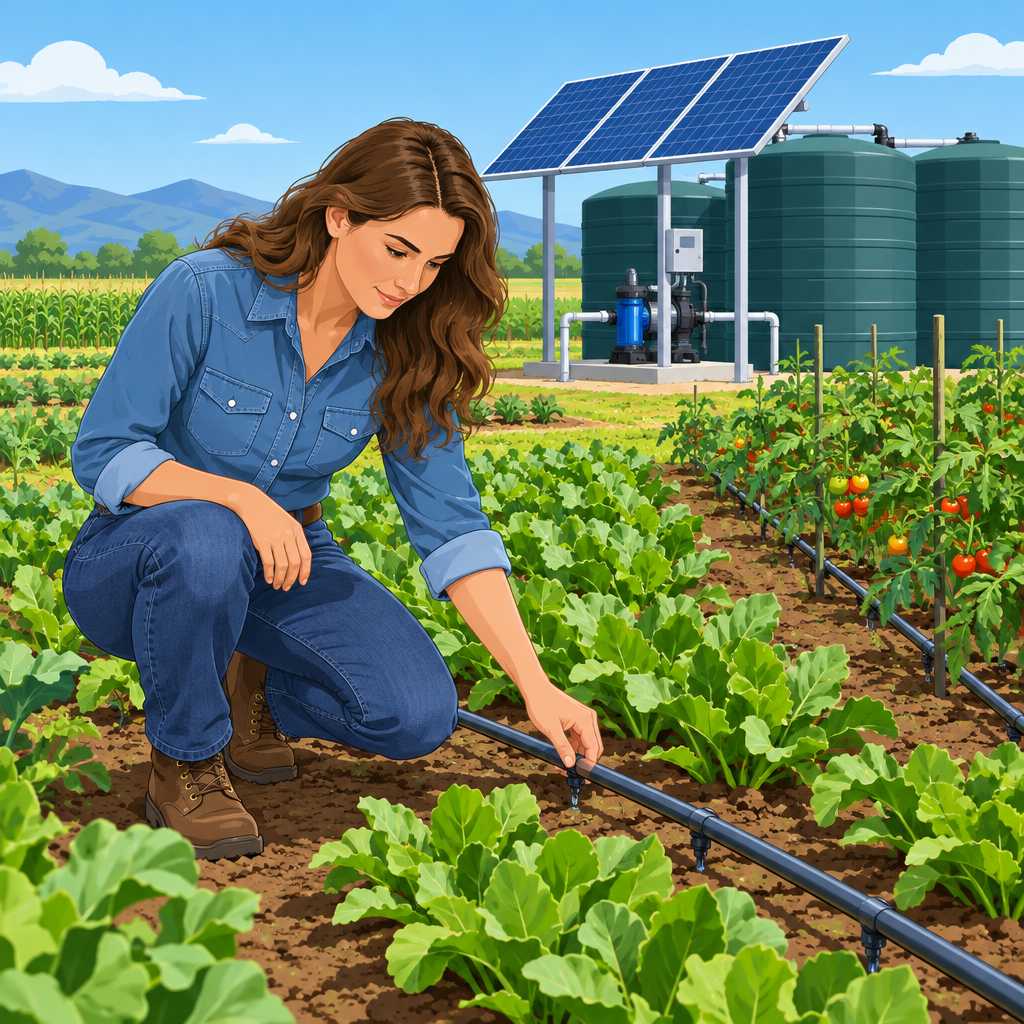
For example, drip irrigation delivers water directly to plant roots.
This method reduces evaporation and runoff significantly.
Additionally, sustainable irrigation maintains soil health and productivity.
Farmers like Emma Carlson at Green Valley Farms adopt these methods daily.
Link Between Irrigation and Climate Change
Irrigation practices have a strong impact on global water resources.
Excessive water use increases energy consumption and greenhouse gas emissions.
Therefore, efficient irrigation helps lower agriculture’s carbon footprint.
Moreover, adapting irrigation can improve resilience against climate variability.
Companies such as EcoAg Solutions develop technologies supporting these goals.
Importance of Sustainable Irrigation
Sustainable irrigation conserves freshwater for future use.
Transform Your Agribusiness
Unlock your farm's potential with expert advice tailored to your needs. Get actionable steps that drive real results.
Get StartedIt reduces pressure on rivers and aquifers across vulnerable regions.
Furthermore, it supports food security by stabilizing crop yields.
Local farmers, including Miguel Torres, benefit from reliable water supplies.
Ultimately, sustainable practices foster environmental and economic stability.
The Impact of Traditional Irrigation Methods on Climate Sustainability
Traditional irrigation methods affect water use, energy demand, soil conditions, and local microclimates.
These effects create environmental and financial pressures for farmers.
Therefore, examining these impacts clarifies the challenges surrounding climate sustainability.
Water Inefficiency and Waste
Traditional methods, including flood and furrow irrigation, use excessive amounts of water.
They distribute water unevenly across fields, which causes significant losses.
Consequently, this inefficiency places pressure on local water resources and ecosystems.
Moreover, open-field applications experience high evaporation rates.
As a result, traditional irrigation worsens water scarcity in many regions.
Energy Consumption and Carbon Footprint
Many conventional irrigation systems depend on diesel-powered or electric pumps.
These energy sources increase greenhouse gas emissions from agricultural activities.
As a result, irrigation directly contributes to climate change impacts.
For example, excessive pumping increases carbon dioxide and methane emissions.
Thus, traditional irrigation raises farming’s overall carbon footprint.
Soil Degradation and Greenhouse Gas Emissions
Traditional irrigation can overwater fields, causing waterlogging and soil erosion.
This degradation reduces soil fertility and disrupts natural carbon storage.
When soil quality declines, the soil releases stored carbon into the atmosphere.
Furthermore, degraded soil can increase nitrous oxide emissions through microbial activity.
Consequently, declining soil health increases agriculture’s contribution to climate change.
Impact on Local Microclimates
Traditional irrigation can change humidity and temperature around agricultural areas.
Higher moisture levels may sometimes increase local greenhouse gas emissions.
Showcase Your Farming Business
Publish your professional farming services profile on our blog for a one-time fee of $200 and reach a dedicated audience of farmers and agribusiness owners.
Publish Your ProfileAdditionally, increased humidity affects nearby vegetation and wildlife habitats.
These changes can disrupt ecological balances within agricultural regions.
Therefore, traditional irrigation affects climate sustainability at local scales.
Challenges Faced by Farmers
Farmers often carry financial and labor burdens because of inefficient irrigation.
Water shortages and rising energy costs reduce farm profitability.
Consequently, many farmers continue using older systems out of necessity or tradition.
However, this choice prolongs unsustainable environmental effects.
Thus, farmers need awareness and resources to adopt more sustainable methods.
Key Sustainable Irrigation Techniques
Sustainable irrigation techniques direct water more carefully.
They include drip irrigation, sprinkler irrigation, and rainwater harvesting.
Each method can support efficient water management.
Drip Irrigation
Drip irrigation delivers water directly to plant roots where plants need it.
This technique reduces water waste significantly compared with traditional methods.
Farmers like Ricardo Moreno use drip systems to improve farm efficiency.
Moreover, drip irrigation minimizes evaporation and runoff, preserving water resources effectively.
Companies such as VerdeGrow Solutions install advanced drip irrigation equipment.
Consequently, drip irrigation supports climate change mitigation by conserving scarce water.
Sprinkler Irrigation
Sprinkler irrigation distributes water evenly across fields through controlled spray systems.
This method suits various crops and landscape types, increasing farming flexibility.
Agronomist Elena Vasquez recommends sprinklers for areas with irregular rainfall.
Furthermore, modern sprinklers reduce water loss caused by wind drift.
Farms managed by Sterling Agro Innovations use advanced sprinklers to optimize water use.
Therefore, sprinkler irrigation helps maintain soil health while lowering environmental impact.
Rainwater Harvesting
Rainwater harvesting captures and stores rainfall for later irrigation use.
This practice reduces dependence on groundwater and municipal water sources.
Environmental engineer Kamal Singh advises integrating harvesting with existing irrigation systems.
Additionally, harvesting improves water availability during dry seasons and drought conditions.
Greenfield Farms combines rainwater harvesting with drip irrigation to maximize sustainability.
Thus, harvesting rainwater supports climate resilience and efficient water management.
You Might Also Like: Eco-Friendly Irrigation Solutions for Sustainable Farmland Management
How Sustainable Irrigation Contributes to Water Conservation
Sustainable irrigation conserves water through precise delivery.
It combines resource planning, soil care, technology, and cooperation.
These practices support efficient water management.
Reducing Water Waste through Efficient Techniques
Sustainable irrigation uses precise water delivery systems.
These systems target plant roots, minimizing evaporation and runoff.
For instance, drip irrigation delivers water directly where plants need it.
Furthermore, soil moisture sensors help regulate watering schedules.
Consequently, farmers apply only the necessary amount of water.
Utilizing Renewable Water Sources
Many sustainable irrigation systems incorporate rainwater harvesting.
This practice reduces dependence on groundwater and municipal supplies.
Showcase Your Farming Business
Publish your professional farming services profile on our blog for a one-time fee of $200 and reach a dedicated audience of farmers and agribusiness owners.
Publish Your ProfileMoreover, recycled wastewater can safely irrigate certain crops.
These methods help preserve natural freshwater reserves.
Improving Soil Health to Retain Moisture
Healthy soil absorbs and holds water better than degraded soil.
Therefore, sustainable irrigation often works alongside soil conservation.
Techniques such as mulching reduce surface evaporation.
Additionally, organic amendments improve soil structure and water retention.
Integrating Technology for Adaptive Water Management
Smart irrigation controllers adjust watering according to weather data.
For example, these controllers pause irrigation during rainfall events.
Meanwhile, remote monitoring enables real-time adjustments to irrigation practices.
This adaptive management prevents overwatering and conserves water.
Encouraging Collaborative Water Stewardship
Local farmers share data and strategies for water conservation.
Community programs promote sustainable irrigation education.
Such collaboration maximizes regional water use efficiency.
In turn, it supports long-term water resource sustainability.
Uncover the Details: Pest and Disease Control Strategies for Sustainable Farmland Homes
Role of Sustainable Irrigation in Soil Health and Crop Resilience
Sustainable irrigation protects soil health while helping crops withstand climate stress.
It balances water delivery with long-term farm productivity.
These practices connect soil care, crop adaptation, and efficient resource use.
Enhancing Soil Structure and Fertility
Sustainable irrigation improves soil structure by maintaining suitable moisture levels.
Additionally, balanced water application prevents soil compaction and erosion.
Meanwhile, suitable moisture promotes microbial activity that supports nutrient cycling.
Healthy microbes also decompose organic matter effectively.
Consequently, decomposition increases soil fertility and nutrient availability.
Furthermore, sustainable irrigation reduces salinization risks in irrigated fields.
Supporting Crop Resilience to Climate Stress
Consistent moisture supply strengthens crop tolerance to drought and heat stress.
Regulated irrigation practices encourage plants to develop deeper root systems.
As a result, roots access water and nutrients from lower soil layers efficiently.
This adaptability helps crops survive unpredictable weather patterns.
Additionally, sustainable irrigation reduces plant vulnerability to diseases.
Proper water management limits excess humidity that favors pathogen growth.
Optimizing Water Use for Long-Term Productivity
Efficient irrigation techniques minimize water wastage on farms.
For example, farmers use drip or sprinkler systems to deliver water directly to roots.
These methods preserve soil moisture while preventing runoff and evaporation.
Consequently, this approach maintains soil health across multiple cropping cycles.
Therefore, efficient water use supports steady crop yields during harsh climate conditions.
Collaborative Efforts and Technological Innovations
Agronomists such as Lucas Mendoza champion precision irrigation technologies worldwide.
Meanwhile, companies such as GreenSprout Agro invest in smart irrigation controllers.
These devices adjust watering schedules using real-time soil moisture data.
As a result, farmers optimize input use and improve crop resilience.
Moreover, training programs increase awareness of sustainable irrigation benefits.
Showcase Your Farming Business
Publish your professional farming services profile on our blog for a one-time fee of $200 and reach a dedicated audience of farmers and agribusiness owners.
Publish Your ProfileFinally, communities adopting these practices strengthen food security under climate change.
Gain More Insights: Impact of Invasive Pests on Farmland and Rural Property Values
Technological Innovations in Sustainable Irrigation Practices
Modern irrigation technologies help farmers direct water more accurately across agricultural fields.
These tools combine monitoring, automation, renewable energy, and data analysis.
Farmers can therefore improve water management while supporting productive and climate-conscious agriculture.
Precision Irrigation Systems
Precision irrigation systems apply water exactly where plants need it most.
These systems reduce water waste by monitoring soil moisture levels continuously.
Farmers like Carlos Varela of GreenGear Solutions implement these smart systems effectively.
Moreover, precision irrigation improves crop yields by optimizing water usage daily.
Consequently, it lowers energy consumption linked to pumping unnecessary water.
Automated Drip Irrigation
Automated drip irrigation delivers water directly to plant roots with minimal loss.
Agritech developer Marissa Chen recently enhanced these systems with IoT sensors.
This innovation allows real-time adjustments based on weather and soil data.
Therefore, farms significantly reduce evapotranspiration and runoff.
Ultimately, automated drip irrigation conserves water while increasing plant health.
Use of Remote Sensing and Drones
Remote sensing technology tracks crop water stress from above accurately.
Drones equipped with thermal cameras help farms identify dry zones quickly.
Innovators like Emilio Sanchez employ this technology to target irrigation precisely.
In addition, this method saves labor costs and improves irrigation timing.
Thus, water consumption decreases without compromising crop quality.
Solar-Powered Irrigation Pumps
Solar-powered pumps provide a sustainable energy alternative for irrigation needs.
Renewable Energy Solutions Ltd., led by engineer Naomi Watanabe, promotes their use.
These pumps reduce greenhouse gas emissions commonly linked to diesel engines.
Additionally, they enable off-grid farms to operate irrigation independently.
As a result, sustainable energy adoption supports climate-friendly agricultural practices.
Data-Driven Irrigation Management Platforms
Data platforms aggregate environmental and crop information to guide irrigation schedules.
Software company AgroTrac offers cloud-based tools that analyze real-time data streams.
Farmers can predict water needs accurately and avoid over-irrigation this way.
Hence, these platforms improve water resource management sustainably and efficiently.
Furthermore, they foster informed decision-making for long-term climate resilience.
Integration of Sustainable Irrigation Innovations
Combining multiple technologies enhances water conservation efforts on farms.
For instance, smart drip systems powered by solar pumps maximize efficiency.
Furthermore, data analytics paired with drone surveillance optimize irrigation timing.
Leading agricultural consultants like Mei-Ling Zhou advocate such integrated solutions.
Therefore, innovative sustainable irrigation fosters both economic and environmental benefits.
Find Out More: How Agricultural Pests Affect Property Values in Rural Areas
Economic Benefits of Implementing Sustainable Irrigation Systems
Sustainable irrigation systems can reduce operating costs while supporting stronger agricultural productivity.
They also help farmers manage resources precisely and protect farm profitability over time.
Moreover, public incentives and local services can improve access to these technologies.
Cost Savings Through Efficient Water Use
Farmers reduce water expenses by adopting sustainable irrigation methods.
Showcase Your Farming Business
Publish your professional farming services profile on our blog for a one-time fee of $200 and reach a dedicated audience of farmers and agribusiness owners.
Publish Your ProfileFor example, drip irrigation minimizes water wastage significantly.
Moreover, precise water delivery lowers energy costs required for pumping.
Consequently, sustainable irrigation systems improve overall farm profitability.
Increased Crop Yields and Quality
Proper irrigation enhances soil moisture consistency, which boosts crop growth.
As a result, farmers achieve higher yields with improved crop quality.
Companies like GreenHarvest Farms report 20% yield increases after system adoption.
Thus, sustainable irrigation supports stronger market competitiveness.
Long-Term Investment Advantages
Although installation requires an initial investment, sustainable systems reduce future expenses.
Additionally, soil moisture sensors optimize resource use over time.
Farmers can achieve better returns through improved operational efficiency.
Furthermore, sustainable irrigation supports resilience against climate variability.
Economic Incentives and Support Programs
Many governments, including California’s Department of Agriculture, offer subsidies.
These incentives lower upfront costs and encourage wider technology adoption.
Meanwhile, private companies such as TerraTech Solutions provide financing options for farmers.
Therefore, incentives combined with technology can improve economic feasibility.
Job Creation and Local Economic Growth
Sustainable irrigation technologies stimulate job opportunities in rural communities.
These opportunities include installation, maintenance, and technical consulting roles.
Local businesses like AquaSmart Systems benefit from increased service demand.
Consequently, sustainable irrigation promotes regional economic development.
Risk Reduction and Economic Stability
Efficient water management decreases vulnerability to drought-related losses.
For instance, farmers like Carlos Mendez report fewer crop failures after system upgrades.
Therefore, stable agricultural output encourages investment in farming operations.
Ultimately, sustainable irrigation contributes to broader economic resilience.
Successful Sustainable Irrigation Projects Worldwide
Successful irrigation projects combine practical methods with careful resource management.
These projects address water scarcity, energy challenges, and agricultural needs in different regions.
Moreover, local participation and ongoing adaptation help communities sustain these efforts.
Innovative Drip Irrigation in Israel
Israel leads in using drip irrigation to conserve water effectively.
Netafim developed tailored solutions for arid regions.
Consequently, farmers reduce water waste while improving crop yields.
Additionally, drip irrigation uses less energy than traditional irrigation.
Rainwater Harvesting in Rajasthan, India
Rajasthan faces severe water scarcity and irregular rainfall.
Local communities combine rainwater harvesting with agricultural irrigation.
This approach collects and stores rainwater for farm use.
Furthermore, stored water increases groundwater recharge and improves availability.
The NGO Jalmitra has helped farmers adopt these sustainable practices.
Solar-Powered Irrigation in Sub-Saharan Africa
Sub-Saharan Africa often faces unreliable electricity supplies for irrigation.
Solar-powered pumps provide off-grid alternatives using renewable energy.
In Kenya, SunCulture promoted solar irrigation kits for smallholder farmers.
These systems help farmers irrigate crops efficiently throughout the year.
They also reduce fossil fuel dependence and lower emissions.
Showcase Your Farming Business
Publish your professional farming services profile on our blog for a one-time fee of $200 and reach a dedicated audience of farmers and agribusiness owners.
Publish Your ProfileModernizing Traditional Systems in Spain
Spain transformed ancient acequia systems into more efficient irrigation networks.
The Andalucian Water Agency modernized canals to reduce seepage.
Meanwhile, farmers use sensors and automated controls for precise watering.
These water savings help protect regional ecosystems.
Thus, modernization preserves cultural heritage while advancing sustainability.
Community-Based Irrigation in Vietnam’s Mekong Delta
The Mekong Delta depends heavily on rice farming and efficient water use.
Local cooperatives coordinate irrigation schedules and maintenance collectively.
They also use alternate wetting and drying techniques.
This management approach reduces water use while maintaining crop productivity.
International support from agencies such as Oxfam helped expand these efforts.
Water Recycling and Reuse in California, USA
California faces frequent droughts and increasing agricultural water demands.
Farmers use treated wastewater and recycled water for safe irrigation.
Advanced filtration and treatment help maintain water quality standards.
As a result, recycling reduces freshwater extraction and supports farming.
The Sustainable Conservation group promotes these technologies.
Shared Lessons from Irrigation Projects
These projects show how communities can support lasting irrigation improvements.
Technology can improve efficiency while protecting water and energy resources.
Furthermore, partnerships and monitoring help projects respond to changing conditions.
- Engaging local communities encourages adoption and long-term sustainability.
- Integrating technology preserves resources and improves efficiency.
- Using renewable energy cuts costs and emissions.
- Partnerships among governments, NGOs, and businesses drive progress.
- Continuous monitoring and adaptation address changing conditions.


